


By CoinEpigraph Editorial Desk | December 9, 2025
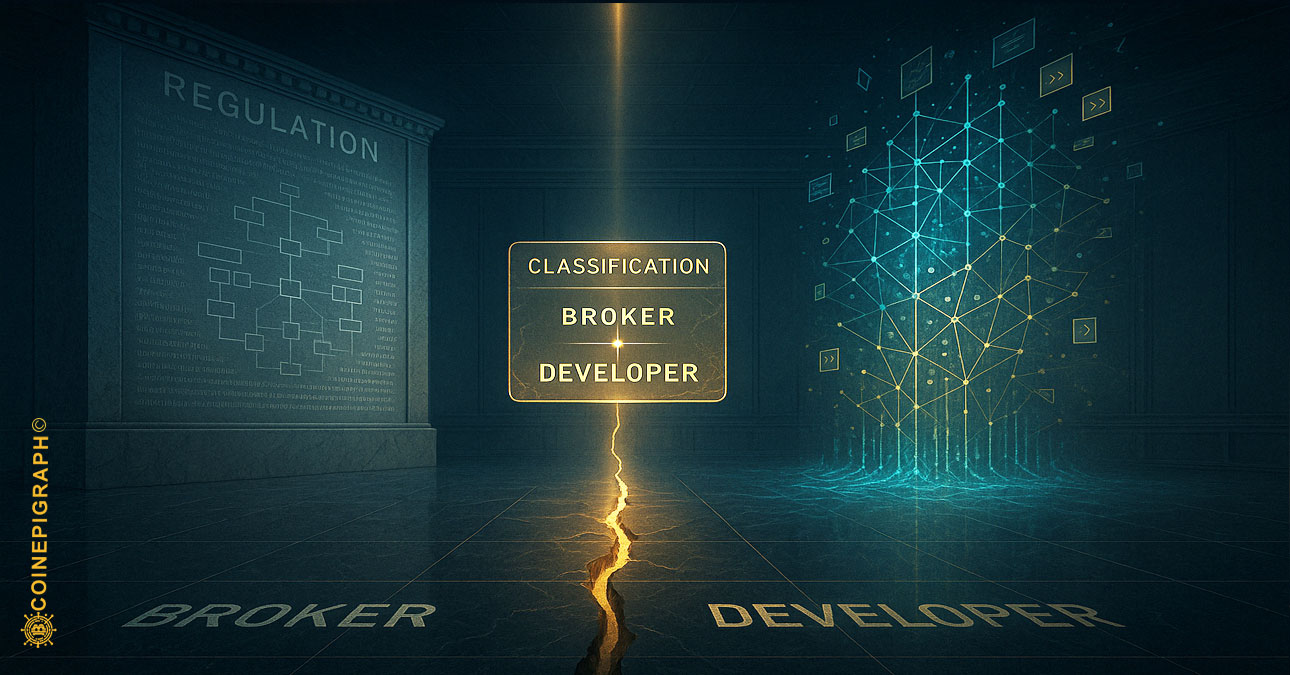
When the financial world thinks of disruptive rule-making, it typically looks toward Washington, not GitHub. Yet one of the most consequential regulatory maneuvers emerging today is not about capital requirements, market access, or even custody. It is about the legal reclassification of open-source development itself — a direct challenge to the intellectual foundations of decentralized finance.
The conflict did not arise organically. It was engineered.
At the center of the controversy stands Citadel Securities, the high-frequency trading titan whose influence over equities market structure is unparalleled. Citadel has urged the U.S. Securities and Exchange Commission to consider that open-source protocol developers may themselves be unregistered brokers, arguing that their role in facilitating asset movement brings them under the same regulatory umbrella as traditional intermediaries.
Uniswap Labs — the most prominent name in decentralized exchange architecture — has fired back forcefully, framing Citadel’s proposal as an existential threat not just to DeFi, but to the future of open software and innovation in the United States.
Behind the headlines lies something far more critical:
This is a sovereignty fight over who controls the market rails of the next century.
And the battle is not about code. It is about classification, perimeter, and power.
The Definition War: Why Classification Matters More Than Regulation
Most industry observers misunderstand what is happening.
Citadel is not asking the SEC to regulate developers. It is asking the SEC to reclassify their work.
That distinction defines the entire conflict.
1. If developers are “brokers,” then…
- They must register with the SEC.
- All code deployments become regulated activities.
- Open-source venues must adopt compliance, KYC, surveillance, and reporting regimes.
- Protocol neutrality evaporates.
2. If developers are not brokers, then…
- Code remains speech.
- Protocols remain neutral infrastructure.
- Innovation remains permissionless.
- Market architecture can evolve without gatekeeping from incumbents.
The dispute is not technical. It is philosophical.
And historically, classification battles—not enforcement battles—are what reshape financial markets.
Whether the asset is a stock, a commodity, a derivative, or a digital token…
Whether a participant is a trader, a publisher, a facilitator, or an intermediary…
These definitions determine who controls liquidity, who bears liability, and who captures value.
Citadel is playing the classification game with surgical precision.
Citadel’s Argument: If It Facilitates Trading, It Is a Brokerage Function
Citadel’s submission to the SEC adopts a simple—but powerful—logic:
“If code facilitates trading volume in assets that may be securities, the responsible developers functionally act as intermediaries.”
This logic is appealing to regulators for three reasons:
1. It frames market integrity as a software liability issue.
This allows the SEC to extend its perimeter into areas it cannot easily regulate.
2. It implies accountability mechanisms for decentralized systems.
A long-standing friction point in the regulatory narrative: “Who do we call when something breaks?”
3. It preserves incumbents’ advantage in market structure.
By imposing broker-level obligations on open-source developers, DeFi protocols would face operational burdens that only centralized or heavily capitalized entities can satisfy.
In other words:
The classification would re-centralize the rails under the guise of investor protection.
Citadel’s view is coherent, strategically sound, and deeply self-interested — exactly what one expects from a firm that dominates automated liquidity provision in U.S. equity markets.
Uniswap’s Counterstrike: Code Is Not Brokerage
Uniswap’s response is one of its most consequential public arguments to date.
The central claim:
Developing open-source software does not constitute “effecting transactions,” the core legal test for brokerage activity.
Their rebuttal focuses on four pillars:
1. Developers do not take possession of user assets.
Users retain custody; developers never touch funds.
2. Developers do not match buyers and sellers.
Protocols are autonomous. Liquidity pools execute transactions algorithmically.
3. Developers do not solicit, recommend, or negotiate trades.
There is no human intermediation — only math.
4. Developers do not receive transaction-based compensation.
Brokers earn commissions; developers write software.
If brokers provide services, developers provide tools.
The sharpest point in Uniswap’s response is the most provocative:
If the SEC equates open-source software with brokerage activity, then any developer contributing code to financial infrastructure — including those employed by major banks — becomes a “broker.”
This is not a DeFi exemption; this is a universal principle.
Uniswap’s argument is not defensive.
It is a constitutional defense of software as speech — a foundational U.S. legal principle recognized in case law ranging from encryption to PGP to compiler tools.
The Broader Stakes: Why Financial Incumbents Need Developers Classified as Brokers
Citadel’s push to reclassify developers is not about DeFi alone.
It is about market structure in the 2030s and 2040s, where:
- Liquidity is increasingly on-chain
- Settlement layers operate 24/7
- Order routing becomes decentralized
- Trade execution moves away from centralized venues
- Profit centers shift from intermediaries to protocols
If developers remain unregulated:
- Protocols evolve freely
- Intermediation collapses
- Spread capture diminishes
- Payment-for-order-flow (PFOF) models erode
- Competition becomes algorithmic rather than institutional
Citadel’s most profitable operations rely on:
- Speed
- Spread capture
- Frontrunning prevention
- Flow internalization
- Market access control
But decentralized exchanges eliminate:
- Market makers as privileged actors
- Order routing opacity
- Internalization incentives
- Preferential venue advantages
Thus:
For Citadel, this is a fight to preserve a world in which intermediaries remain indispensable.
Which makes the open-source classification angle a remarkably elegant strategic maneuver.
The Regulatory Trap Door: Expand the Definition, Shrink the Ecosystem
If the SEC accepts Citadel’s classification logic, the downstream consequences are enormous.
1. Every developer who contributes to financial code would need broker registration.
This instantly collapses open participation.
2. Open-source development becomes a high-liability field.
Developers face enforcement risk for writing code that others misuse.
3. Only well-capitalized entities could afford compliance.
The ecosystem would re-centralize around a few corporate actors.
4. Innovation migrates offshore.
Just as early encryption development left U.S. soil in the 1990s.
5. DeFi liquidity fractures.
Protocols lose contributors. Evolution slows. Capital seeks more permissive jurisdictions.
6. The U.S. cedes leadership in digital asset infrastructure.
While:
- Dubai
- Singapore
- South Korea
- Switzerland
- Hong Kong
…continue pursuing developer-friendly frameworks.
It is no exaggeration to say:
The future of U.S. dominance in financial innovation hinges on whether the SEC accepts this classification maneuver.
What Comes Next: The New Phase of the Market-Structure War
This confrontation signals a new era of regulatory strategy:
1. Incumbent financial institutions will use classification as a competitive weapon.
Not enforcement — definition.
2. Open-source communities must articulate legal standards now.
The ambiguity zone is no longer safe.
3. Policy frameworks will increasingly treat protocols as market actors.
Not neutral infrastructure.
4. Developers will become the new geopolitical battleground.
Jurisdictions that protect them will win the next wave of financial innovation.
5. Market structure will bifurcate into two global regimes:
- Regulated intermediated markets (U.S., EU)
- Permissionless protocol economies (Asia, Middle East)
And the competitive outcome will define:
- who controls global liquidity
- who designs the rails
- who captures economic rent
- and who sets the rules of the next financial era

Conclusion: The Issue Is Not About Code — It Is About Control
Citadel’s proposal and Uniswap’s rebuttal are not two sides of a regulatory comment letter.
They are two competing visions for the structure of financial markets.
One vision maintains a world where intermediaries remain central — essential, unreplaceable, and protected by regulatory perimeter.
The other envisions a world where infrastructure is public, open, neutral, and permissionless — and where the power to innovate is not constrained by legacy institutions.
The SEC now sits at the fulcrum of this choice.
And whichever path it selects will determine not only the future of DeFi and open-source development, but the very foundations of market sovereignty for the next century.
At CoinEpigraph, we are committed to delivering digital-asset journalism with clarity, accuracy, and uncompromising integrity. Our editorial team works daily to provide readers with reliable, insight-driven coverage across an ever-shifting crypto and macro-financial landscape. As we continue to broaden our reporting and introduce new sections and in-depth op-eds, our mission remains unchanged: to be your trusted, authoritative source for the world of crypto and emerging finance.
— Ian Mayzberg, Editor-in-Chief
The team at CoinEpigraph.com is committed to independent analysis and a clear view of the evolving digital asset order.
To help sustain our work and editorial independence, we would appreciate your support of any amount of the tokens listed below. Support independent journalism:
BTC: 3NM7AAdxxaJ7jUhZ2nyfgcheWkrquvCzRm
SOL: HxeMhsyDvdv9dqEoBPpFtR46iVfbjrAicBDDjtEvJp7n
ETH: 0x3ab8bdce82439a73ca808a160ef94623275b5c0a
XRP: rLHzPsX6oXkzU2qL12kHCH8G8cnZv1rBJh TAG – 1068637374
SUI – 0xb21b61330caaa90dedc68b866c48abbf5c61b84644c45beea6a424b54f162d0c
and through our Support Page.
🔍 Disclaimer: CoinEpigraph is for entertainment and information, not investment advice. Markets are volatile — always conduct your own research.
COINEPIGRAPH™ does not offer investment advice. Always conduct thorough research before making any market decisions regarding cryptocurrency or other asset classes. Past performance is not a reliable indicator of future outcomes. All rights reserved | 版权所有 ™ © 2024-2029.