


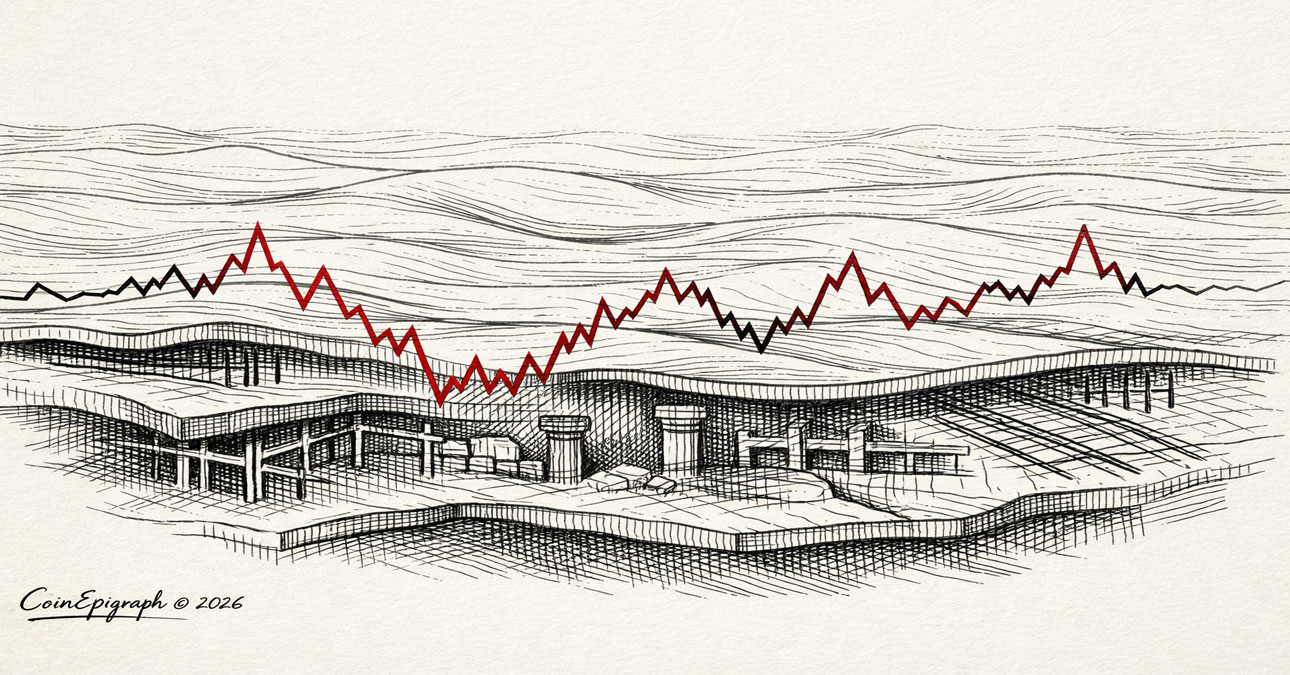
Why price instability in early-stage financial systems reflects unresolved structure rather than emotion.
By CoinEpigraph Editorial Desk | February 6, 2026
Volatility is often treated as an emotional condition of markets. In emerging financial systems, it is more accurately understood as a structural signal.
Crypto markets have always moved sharply because they are still resolving foundational questions that legacy systems answered over decades: how assets are custodied, how value settles, where governance resides, and which regulatory assumptions apply. Price absorbs that uncertainty first. Structure follows later. This sequencing is not unique to crypto, but the pace at which it occurs is.
Unlike asset classes supported by centuries of institutional precedent, crypto is compressing long cycles of financial development into a much shorter window. New settlement rails are introduced before standards are fully agreed upon. Governance models iterate publicly. Risk is surfaced in real time rather than amortized quietly over years. In such an environment, stability cannot precede definition. It emerges only after definition hardens.
This does not make volatility benign, nor does it excuse excess. It simply places price movement in context. Volatility reflects unresolved architecture as much as speculative behavior. When custody frameworks are still evolving, when settlement assumptions are shifting, and when regulatory boundaries remain fluid, markets have fewer anchors. Price discovery fills that gap.
The relevance is not whether crypto markets are volatile. They always have been. The relevance is what that volatility reveals about the stage of system formation. Large moves often coincide with moments when inherited assumptions are being tested: about liquidity, about leverage, about the timing of settlement, about who ultimately bears risk. Those tests are structural, not psychological.
It is also worth noting what volatility has not prevented. Crypto-native systems have continued to innovate across payments, settlement, capital formation, custody, and programmable finance—even as prices oscillate. Infrastructure has advanced through cycles of expansion and contraction. That persistence suggests the market is not simply speculating on an idea, but iterating on a set of functions legacy systems were slow to modernize.
None of this implies inevitability or guaranteed outcomes. Early-stage markets produce both breakthroughs and failures. Volatility does not discriminate between them. What it does offer is immediacy. Weak models fail quickly. Stronger ones are stress-tested repeatedly before they stabilize. That process is uneven, but it is not random.
Periods of highest uncertainty in financial history often coincide with moments when new architectures are being negotiated into place. Railways, telecommunications, and electronic markets all exhibited prolonged volatility before standards emerged and returns normalized. Crypto’s distinction lies not in instability, but in the speed with which instability is expressed.

For readers navigating current market conditions, the point is not reassurance. It is orientation. Volatility is not the story. It is the byproduct of deeper structural change underway—change that continues regardless of short-term price behavior. Understanding that distinction matters more than predicting the next move.
Markets eventually quiet when systems stop arguing with themselves. Until then, price will continue to do what structure has not yet finished doing: resolve uncertainty in public.
At CoinEpigraph, we are committed to delivering digital-asset journalism with clarity, accuracy, and uncompromising integrity. Our editorial team works daily to provide readers with reliable, insight-driven coverage across an ever-shifting crypto and macro-financial landscape. As we continue to broaden our reporting and introduce new sections and in-depth op-eds, our mission remains unchanged: to be your trusted, authoritative source for the world of crypto and emerging finance.
— Ian Mayzberg, Editor-in-Chief
The team at CoinEpigraph.com is committed to independent analysis and a clear view of the evolving digital asset order.
To help sustain our work and editorial independence, we would appreciate your support of any amount of the tokens listed below. Support independent journalism:
BTC: 3NM7AAdxxaJ7jUhZ2nyfgcheWkrquvCzRm
SOL: HxeMhsyDvdv9dqEoBPpFtR46iVfbjrAicBDDjtEvJp7n
ETH: 0x3ab8bdce82439a73ca808a160ef94623275b5c0a
XRP: rLHzPsX6oXkzU2qL12kHCH8G8cnZv1rBJh TAG – 1068637374
SUI – 0xb21b61330caaa90dedc68b866c48abbf5c61b84644c45beea6a424b54f162d0c
and through our Support Page.
🔍 Disclaimer: CoinEpigraph is for entertainment and information, not investment advice. Markets are volatile — always conduct your own research.
COINEPIGRAPH™ does not offer investment advice. Always conduct thorough research before making any market decisions regarding cryptocurrency or other asset classes. Past performance is not a reliable indicator of future outcomes. All rights reserved | 版权所有 ™ © 2024-2029.