


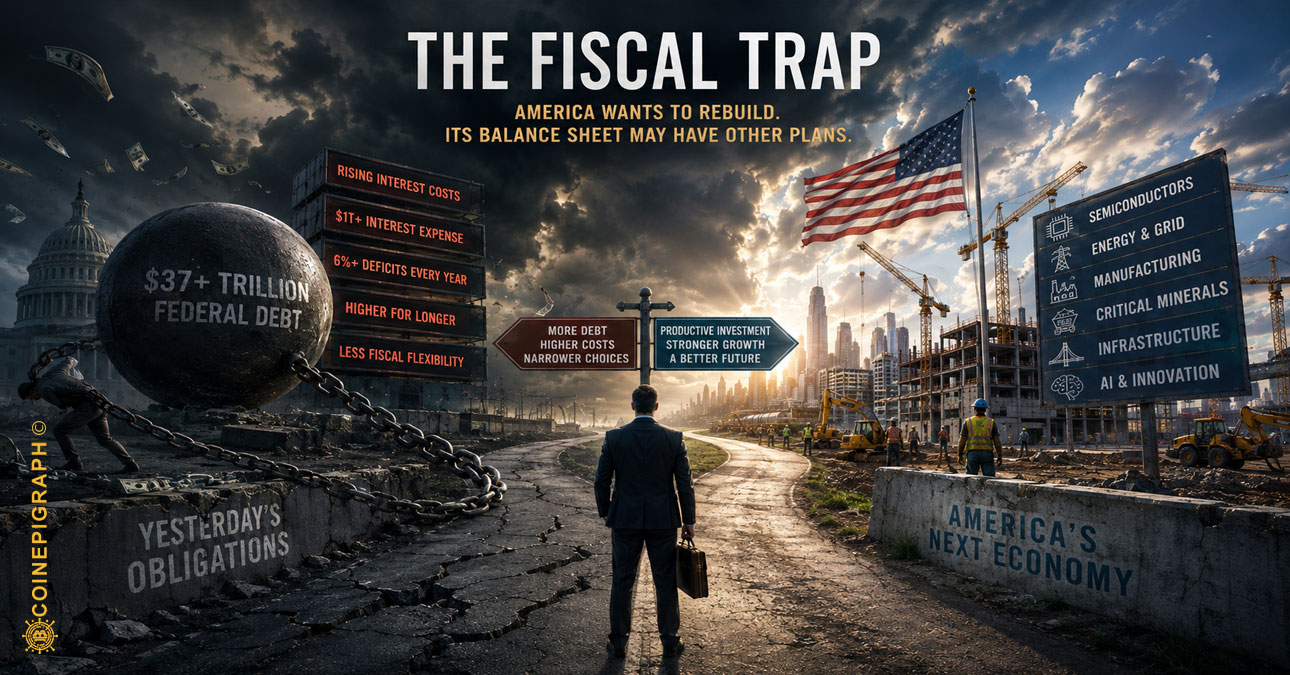
Washington is rediscovering industrial policy just as the cost of financing the American state is becoming harder to ignore. The problem is not simply too much debt or interest rates that are too high. It is that many of the policies capable of easing one constraint risk tightening another.
By CoinEpigraph Editorial Desk
The return of Hamiltonian economics begins with an appealing proposition.
If the United States has allowed strategically important productive capacity to migrate abroad, public policy can help bring some of it back. Capital can be directed toward semiconductor fabrication, critical-mineral processing, shipbuilding, energy infrastructure, advanced manufacturing and the physical systems required to support artificial intelligence. Trade policy can alter incentives. Government procurement can create demand. Public financing can absorb risks private markets are unwilling to take alone.
America, in this formulation, begins rebuilding the industrial depth beneath its economic power.
There is only one complication.
The country attempting the reconstruction is carrying a fiscal structure very different from the one that accompanied earlier periods of American industrial expansion.
The Congressional Budget Office expects the federal government to run a $1.9 trillion deficit in fiscal 2026 even with unemployment remaining relatively low. Debt held by the public is projected at roughly 101% of GDP this year and 120% by 2036. More consequentially, net federal interest expense is expected to exceed $1 trillion this year and reach $2.1 trillion by 2036. At that point, interest alone would consume 4.6% of GDP and nearly one-fifth of federal spending.
Those projections do not describe a government that has run out of money. Sovereign finance does not work that way, particularly for the issuer of the world’s principal reserve currency.
They describe something subtler.
The price of maintaining the existing balance sheet is beginning to compete with the price of building the next economy.
That is the fiscal trap.
The Old Debt Is Meeting the New Interest Rate
For much of the period following the global financial crisis, extraordinary amounts of public debt could be carried at relatively modest cost because interest rates were exceptionally low.
That environment changed the politics of borrowing.
When Treasury securities could be refinanced cheaply, a larger debt stock did not immediately translate into a proportionately larger fiscal burden. The government could borrow more while the economy expanded, investors continued demanding Treasuries, and low rates kept debt service from consuming too much of the federal budget.
The debt remained real. Its carrying cost simply made it easier to ignore.
That relationship has now reversed.
The Federal Reserve’s July meeting left the federal funds target range at 3.5% to 3.75%, with inflation still above the central bank’s 2% objective. Three policymakers actually preferred another quarter-point increase.
Treasury does not refinance the entire federal debt at the overnight policy rate, of course. The government borrows across maturities, and the average interest rate on outstanding debt adjusts gradually as securities mature and new ones replace them.
That lag is precisely why the problem compounds rather than arrives all at once.
CBO estimates that the average rate paid on publicly held federal debt is about 3.4% in 2026 and eventually rises toward 3.9% in its baseline. As older, cheaper securities mature, more of the federal balance sheet is refinanced at today’s higher borrowing costs. At the same time, continuing primary deficits require additional debt issuance. The government is therefore paying higher rates across a debt stock that continues getting larger.
Interest becomes spending.
That spending contributes to deficits.
The deficits require borrowing.
The additional borrowing generates additional interest.
Nothing about that mechanism requires a crisis to become economically important.
It only requires time.
Washington Is Trying to Finance Two Americas at Once
This is where the fiscal problem intersects with the doctrine examined in the first article of this series.
The United States is not merely trying to maintain its existing obligations. It is simultaneously reconsidering the industrial architecture of the country.
Semiconductor fabs are expensive.
New electrical generation is expensive.
Transmission infrastructure is expensive.
Shipyards are expensive.
Mineral processing is expensive.
Advanced manufacturing facilities are expensive.
Defense industrial capacity is expensive.
The data centers supporting artificial intelligence are extraordinarily capital intensive, even when much of that investment remains on private balance sheets.
A serious attempt to rebuild American productive capacity does not mean Washington must finance every factory. The United States has enormous private capital markets, and much of a successful industrial strategy would depend on mobilizing them rather than replacing them.
But government still shapes the economics around that investment.
Tax incentives have fiscal costs. Loan guarantees create contingent liabilities. Infrastructure requires public spending. Defense procurement requires appropriations. Strategic reserves require capital. Permitting reform may be inexpensive, but the transmission lines, ports, roads, water systems and industrial infrastructure unlocked by it are not.
The country is therefore attempting something unusual: it wants to finance the legacy obligations of the previous economic era while assembling the productive capacity required for the next one.
That would be easier if the balance sheet were starting from a position of fiscal abundance.
It isn’t.
CBO’s baseline has the federal government running deficits of at least 5.6% of GDP every year through 2036. Debt continues rising even without assuming a recession, major war or financial crisis.
The fiscal constraint is arriving before the industrial reconstruction is complete.
Why Lower Rates Do Not Solve the Whole Problem
The obvious response is that interest rates will eventually fall.
They may.
Lower borrowing costs would unquestionably help Treasury. They would also support housing, corporate investment and many of the capital-intensive industries Washington wants private investors to finance.
But the Federal Reserve does not set interest rates to minimize the government’s financing bill.
Its mandate is monetary.
If inflation remains elevated, cutting rates aggressively to reduce Treasury’s debt-service burden would create another problem. Markets could begin questioning whether monetary policy was being calibrated to economic conditions or increasingly subordinated to fiscal necessity.
That distinction has enormous consequences for a country whose debt functions as a global reserve asset.
The danger is not that one rate cut destroys the dollar. Nor does a high debt-to-GDP ratio mechanically produce a currency crisis. Japan alone should make anyone cautious about drawing such straight lines.
The issue is institutional.
The larger the federal debt becomes, the more sensitive the budget becomes to interest rates. The more sensitive the budget becomes, the greater the political incentive for lower rates. If investors eventually conclude that monetary restraint cannot be sustained because the fiscal system cannot tolerate it, the credibility supporting long-duration government debt can begin to change.
The government may obtain cheaper nominal financing.
Bondholders may demand compensation somewhere else.
That compensation can appear through higher long-term yields, inflation expectations, currency adjustment or a reduced willingness to hold fixed-rate claims at existing prices.
The constraint has not disappeared.
It has moved.
Inflation Offers Relief With a Price Attached
There is another way heavily indebted governments can reduce the burden of old nominal debt.
Inflation.
If nominal GDP and tax receipts rise while previously issued debt remains fixed in nominal dollars, the real weight of that debt can decline. Moderate inflation can therefore make an old debt stock easier to carry, particularly when interest rates do not immediately adjust upward by the same amount.
This is one reason periods of financial repression and negative real interest rates recur throughout fiscal history.
But inflation is not free financing.
Creditors understand the mechanism.
If investors expect inflation to remain higher, they eventually demand higher nominal yields to compensate. Households lose purchasing power. Businesses face less predictable input costs. Long-duration investment becomes harder to price. Foreign holders of dollar assets reassess their real returns.
For an industrial strategy, the contradiction is particularly uncomfortable.
Rebuilding productive capacity requires patient capital.
Factories are long-duration assets. Power infrastructure can take decades to repay its initial investment. Semiconductor fabs require enormous upfront expenditures before meaningful revenue arrives. Transmission projects can spend years in development before carrying a single electron.
The state therefore wants an environment in which long-term capital is willing to commit.
Using persistent inflation to reduce the real burden of government debt can undermine the very long-term price stability that makes those investments easier to finance.
Again, solving one side of the equation worsens another.
Growth Is the Cleanest Exit—and the Hardest to Guarantee
There is one solution that avoids much of this conflict.
Grow faster.
If nominal debt expands more slowly than the productive economy supporting it, debt-to-GDP can stabilize or decline without default, extraordinary inflation or severe fiscal contraction. Higher productivity raises incomes, expands the tax base and improves the government’s ability to service existing obligations.
This is where the Hamiltonian strategy and the fiscal problem potentially reinforce one another.
If investments in artificial intelligence, advanced manufacturing, energy, semiconductors and infrastructure raise American productivity sufficiently, the resulting economic growth could make today’s debt burden easier to carry.
That may ultimately be the strongest economic argument for rebuilding productive capacity.
Industrial policy would not merely address geopolitical vulnerability. If successful, it could expand the denominator underneath the federal balance sheet.
But growth cannot be booked in advance.
Industrial projects can take years to produce returns. Government can subsidize the wrong technologies. Tariffs can raise input costs before domestic capacity appears. Capital can flow toward politically attractive projects rather than productive ones. Infrastructure bottlenecks can delay investment. An aging population can restrain labor-force growth.
Most importantly, the debt continues accruing interest while policymakers wait for the productivity gains to arrive.
CBO already assumes continued economic growth in its baseline and still projects publicly held debt reaching 120% of GDP by 2036.
Growth is the least destructive escape from the fiscal trap.
It is not an automatic one.
Cutting the Deficit Has Its Own Timing Problem
Fiscal consolidation appears more straightforward.
Spend less. Raise more revenue. Borrow less.
Over time, a smaller primary deficit would slow debt accumulation and reduce the amount of interest that must be financed with additional borrowing.
But the composition and timing matter enormously.
Cut spending indiscriminately while simultaneously trying to rebuild industrial capacity, and Washington can weaken the very investments expected to improve future productivity.
Raise taxes too aggressively on investment, and private capital becomes less willing to finance the reconstruction.
Reduce public research, infrastructure or workforce development, and apparent near-term savings can lower long-term productive capacity.
That does not make fiscal consolidation impossible. It means that a government pursuing industrial policy must distinguish consumption from investment more carefully than one focused primarily on reducing the annual deficit.
A dollar spent maintaining an inefficient program and a dollar invested in infrastructure that raises private-sector productivity both appear as federal outlays.
Economically, they are not necessarily equivalent.
Neither does labeling expenditure an “investment” make it productive. Governments have considerable experience proving otherwise.
The fiscal challenge is therefore more demanding than austerity.
Washington would have to improve the quality of the balance sheet while improving its quantity: reducing structural deficits without cutting deeply into the productive investments expected to make the future debt burden more manageable.
That requires a degree of political discrimination the budget process rarely rewards.
Tariffs Help the Treasury, but They Cannot Carry the State
The administration’s trade policy introduces another dimension.
Tariffs generate federal revenue, and CBO’s current baseline estimates that higher tariff rates materially reduce projected deficits over the coming decade. Even after accounting for their economic effects, CBO estimates higher tariffs reduce cumulative deficits by roughly $3 trillion between 2026 and 2035.
That is significant.
It is not sufficient.
Tariffs are ultimately taxes collected at the border, and their economic incidence can be distributed among importers, foreign producers, American businesses and consumers depending on market conditions. Their ability to generate revenue also interacts with their industrial objective: a tariff that successfully reduces imports can eventually shrink part of the tax base from which the tariff revenue is collected.
That produces an interesting tension inside the Hamiltonian framework.
If the tariff exists primarily to raise revenue, continued imports are useful.
If it exists primarily to relocate production, declining imports may indicate success.
The same instrument cannot maximize both objectives indefinitely.
Tariff revenue can improve the fiscal arithmetic.
It cannot substitute for fiscal arithmetic.
The Treasury Market Sits Beneath Everything
The fiscal trap ultimately reaches the market that finances the American state.
The Treasury market is not merely where Washington borrows money. Treasury securities serve as collateral throughout global finance, anchor benchmark interest rates, populate bank balance sheets and provide reserve assets to governments and institutions around the world.
That extraordinary demand is one of America’s greatest financial advantages.
It allows the federal government to finance itself in its own currency through a market of unparalleled depth.
But reserve-currency privilege should not be confused with immunity from price.
Investors can continue buying Treasuries while demanding higher yields.
Banks can continue holding government securities while preferring shorter maturities.
Foreign reserve managers can continue holding dollars while gradually diversifying at the margin.
Households can continue purchasing Treasury bills precisely because the government must offer attractive returns.
None of those developments requires abandonment of the dollar.
They simply make financing more expensive.
And that is enough to tighten the trap.
Higher Treasury yields affect more than Washington. They become reference rates against which mortgages, corporate bonds and other assets are priced. CBO explicitly warns that rising federal borrowing can raise borrowing costs throughout the economy and reduce private investment.
That creates perhaps the most important contradiction in the entire industrial strategy.
Washington needs enormous amounts of private capital to rebuild American productive capacity.
But persistent government borrowing competes for capital while helping establish the risk-free rates against which those private investments must be justified.
A semiconductor fab does not compete only with another semiconductor fab for investor capital.
At the margin, it competes with the return available from holding Treasury securities.
The higher that hurdle becomes, the more productive private investment has to earn before capital accepts the additional risk.
Fiscal policy can therefore begin working against industrial policy without either side explicitly intending it.
The Dollar Makes the Trap Easier to Enter
America has been able to accumulate debt on this scale partly because the dollar occupies a position no other currency fully replicates.
Global trade is heavily dollarized. Central banks hold dollar reserves. International institutions need dollar liquidity. Treasury securities remain foundational collateral. American capital markets provide unmatched depth.
That creates persistent structural demand for dollar assets.
It also means the United States has more room to make fiscal mistakes than most countries.
That room is an asset.
It can also become a temptation.
Reserve-currency status allows fiscal adjustment to be postponed because the market can absorb borrowing that would place much greater pressure on a smaller sovereign issuer. But postponement can make the eventual adjustment more difficult by allowing the debt stock and interest burden to become larger before political action becomes unavoidable.
The risk should not be exaggerated into an imminent dollar-collapse thesis. Reserve currencies are supported by networks of institutions, markets, legal systems, liquidity and geopolitical relationships that do not disappear because a debt ratio crosses an arbitrary threshold.
The more useful question is whether persistent fiscal pressure gradually changes the terms on which the privilege operates.
The dollar can remain dominant while Treasury pays more to borrow.
It can remain the principal reserve currency while other countries diversify portions of their reserves.
It can remain central to global finance while inflation reduces the real value of dollar claims.
Reserve status is not binary.
Neither is its erosion.
The fiscal trap therefore does not require the dollar to fail.
It merely requires the cost of preserving confidence in the dollar to begin constraining other policy choices.
There Is No Single Door Out
This is why the problem resists the kind of solution markets often prefer.
Lower rates ease debt service and capital formation, but can become problematic if inflation has not been contained.
Higher inflation can reduce the real burden of existing debt, but risks increasing future borrowing costs and weakening long-duration purchasing power.
Fiscal consolidation can slow debt accumulation, but poorly designed consolidation can suppress investment and growth.
Tariffs can generate revenue, but cannot plausibly finance the federal state and may impose costs elsewhere in the economy.
Financial repression can hold government financing costs below what a fully unconstrained market might demand, but transfers value from savers and can distort capital allocation.
Faster growth improves nearly every part of the arithmetic, but requires investment today for productivity that may arrive years later.
The choices are not equally likely, nor are their costs equivalent. They also need not occur in isolation. History suggests heavily indebted governments usually adjust through combinations rather than clean solutions.
That is what makes the current moment consequential.
The United States is trying to reconstruct productive capacity while simultaneously preserving monetary credibility, financing large existing obligations, supporting an aging population, maintaining military power and protecting the deepest sovereign-debt market in the world.
Each objective is defensible on its own.
Together they compete for fiscal space.
Hamilton Had a Balance-Sheet Insight Too
There is an irony in invoking Alexander Hamilton only for tariffs and manufacturing.
Hamilton’s industrial ideas were inseparable from his ideas about public credit.
He understood that a government’s capacity to borrow was itself a strategic national asset. Public debt, properly structured and credibly serviced, could strengthen the state by creating a reliable financial foundation upon which private capital and public ambition could operate.
That is quite different from treating borrowing capacity as unlimited.
The modern Hamiltonian question is therefore not simply whether Washington can use the federal balance sheet to rebuild strategic industry.
It is whether doing so strengthens the productive economy quickly enough to preserve the credibility of the balance sheet being used.
That relationship runs in both directions.
Strong public credit can help finance national development.
Successful national development can strengthen public credit.
But persistent borrowing that does not produce sufficient future capacity eventually weakens the mechanism itself.
This is where Article One’s doctrine encounters Article Two’s constraint.
America has identified productive capacity as a strategic objective at almost exactly the moment when the price of financing government has become a strategic variable of its own.

The Fiscal Trap Is Really a Race
The United States is not insolvent.
It is not about to lose the dollar’s reserve status because interest expense crossed $1 trillion.
Nor does a high debt ratio mean an unavoidable fiscal crisis lies immediately ahead.
Those conclusions would turn a structural problem into a sensational one.
The more credible concern is about narrowing choices.
Every additional dollar devoted to servicing yesterday’s borrowing is a dollar that cannot be used elsewhere without additional taxation or borrowing. Every increase in Treasury yields changes the hurdle rate confronting private investment. Every attempt to suppress those yields has potential consequences for inflation, capital allocation or monetary credibility. Every year that structural deficits persist increases the amount of debt upon which the next interest-rate cycle will operate.
Meanwhile, the industrial reconstruction has its own clock.
Semiconductor fabs have to be built.
Power generation has to expand.
Transmission has to connect it.
Minerals have to be processed.
Shipyards have to recover capacity.
AI infrastructure has to be financed.
Workers have to be trained.
Supply chains have to deepen enough that domestic production becomes competitive rather than permanently dependent on protection.
The fiscal question is therefore not whether the United States possesses enough dollars to attempt these things.
It does.
The question is whether the country can expand its productive capacity faster than the cost of carrying its accumulated obligations narrows the room available to finance that expansion.
That is a very different problem from running out of money.
It is a race between the balance sheet and the productive economy beneath it.
If productivity, investment and real economic growth win that race, today’s industrial strategy could eventually strengthen the fiscal position that currently constrains it. More output creates more income, a larger tax base and greater capacity to service debt without sacrificing other national priorities.
If debt service wins, Washington’s options become progressively less attractive. Taxes rise, spending is displaced, borrowing grows, monetary policy encounters greater political pressure, or some portion of the adjustment is transmitted through inflation and the real value of dollar claims.
None is literally costless.
And none means the dollar must disappear.
The more important possibility is that America could retain the world’s dominant currency while discovering that the privilege no longer purchases quite as much policy freedom as it once did.
That is the fiscal trap sitting beneath the Hamiltonian revival.
The first article in this series asked what America believes it needs to rebuild.
The answer was productive capacity.
The second question is harder.
Can the United States rebuild the productive economy quickly enough to strengthen the balance sheet being asked to finance it?
The answer will determine whether the new industrial doctrine becomes a source of renewed American economic power—or another obligation added to an already expensive past.
At CoinEpigraph, we are committed to delivering digital-asset journalism with clarity, accuracy, and uncompromising integrity. Our editorial team works daily to provide readers with reliable, insight-driven coverage across an ever-shifting crypto and macro-financial landscape. As we continue to broaden our reporting and introduce new sections and in-depth op-eds, our mission remains unchanged: to be your trusted, authoritative source for the world of crypto and emerging finance.
— Ian Mayzberg, Editor-in-Chief
The team at CoinEpigraph.com is committed to independent analysis and a clear view of the evolving digital asset order.
To help sustain our work and editorial independence, we would appreciate your support of any amount of the tokens listed below. Support independent journalism:
BTC: 3NM7AAdxxaJ7jUhZ2nyfgcheWkrquvCzRm
SOL: HxeMhsyDvdv9dqEoBPpFtR46iVfbjrAicBDDjtEvJp7n
ETH: 0x3ab8bdce82439a73ca808a160ef94623275b5c0a
XRP: rLHzPsX6oXkzU2qL12kHCH8G8cnZv1rBJh TAG – 1068637374
SUI – 0xb21b61330caaa90dedc68b866c48abbf5c61b84644c45beea6a424b54f162d0c
and through our Support Page.
🔍 Disclaimer: CoinEpigraph is for entertainment and information, not investment advice. Markets are volatile — always conduct your own research.
COINEPIGRAPH™ does not offer investment advice. Always conduct thorough research before making any market decisions regarding cryptocurrency or other asset classes. Past performance is not a reliable indicator of future outcomes. All rights reserved | 版权所有 ™ © 2024-2029.