


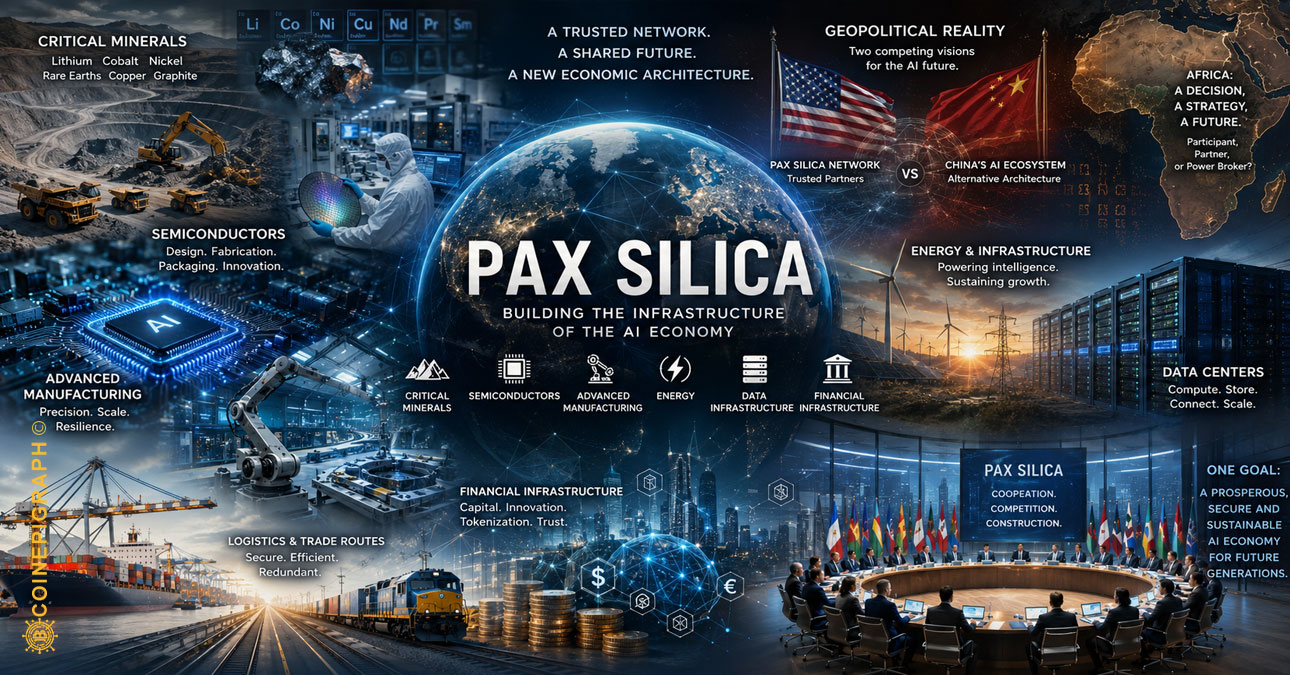
The initiative is often described as a semiconductor partnership or an AI cooperation framework. It may ultimately become something far more consequential: an attempt to organize the industrial, financial and geopolitical architecture of the artificial intelligence economy.
By CoinEpigraph Editorial Desk
The artificial intelligence race is frequently portrayed as a competition between chatbots.
That framing is becoming increasingly inadequate.
Artificial intelligence does not begin with a large language model.
It begins with mines.
It moves through refineries, semiconductor fabrication plants, precision manufacturing equipment, power stations, transmission networks, cooling systems, data centers and global capital markets before a single prompt is ever processed.
The countries capable of coordinating those layers will possess advantages extending well beyond software.
That broader reality is beginning to emerge through an initiative known as Pax Silica.
It is often introduced as a partnership around semiconductors, trusted technology and AI supply chains.
Viewed more carefully, it appears to represent something considerably larger.
Not simply an AI initiative.
An economic architecture.
The Geography of Intelligence
For much of the digital era, technology companies could expand globally with relatively modest physical footprints.
Artificial intelligence is different.
Training frontier models requires extraordinary computing capacity.
Computing capacity requires advanced semiconductors.
Semiconductors require sophisticated manufacturing equipment.
Factories require electricity.
Electricity requires generation and transmission.
Data centers require cooling, water, fiber connectivity and increasingly scarce grid capacity.
Each layer introduces another physical dependency.
Each dependency introduces another strategic decision.
The AI economy therefore resembles an industrial system more than a software ecosystem.
That distinction changes how nations compete.
Beyond the Chip
Much of the public conversation still concentrates on processors.
For understandable reasons.
Advanced accelerators have become the most visible symbol of the AI revolution.
But the semiconductor itself is only one component of a much larger production chain.
Behind every advanced processor stand companies manufacturing lithography systems, deposition equipment, inspection tools, metrology systems, specialty materials, packaging technologies and highly specialized industrial machinery.
Behind those manufacturers stand power producers, engineering firms, logistics providers and capital markets financing facilities measured in billions of dollars.
Recent developments in financial markets reinforce that progression.
Investors increasingly appear willing to move beyond the companies designing AI processors toward the industrial infrastructure required to manufacture them.
The investment thesis itself is evolving.
The AI economy is becoming progressively more physical.
Supply Chains Become Strategy
This is where Pax Silica becomes especially relevant.
Rather than attempting to dominate every stage of AI production within a single country, the initiative seeks to strengthen trusted supply chains across participating economies.
Critical minerals.
Advanced manufacturing.
Semiconductor capacity.
Energy infrastructure.
Logistics.
Artificial intelligence.
Viewed individually, each appears to be another industrial policy objective.
Viewed collectively, they begin resembling something else.
An integrated production network.
History offers numerous examples of nations competing through industrial capacity.
The AI era may instead reward countries capable of coordinating industrial ecosystems.
That is a different challenge.
Infrastructure Creates Influence
Technological revolutions rarely depend upon technology alone.
Railroads transformed economies because they reorganized transportation.
Electrification reshaped manufacturing because it reorganized energy.
The internet altered commerce because it reorganized information.
Artificial intelligence appears poised to reorganize infrastructure.
Power generation.
Grid modernization.
Semiconductor manufacturing.
Fiber networks.
Data centers.
Capital allocation.
These are becoming strategic assets rather than supporting utilities.
Infrastructure has always created influence.
The question is whether AI infrastructure will do so on an even larger scale.
The Financial Layer
Industrial systems require financial systems.
Factories must be financed.
Energy projects require long-duration capital.
Data centers depend upon project finance, insurance, institutional lending and sophisticated payment infrastructure.
Digital capital markets are evolving alongside physical infrastructure.
Stablecoins increasingly provide programmable settlement.
Tokenized securities seek continuous trading.
Digital custody is becoming institutional.
Real-world assets are moving onto blockchain rails.
Each of these developments has appeared in isolation.
Increasingly they look interconnected.
The financial architecture supporting AI is evolving at the same time as the industrial architecture beneath it.
The relationship is unlikely to be coincidental.
Large industrial transformations have historically produced corresponding financial innovation.
Artificial intelligence appears to be following that pattern.
A Different Kind of Competition
Perhaps the most significant aspect of Pax Silica is not what it includes.
It is what it implies.
The initiative is emerging during a period in which the United States and China are advancing different approaches to AI development, technology supply chains and international cooperation. Recent reporting suggests Washington is encouraging partners to align with its trusted AI framework rather than China’s competing initiatives.
That does not mean the world is dividing neatly into two camps.
Many countries continue pursuing relationships with multiple economic partners.
Nor does it suggest that every nation will make identical strategic choices.
It does indicate that AI is increasingly becoming an organizing principle for economic policy.
Countries may find themselves evaluating future partnerships not only through trade, but through semiconductors, critical minerals, digital infrastructure, energy security and technological interoperability.
Competition is moving beyond products.
It is beginning to encompass production systems.
The Missing Question
Much attention has focused on which countries have joined Pax Silica.
Less attention has been given to a different question.
What does participation ultimately mean?
If the initiative succeeds, it will not simply produce additional semiconductor facilities or data centers.
It could contribute to the emergence of a geographically distributed AI production network, where different economies specialize in different stages of the same industrial process.
One nation refines critical minerals.
Another manufactures semiconductor equipment.
Another fabricates chips.
Another hosts hyperscale computing.
Another provides energy.
Another supplies financial capital.
Collectively, they produce an AI ecosystem that no single participant could easily replicate alone.
That possibility deserves closer attention than individual project announcements.

The Next Economic Architecture
Pax Silica remains a developing initiative.
Its long-term governance, scale and effectiveness remain uncertain.
Industrial strategies evolve.
Political priorities change.
Supply chains adjust.
Markets respond.
There are legitimate questions about implementation, economics, national interests and how participating countries will balance cooperation with strategic autonomy.
Those questions deserve careful observation rather than predetermined conclusions.
Yet one reality is becoming increasingly difficult to ignore.
Artificial intelligence is no longer simply a software story.
It is becoming an industrial story.
And industrial stories eventually become financial stories.
The first phase of AI rewarded companies capable of building powerful models.
The second rewarded those supplying extraordinary computing power.
The next phase may increasingly reward the countries, industries and institutions capable of coordinating the physical systems upon which intelligence ultimately depends.
Pax Silica should therefore be understood as more than another technology initiative.
It represents an emerging attempt to organize the industrial foundations of artificial intelligence.
Whether it ultimately succeeds remains an open question.
But the direction is becoming clearer.
The future AI economy may not be won solely by the country that builds the smartest model.
It may be shaped by the countries that build—and coordinate—the infrastructure that makes those models possible.
At CoinEpigraph, we are committed to delivering digital-asset journalism with clarity, accuracy, and uncompromising integrity. Our editorial team works daily to provide readers with reliable, insight-driven coverage across an ever-shifting crypto and macro-financial landscape. As we continue to broaden our reporting and introduce new sections and in-depth op-eds, our mission remains unchanged: to be your trusted, authoritative source for the world of crypto and emerging finance.
— Ian Mayzberg, Editor-in-Chief
The team at CoinEpigraph.com is committed to independent analysis and a clear view of the evolving digital asset order.
To help sustain our work and editorial independence, we would appreciate your support of any amount of the tokens listed below. Support independent journalism:
BTC: 3NM7AAdxxaJ7jUhZ2nyfgcheWkrquvCzRm
SOL: HxeMhsyDvdv9dqEoBPpFtR46iVfbjrAicBDDjtEvJp7n
ETH: 0x3ab8bdce82439a73ca808a160ef94623275b5c0a
XRP: rLHzPsX6oXkzU2qL12kHCH8G8cnZv1rBJh TAG – 1068637374
SUI – 0xb21b61330caaa90dedc68b866c48abbf5c61b84644c45beea6a424b54f162d0c
and through our Support Page.
🔍 Disclaimer: CoinEpigraph is for entertainment and information, not investment advice. Markets are volatile — always conduct your own research.
COINEPIGRAPH™ does not offer investment advice. Always conduct thorough research before making any market decisions regarding cryptocurrency or other asset classes. Past performance is not a reliable indicator of future outcomes. All rights reserved | 版权所有 ™ © 2024-2029.