


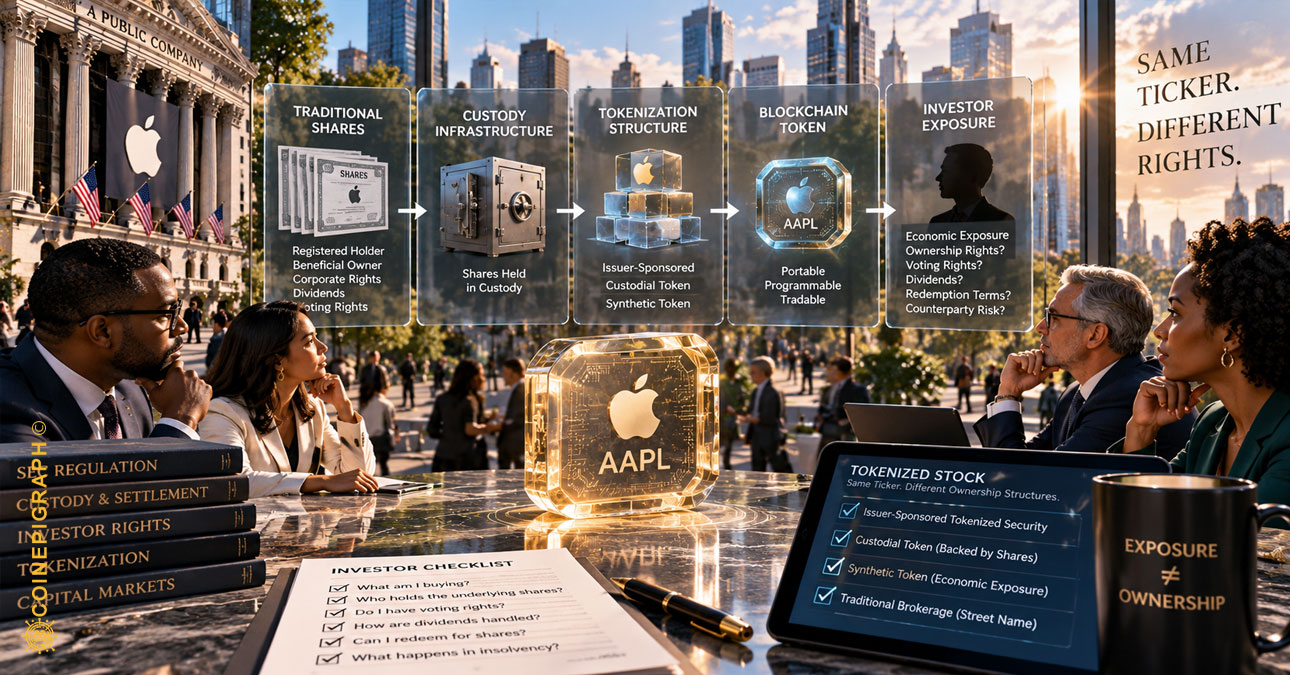
Tokenized equities promise to move public-company exposure onto programmable financial rails. But the same ticker can conceal very different ownership structures. Before tokenization transforms how stocks trade, investors may need to understand what the token actually represents.
By CoinEpigraph Editorial Desk
A stock certificate was once a physical object.
Today, most investors never see one.
An investor buys shares through a brokerage account, a position appears on a screen and the financial system maintains the chain of records establishing who ultimately owns the economic interest. In the United States, most investors hold securities in “street name”: an intermediary is recorded as the registered holder while the customer remains the beneficial owner. The SEC describes this as the dominant way Americans hold securities today.
Tokenization appears, at first, to be another evolution in record-keeping.
Put the share on a blockchain. Allow it to move between wallets. Settle transactions continuously. Make fractional ownership easier. Eventually allow the asset to interact with lending markets, automated portfolios and other programmable financial infrastructure.
But a blockchain can record possession of a token with extraordinary precision without answering a more fundamental question.
What does possession of that token legally entitle its holder to own?
That distinction is becoming more important as tokenized equities move from experiments toward functioning markets.
One Stock Can Produce Different Tokens
The phrase tokenized stock sounds more standardized than the market actually is.
In January, the SEC’s Divisions of Corporation Finance, Investment Management, and Trading and Markets published a taxonomy that makes the differences unusually clear.
A company can tokenize its own securities, or someone acting on its behalf can do so. In that structure, blockchain infrastructure becomes part of the mechanism through which ownership of the actual security is recorded.
But an unaffiliated third party can also create a token referencing somebody else’s stock.
The SEC identifies two broad versions of that second model.
One is custodial. An underlying security is held in custody while the blockchain token represents an ownership interest—direct or indirect—in that security.
The other is synthetic. A third party issues its own instrument whose economic performance is linked to another company’s security. Depending upon its construction, that instrument might be a linked debt security, another type of security, or a security-based swap.
All three can produce something an interface might understandably describe using the name of a familiar public company.
They do not necessarily produce the same asset.
That is the ownership problem beneath tokenized stocks.
The Blockchain Knows the Token
Robinhood provides a useful contemporary example.
Its Stock Tokens can be held in wallets and transferred as ERC-20 tokens. Robinhood says each is backed one-for-one by the corresponding underlying equity held with a U.S.-based custody partner. Its blockchain documentation describes an infrastructure designed to make those tokens composable with trading, lending and other applications.
Yet Robinhood is equally explicit about the legal structure.
The Stock Tokens are debt securities issued by Robinhood Assets (Jersey) Limited. They provide economic exposure to the referenced securities, but holders receive no legal or beneficial rights in or against the issuer of those underlying shares.
If the token references Apple, therefore, possessing the token is not the same legal relationship as being an Apple shareholder.
That does not make the product inherently defective.
It makes the distinction essential.
The blockchain can establish that a particular wallet owns a particular token. It cannot, by itself, determine what corporate, contractual or property rights the token represents.
Those rights come from the legal architecture surrounding it.
“Backed 1:1” Answers Only One Question
This becomes particularly important when tokenized-stock providers use the phrase 1:1 backed.
Backing matters. If one token is supported by one underlying share held in custody, there is an identifiable asset connecting the token’s economics to the conventional market.
But backing and ownership are different questions.
Who legally owns the underlying share?
Who is the registered shareholder?
Does the token holder possess a beneficial interest in that share, or a contractual claim against another entity?
Who receives the dividend?
Who exercises voting rights?
Can the token be redeemed for the underlying security, or only cash?
What happens to the collateral if the token issuer becomes insolvent?
These questions determine the economic substance beneath the blockchain representation.
Robinhood, for example, says dividends associated with its underlying shares are reinvested and reflected through a multiplier rather than distributed as conventional cash dividends to token holders. It also describes an insolvency mechanism under which an independent security agent would sell underlying shares and arrange distribution of the proceeds to token holders.
That is a financial architecture.
It is not simply a stock placed on a blockchain.
Traditional Ownership Was Already Layered
This distinction should not be exaggerated into the claim that conventional brokerage customers directly appear on corporate share registers while token holders do not.
Most do not.
Street-name ownership already separates the registered shareholder from the beneficial investor. A broker, clearing agency or nominee may appear on the issuer’s records while the brokerage maintains records identifying the customer as beneficial owner. The customer can still receive economic benefits and generally direct how shares are voted through the intermediary.
Finance has therefore operated through layered ownership for decades.
Tokenization is not inventing intermediated ownership.
What it can do is introduce new kinds of layers.
In one architecture, blockchain may simply become another record-keeping rail for substantially familiar shareholder rights.
In another, the investor owns a tokenized entitlement to securities held by a custodian.
In another, the investor owns an instrument issued by a third party whose value tracks a security that the investor never owns at all.
The SEC has warned that third-party tokenization can introduce counter-party and bankruptcy risks that a direct holder of the underlying security would not necessarily face.
The important distinction is therefore not physical versus digital.
It is which chain of legal claims sits behind the digital asset.
Same Price Does Not Mean Same Property
Markets can obscure that distinction because different instruments may track nearly identical prices during normal conditions.
A share trading at $200 and a properly functioning token designed to track that share may both trade close to $200.
Economically, they can appear interchangeable.
Legally, they may not be.
The difference becomes more important when something breaks: an issuer fails, a custodian encounters trouble, redemption is suspended, liquidity fragments, a corporate action occurs, or the token’s market price separates from the underlying security.
At that moment, the investor no longer cares only about price exposure.
The investor cares about the claim.
This is familiar territory in financial history. Depositary receipts, derivatives, fund shares and structured products have long demonstrated that exposure to an asset and ownership of that asset are not synonymous.
Blockchain does not repeal that distinction.
It can make the resulting instrument considerably more portable.

Tokenization’s Real Innovation May Come After Ownership
That portability is precisely why the ownership question matters now.
A conventional security generally lives within established brokerage, custody, clearing and settlement infrastructure. A tokenized representation can potentially move into wallets, trade outside conventional market hours and interact with smart contracts.
Robinhood’s developer documentation already describes stock tokens as usable building blocks for trading and lending applications. Meanwhile, xStocks has expanded tokenized equity exposure across blockchain networks, and its current disclosures similarly warn that some products provide economic exposure without constituting ownership of the underlying shares or their voting rights.
As those assets become more programmable, the legal distinction beneath them becomes more—not less—important.
A token used as collateral may pass through several protocols. It may enter a vault. It may support borrowing. It may become part of an automated strategy.
The blockchain can trace the token throughout that journey.
But somewhere beneath the entire programmable structure remains the original question:
What is the claim at the bottom of the stack?
That may ultimately determine which tokenized-stock architectures institutions accept.
The strongest model will not necessarily be the one that produces the most transferable token or the longest trading day. It may be the architecture that most cleanly connects blockchain possession with legally enforceable ownership, custody, corporate actions and recovery rights.
Tokenization can change how a security moves.
It can change where it trades.
It can change how quickly it settles and what financial applications can be built around it.
What it cannot do is make the ownership question disappear.
A blockchain can tell the world exactly which wallet possesses the token.
The harder—and increasingly consequential—question is what possessing that token gives its owner the legal right to claim.
At CoinEpigraph, we are committed to delivering digital-asset journalism with clarity, accuracy, and uncompromising integrity. Our editorial team works daily to provide readers with reliable, insight-driven coverage across an ever-shifting crypto and macro-financial landscape. As we continue to broaden our reporting and introduce new sections and in-depth op-eds, our mission remains unchanged: to be your trusted, authoritative source for the world of crypto and emerging finance.
— Ian Mayzberg, Editor-in-Chief
The team at CoinEpigraph.com is committed to independent analysis and a clear view of the evolving digital asset order.
To help sustain our work and editorial independence, we would appreciate your support of any amount of the tokens listed below. Support independent journalism:
BTC: 3NM7AAdxxaJ7jUhZ2nyfgcheWkrquvCzRm
SOL: HxeMhsyDvdv9dqEoBPpFtR46iVfbjrAicBDDjtEvJp7n
ETH: 0x3ab8bdce82439a73ca808a160ef94623275b5c0a
XRP: rLHzPsX6oXkzU2qL12kHCH8G8cnZv1rBJh TAG – 1068637374
SUI – 0xb21b61330caaa90dedc68b866c48abbf5c61b84644c45beea6a424b54f162d0c
and through our Support Page.
🔍 Disclaimer: CoinEpigraph is for entertainment and information, not investment advice. Markets are volatile — always conduct your own research.
COINEPIGRAPH™ does not offer investment advice. Always conduct thorough research before making any market decisions regarding cryptocurrency or other asset classes. Past performance is not a reliable indicator of future outcomes. All rights reserved | 版权所有 ™ © 2024-2029.