

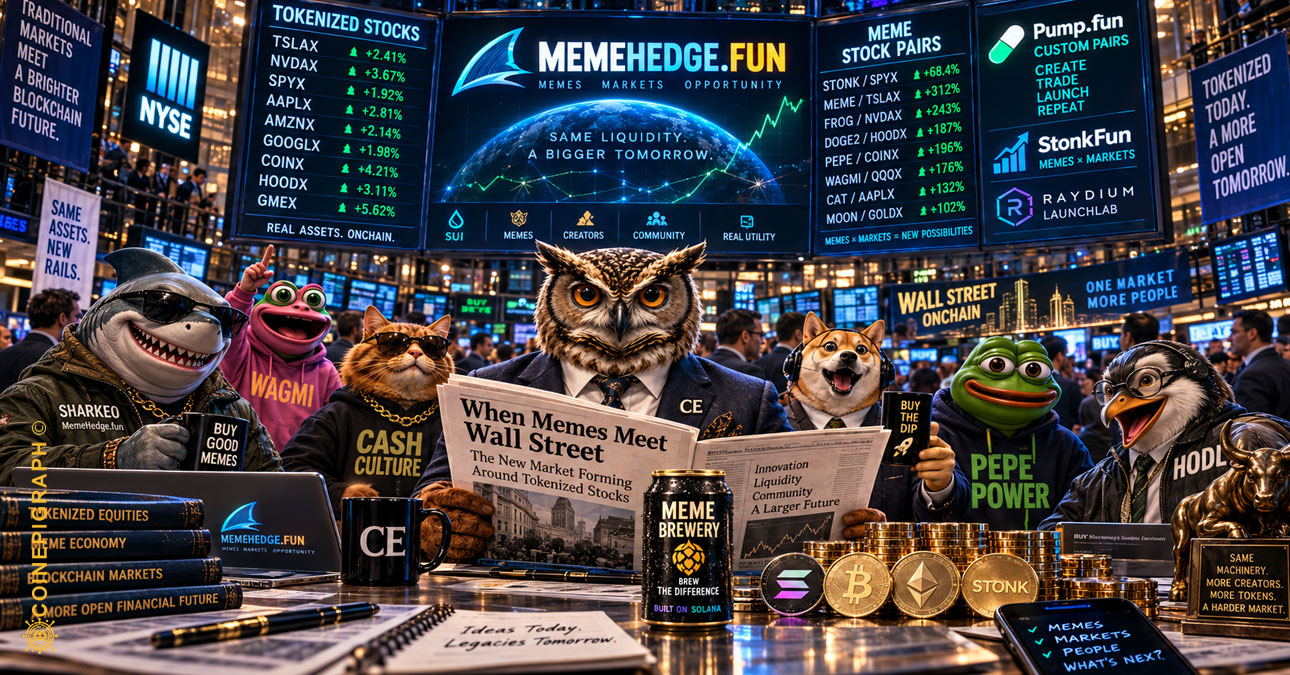
A strange experiment on Solana is beginning to blur one of crypto’s most familiar boundaries. Memecoins can now trade directly against tokenized stocks, ETFs, commodities and other assets. STONK may have supplied the spark, but the larger story is what happens when tokenized attention meets tokenized finance.
By CoinEpigraph Editorial Desk
It began, appropriately enough, with a joke.
“Stonks”—the intentionally misspelled internet shorthand for stocks—was once a way of mocking questionable financial reasoning. Then came the meme-stock era, when GameStop demonstrated that internet culture could escape the screen and exert extraordinary pressure on an actual publicly traded security.
Crypto took the experiment further. Memecoins demonstrated that attention itself could be financialized. A joke, dog, frog, political slogan or cultural moment could become a token, acquire liquidity and trade around the clock without earnings, factories, cash flows or conventional valuation models.
Now those histories are colliding.
On Solana, StonkFun has built a launchpad around an unusual proposition: instead of launching a token exclusively against SOL or a stablecoin, the token can be paired against another asset—including a tokenized stock.
Its own STONK token has become the advertisement for the experiment.
But STONK may be considerably less important than what the experiment has uncovered.
The Denominator Just Changed
Most people looking at a memecoin chart concentrate on the meme.
The more consequential innovation may now be sitting on the other side of the slash.
Traditionally, a Solana meme might trade as MEME/SOL. Its value is therefore being expressed against SOL.
Replace SOL with a tokenized representation of Tesla, Nvidia, GameStop or the S&P 500 and something unusual happens.
The meme remains a meme.
It does not become stock. Its holder does not suddenly own Tesla, receive Tesla dividends or acquire Tesla voting rights.
Instead, the tokenized security becomes the asset against which the meme is priced and traded.
That distinction is critical.
Pump.fun now explicitly supports this architecture through its Custom Pairs system. Its supported assets include tokenized representations linked to Apple, Nvidia, Tesla, Amazon, Coinbase, Robinhood, GameStop, Berkshire Hathaway, Microsoft, Palantir, the S&P 500 and Nasdaq-100.
There are also cryptocurrencies, gold-linked products and other digital assets.
The meme economy has acquired a new denominator.
Pump.fun Did Not Ignore the Experiment
StonkFun’s rise might have remained an interesting niche story had the largest name in Solana meme launching simply watched from the sidelines.
It didn’t.
Pump.fun expanded into Custom Pairs, allowing creators to launch tokens against supported assets rather than limiting the market structure to familiar crypto quote assets.
That response matters more than trying to declare a winner between StonkFun and Pump.fun.
StonkFun is still dramatically smaller than Pump.fun over longer measurement periods. Yet its activity has become substantial enough to demonstrate that the stock-paired model has a market.
DeFiLlama currently records roughly $145 million in StonkFun DEX volume over the preceding 30 days and nearly $10 million in third-quarter protocol revenue. About $4.9 million is identified as STONK buyback-and-burn activity.
The important lesson is therefore not that StonkFun defeated Pump.fun.
It is that a new competitive category became difficult to ignore.
The MemeFi Flywheel
STONK also introduces another element.
Platform activity can finance purchases and destruction of the platform token itself.
Trading produces fees. A portion of those economics purchases STONK. Purchased tokens are burned, permanently reducing supply.
That creates a feedback mechanism considerably different from the classic memecoin proposition.
Traditional meme speculation says:
Attention → demand → price speculation.
The StonkFun model adds another circuit:
Platform activity → revenue → token purchases → burns → reduced supply.
That does not guarantee appreciation. If trading activity disappears, the economic engine feeding those purchases weakens with it.
But it does make STONK something other than a meme relying exclusively upon continued belief in the meme.
The joke has acquired machinery.
Beneath the Meme Is Serious Infrastructure
This is where the apparent absurdity masks something far more consequential
The front end can look almost absurd: internet humor trading against Nvidia.
Underneath it sits an increasingly sophisticated financial stack.
Some assets supported by Pump.fun come from xStocks, whose issuer says its tokenized equities are backed 1:1 by underlying securities held in custody. Other supported equities originate through Backpack Securities and reach Solana through infrastructure involving Sunrise and Wormhole.
Liquidity and trading infrastructure add another layer.
StonkFun has integrated with Raydium’s LaunchLab. Pump.fun has its own PumpSwap ecosystem. Jupiter can provide routing into the broader Solana liquidity environment.
The resulting chain can look something like this:
Traditional security → custody → tokenized representation → blockchain → liquidity infrastructure → launchpad → meme pair → trader.
The interface may contain a cartoon.
The plumbing increasingly resembles financial infrastructure.
There Is Also a Weak Link
Tokenization does not eliminate intermediaries. In some circumstances it rearranges them.
Pump.fun makes an unusually important disclosure about its supported paired assets: Pump does not itself audit or verify claims that an outside asset is actually backed by or tracks the security it purports to represent.
That responsibility belongs elsewhere in the chain.
Pump also warns that an issuer or listing provider could freeze, convert or otherwise act upon a supported asset, potentially affecting a bonding curve or liquidity pool using it.
That creates a dependency chain worth examining:
meme → launchpad → tokenized asset → issuer → custodian → underlying security.
For an industry built partly around eliminating trusted intermediaries, that is an interesting amount of trust.
There is another complication.
xStocks says its products are backed 1:1 and can be redeemed for equivalent cash value or the underlying asset, but its products are not available within the United States or to U.S. persons.
The technology may be borderless.
The securities laws governing the assets are not.
That tension will become increasingly important if stock-paired meme trading grows.
Solana Isn’t Alone
Nor should this phenomenon be mistaken for an exclusively Solana invention.
Stock-paired memecoins have also appeared around Robinhood Chain and elsewhere. Market trackers are already following hundreds of meme tokens trading against dozens of stock-related assets across several blockchain environments.
That suggests something larger than a temporary STONK narrative.
A market structure is being tested.
And the experiment asks an unusual question:
What happens when one tokenized idea is priced directly against another?
A memecoin can be understood as tokenized attention.
A tokenized stock represents a traditional financial asset placed onto blockchain rails.
Put them together and the market begins trading:
tokenized attention against tokenized assets.
That is MemeFi in a considerably more consequential form.
Wall Street Is Coming From the Other Direction
At almost precisely the same moment, traditional finance is moving toward the same intersection.
Nasdaq recently agreed to invest $100 million in Payward, the parent of Kraken, as the companies deepen their work around infrastructure supporting tokenized equities.
Consider the direction of travel.
Crypto began with Bitcoin, moved into smart contracts, DeFi, memecoins and eventually tokenized traditional assets.
Wall Street began with traditional securities and is now investigating how those securities can trade through blockchain infrastructure.
One road is moving from crypto toward stocks.
The other is moving from stocks toward crypto.
They are beginning to meet.
And somewhere between them sits a memecoin trading against a tokenized representation of a public company.

From Meme Stock to Stock Meme
GameStop makes the evolution particularly difficult to ignore.
A company became a meme.
The meme affected the stock.
Crypto then turned memes themselves into tradable assets.
Today, a memecoin can trade against a tokenized representation of GameStop.
The circle is almost complete:
meme → meme stock → memecoin → tokenized stock → meme paired with tokenized stock.
What began as cultural satire is becoming market architecture.
That does not mean every stock-paired meme deserves to survive. Most almost certainly will not. Nor does attaching a token to Nvidia, Tesla or the S&P 500 magically give the meme fundamental value.
The speculative excess of memecoins remains speculative excess.
But focusing exclusively on whether the individual memes survive risks missing the experiment occurring underneath them.
Thousands of failed websites did not invalidate the internet.
Thousands of failed tokens will not necessarily invalidate programmable markets.
The more important question is what infrastructure remains after the speculation moves elsewhere.
The Meme Was Never the Whole Story
STONK may rise dramatically. It may collapse. Another launchpad may overtake StonkFun. Pump.fun may dominate the category. The entire stock-pairing craze could cool as quickly as it appeared.
Those are market outcomes.
The technological development survives those questions.
Blockchains are demonstrating that once an asset becomes programmable, developers can build markets around it that its original issuer never contemplated.
A stock no longer has to exist only as a line item inside a brokerage account.
Once represented onchain, it can become collateral, enter a liquidity pool, move through decentralized exchanges, interact with smart contracts—and now sit opposite an internet meme on a bonding curve.
Wall Street spent years looking at memecoins as financial nonsense.
Crypto spent years looking at Wall Street as financial machinery from another age.
Both judgments may eventually prove incomplete.
Because Wall Street is tokenizing its assets while crypto is learning what can be built around them.
STONK is entertaining.
The architecture underneath it is not a joke.
And if virtually any stock, index, commodity, cryptocurrency or other tokenized asset can eventually become the denominator of a meme market, the question may no longer be where memecoins fit within finance.
It may be where the boundaries of finance itself are going.
At CoinEpigraph, we are committed to delivering digital-asset journalism with clarity, accuracy, and uncompromising integrity. Our editorial team works daily to provide readers with reliable, insight-driven coverage across an ever-shifting crypto and macro-financial landscape. As we continue to broaden our reporting and introduce new sections and in-depth op-eds, our mission remains unchanged: to be your trusted, authoritative source for the world of crypto and emerging finance.
— Ian Mayzberg, Editor-in-Chief
The team at CoinEpigraph.com is committed to independent analysis and a clear view of the evolving digital asset order.
To help sustain our work and editorial independence, we would appreciate your support of any amount of the tokens listed below. Support independent journalism:
BTC: 3NM7AAdxxaJ7jUhZ2nyfgcheWkrquvCzRm
SOL: HxeMhsyDvdv9dqEoBPpFtR46iVfbjrAicBDDjtEvJp7n
ETH: 0x3ab8bdce82439a73ca808a160ef94623275b5c0a
XRP: rLHzPsX6oXkzU2qL12kHCH8G8cnZv1rBJh TAG – 1068637374
SUI – 0xb21b61330caaa90dedc68b866c48abbf5c61b84644c45beea6a424b54f162d0c
and through our Support Page.
🔍 Disclaimer: CoinEpigraph is for entertainment and information, not investment advice. Markets are volatile — always conduct your own research.
COINEPIGRAPH™ does not offer investment advice. Always conduct thorough research before making any market decisions regarding cryptocurrency or other asset classes. Past performance is not a reliable indicator of future outcomes. All rights reserved | 版权所有 ™ © 2024-2029.