


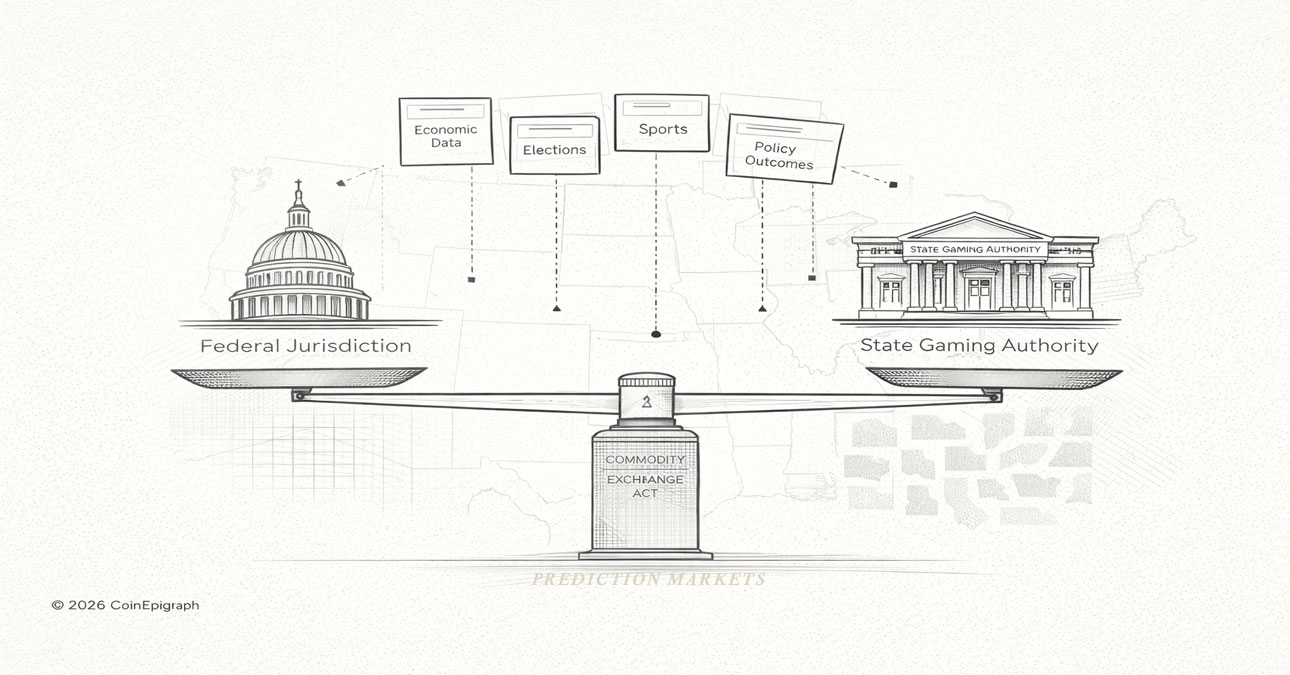
As states push back, the regulatory battle over event contracts may redefine the boundary between derivatives and gambling
By CoinEpigraph Editorial Desk | February 24, 2026
Prediction markets have moved from fringe curiosity to institutional friction point. Now the regulatory perimeter is being tested in open court.
The Commodity Futures Trading Commission (CFTC) has asserted that event-based contracts — including those offered by platforms such as Kalshi and Polymarket — fall under its exclusive federal jurisdiction pursuant to the Commodity Exchange Act (CEA). Several states, however, are pushing back, arguing that certain event contracts resemble sports wagering or unauthorized gaming activity under state law.
At stake is not simply the legality of individual contracts. It is the structural question of who governs probabilistic financial markets in the United States.
The Jurisdictional Core
Under the Commodity Exchange Act, the CFTC regulates futures, swaps, and certain event contracts traded on designated contract markets.
Kalshi, for example, operates as a CFTC-regulated exchange for event contracts. The CFTC’s position is that these contracts — when structured as derivatives — fall squarely within federal commodities jurisdiction.
States including Nevada and Massachusetts have challenged this position in specific contexts, especially where contracts track sports or political outcomes. Their argument: if a contract resembles wagering on an outcome, it should fall under state gaming authority.
The CFTC’s counterpoint is structural:
If an instrument qualifies as a derivative under federal law, federal jurisdiction preempts conflicting state gambling enforcement.
This is not a philosophical dispute. It is a supremacy clause dispute.
Why This Matters Beyond Kalshi
The question extends beyond any single platform.
Prediction markets increasingly price probabilities across:
- Elections
- Economic data releases
- Corporate outcomes
- Policy decisions
- Sports events
- Even macro indicators tied to financial markets
If treated as derivatives, these contracts integrate into the broader financial ecosystem.
If treated as gambling, they fragment under 50 state regulatory regimes.
For capital markets participants, the difference is existential.
Financialization of Probability
Modern markets already trade probabilistic instruments.
Options markets price implied volatility.
Credit markets price default probability.
Rates markets price forward policy expectations.
Prediction markets simply render probabilities more explicit.
The CFTC’s assertion of exclusive jurisdiction reflects a recognition that structured event contracts resemble derivatives in economic function — even if their subject matter differs from traditional commodities.
This is not an endorsement of speculation. It is classification.
And classification determines regulatory architecture.
State Resistance and Industry Friction
State gaming authorities argue that event contracts tied to sports outcomes, in particular, encroach on licensed betting regimes.
Their concern is revenue, consumer protection, and licensing authority.
The CFTC’s position prioritizes uniform federal oversight, arguing that fragmented state intervention risks undermining nationally regulated markets.
The conflict is escalating through injunctions, amicus briefs, and federal court challenges.
It is plausible that appellate courts — or even the Supreme Court — will eventually clarify the boundary.
Institutional Implications
For allocators and market infrastructure participants, the question is less about politics and more about regulatory clarity.
Key issues to monitor:
- Will federal courts affirm CFTC preemption authority?
- Will Congress intervene with legislative clarification?
- Could hybrid frameworks emerge (federal for economic events, state for sports)?
- How will exchanges structure contracts to avoid gaming classification?
- What risk controls will regulators impose if federal jurisdiction is consolidated?
The outcome affects:
- Market structure design
- Capital allocation to prediction platforms
- Liquidity provision
- Clearing infrastructure
- Risk management frameworks
Prediction markets are no longer niche platforms. They are capital formation instruments in development.
The Structural Shift
There is a deeper transition underway.
Prediction markets convert informational asymmetry into tradable pricing signals. In doing so, they intersect with derivatives law, gaming law, and First Amendment considerations.
The CFTC’s assertion of exclusive jurisdiction is a signal that federal regulators view these instruments through a financial lens rather than a gaming lens.
That lens matters.
If prediction markets are formally integrated into federal derivatives oversight, they gain:
- Regulatory legitimacy
- Institutional access
- Potential clearing integration
- Capital markets infrastructure compatibility
If states succeed in fragmenting oversight, the sector remains jurisdictionally unstable.
Markets prefer uniformity.

Are Prediction Markets Here to Stay?
The growth in volume and media integration suggests the category is durable.
But durability does not equal clarity.
The current battle is about perimeter control.
Who regulates probabilistic financial instruments?
Who captures the associated licensing authority?
Who defines the line between wagering and derivatives?
The answers will shape the evolution of prediction markets for years.
Prediction markets may be a small segment of today’s capital markets.
Jurisdictional precedent, however, scales.
The CFTC’s assertion is not just about Kalshi or Polymarket.
It is about whether probability itself becomes a federally regulated financial instrument — or remains subject to state gaming law patchwork.
That is a boundary worth watching.
At CoinEpigraph, we are committed to delivering digital-asset journalism with clarity, accuracy, and uncompromising integrity. Our editorial team works daily to provide readers with reliable, insight-driven coverage across an ever-shifting crypto and macro-financial landscape. As we continue to broaden our reporting and introduce new sections and in-depth op-eds, our mission remains unchanged: to be your trusted, authoritative source for the world of crypto and emerging finance.
— Ian Mayzberg, Editor-in-Chief
The team at CoinEpigraph.com is committed to independent analysis and a clear view of the evolving digital asset order.
To help sustain our work and editorial independence, we would appreciate your support of any amount of the tokens listed below. Support independent journalism:
BTC: 3NM7AAdxxaJ7jUhZ2nyfgcheWkrquvCzRm
SOL: HxeMhsyDvdv9dqEoBPpFtR46iVfbjrAicBDDjtEvJp7n
ETH: 0x3ab8bdce82439a73ca808a160ef94623275b5c0a
XRP: rLHzPsX6oXkzU2qL12kHCH8G8cnZv1rBJh TAG – 1068637374
SUI – 0xb21b61330caaa90dedc68b866c48abbf5c61b84644c45beea6a424b54f162d0c
and through our Support Page.
🔍 Disclaimer: CoinEpigraph is for entertainment and information, not investment advice. Markets are volatile — always conduct your own research.
COINEPIGRAPH™ does not offer investment advice. Always conduct thorough research before making any market decisions regarding cryptocurrency or other asset classes. Past performance is not a reliable indicator of future outcomes. All rights reserved | 版权所有 ™ © 2024-2029.