


Real shares, synthetic claims, and the architecture of modern equity markets
By CoinEpigraph Editorial Desk | April 1, 2026
Financial markets have always separated ownership from exposure.
The difference is that today, the separation is harder to see.
As tokenization expands, Web3 vault products proliferate, and synthetic equity structures migrate on-chain, investors are increasingly offered “stock exposure” in formats that resemble ownership but function differently. The vocabulary has evolved faster than the architecture beneath it.
For institutional readers, the distinction remains fundamental:
Ownership sits in the equity stack.
Exposure can sit anywhere.
Understanding where one stands in that stack determines how risk behaves in stress.
The Equity Stack: What Real Ownership Means
Real stock exposure places an investor inside the capital structure of a corporation.
Shares are issued by the company.
They are recorded in a regulated custody chain.
They settle through clearing infrastructure such as central securities depositories.
They grant defined legal rights—dividends, voting, participation in corporate actions.
Even when held in “street name,” ownership ultimately traces back to issued equity. The investor’s claim is anchored in company law.
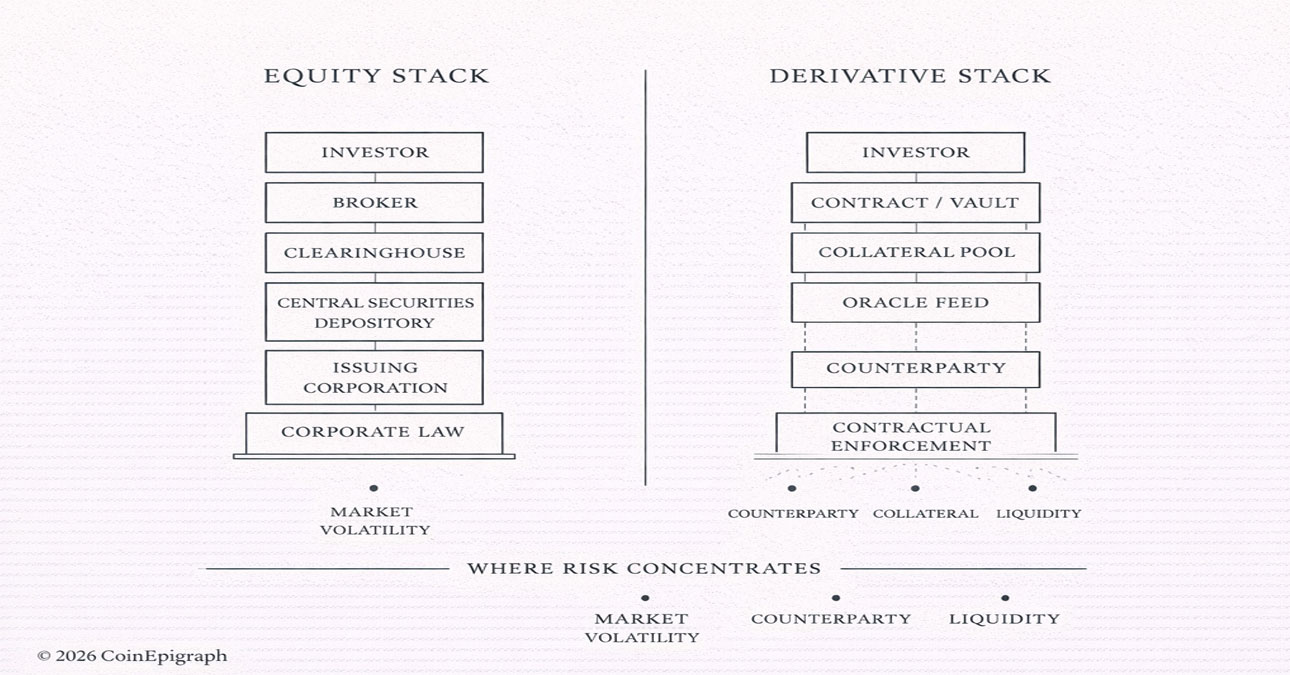
The infrastructure is layered but clear:
Investor
→ Broker
→ Clearinghouse
→ Central Securities Depository
→ Issuer
This architecture is capitalized, regulated, and stress-tested across decades.
When markets dislocate, real shareholders remain in the cap table.
Their risk is market volatility, not counter-party abstraction.
That distinction becomes critical in periods of liquidity contraction.
The Derivative Stack: What Synthetic Exposure Represents
Synthetic stock exposure replicates the economic performance of a share without transferring ownership.
Total return swaps, contracts for difference (CFDs), equity-linked notes, futures, options—these instruments create price participation through contractual mechanisms.
In Web3 environments, synthetic stock exposure may operate through:
- Collateralized smart contracts
- Oracle-fed pricing feeds
- Liquidity pools
- Hedging intermediaries
The investor receives economic return linked to the stock’s movement. But they do not enter the corporate equity structure.
They enter the derivative stack.
In normal conditions, both stacks may appear indistinguishable.
In stress, they diverge.
If a derivative counterparty fails, exposure depends on collateral sufficiency.
If an oracle malfunctions, valuation may freeze.
If liquidity evaporates, redemption becomes conditional.
Synthetic exposure does not disappear—but it behaves according to contract logic, not equity law.
When “Vault” Enters the Conversation
The rise of the term “vault” in crypto and fintech complicates this distinction.
In traditional finance, a vault implied safekeeping—custody of bearer instruments or secured assets. The word suggested storage and protection.
In Web3, “vault” often describes something different:
- Yield-bearing smart contracts
- Automated asset allocation pools
- Structured leverage engines
- Tokenized wrappers referencing external assets
A “stock vault” may not hold shares at all.
It may hold collateral used to replicate price exposure.
The metaphor compresses complexity into comfort.
Institutional readers understand that metaphors are not mechanisms.
The relevant question is not whether vaults are innovative.
It is where risk resides inside them.
Ownership, Rights, and Governance
Real shareholders sit inside governance.
They vote.
They participate in reorganizations.
They receive direct distributions.
Synthetic holders receive economic equivalence only if contract terms specify it.
Dividend equivalents are mirrored, not inherent.
Voting rights are typically absent.
Participation in restructuring depends on derivative clauses.
These differences rarely matter in quiet markets.
They matter when capital structures shift.
For institutional allocators, governance position determines leverage in corporate events.
For retail participants, it determines what exactly they own.
Exposure and ownership are not synonyms.
Where Risk Concentrates
Real exposure concentrates risk in:
- Market volatility
- Clearing infrastructure stress
- Broker solvency (mitigated by regulatory frameworks)
Synthetic exposure concentrates risk in:
- Counter-party solvency
- Collateral adequacy
- Contract enforce-ability
- Smart contract integrity
- Oracle reliability
- Liquidity depth
These are not theoretical categories. They have surfaced repeatedly in financial history—from swap concentration events to structured product failures.
Neither structure is inherently unstable.
But they operate under different failure modes.
In liquidity expansion, the difference is muted.
In liquidity contraction, the difference widens.
Tokenization and the Compression of Layers
Tokenized equities promise to compress settlement cycles and improve capital efficiency. In some designs, shares are genuinely custodied and mirrored on-chain through regulated wrappers.
In others, exposure is synthetically replicated through derivative logic.
Both are innovation.
But they occupy different structural tiers.
As markets move toward continuous settlement and programmable liquidity, the temptation to compress custody, leverage, and yield into unified products grows.
Efficiency increases.
Complexity concentrates.
Institutions can navigate layered risk. Retail participants often cannot.
The role of financial media in this transition is not advocacy. It is clarification.
The Stablecoin Parallel
The debate echoes earlier conversations around stablecoins and yield.
A deposit account is not a yield vault.
A yield vault is not a Treasury bill.
A synthetic equity token is not a share certificate.
Yet marketing language can blur those boundaries.
As programmable finance evolves, the architecture beneath exposure becomes more important than the label attached to it.
Transparency should extend beyond yield percentage. It should include stack position.
The Future of Equity Infrastructure
Equity markets are unlikely to abandon regulated custody chains. Nor will they ignore efficiency gains from digital rails.
The most probable path is hybridization:
- Real shares held in regulated custody
- On-chain representation for settlement compression
- Clear separation between ownership and derivative exposure
- Auditable collateral structures
Innovation will not eliminate traditional architecture.
It will interface with it.
The risk lies not in tokenization itself—but in conflating structure with terminology.
If ownership migrates into code, legal clarity must migrate with it.
Institutional Gravity in a Digital Era
The migration of financial instruments into programmable environments does not negate decades of market structure. It overlays them.
For institutions, the calculus remains unchanged:
What do we legally own?
What is the counter-party?
Where does collateral sit?
What happens under stress?
These questions apply equally to swaps in prime brokerage and to vault-based exposure on-chain.
The novelty lies in access.
The principles remain constant.

A Structural Conclusion
Innovation in financial markets often begins by replicating existing structures in new formats.
Over time, some formats prove more efficient. Others prove fragile.
The difference rarely reveals itself in expansion phases.
It reveals itself when liquidity tightens.
Real stock exposure embeds investors in the corporate equity stack.
Synthetic stock exposure embeds them in the derivative stack.
Both have roles.
Both carry risk.
But they are not interchangeable.
As programmable finance accelerates, clarity about stack position will determine resilience.
Exposure is a claim on performance.
Ownership is a claim in law.
The future of markets may blur interfaces—but architecture still decides outcomes.
At CoinEpigraph, we are committed to delivering digital-asset journalism with clarity, accuracy, and uncompromising integrity. Our editorial team works daily to provide readers with reliable, insight-driven coverage across an ever-shifting crypto and macro-financial landscape. As we continue to broaden our reporting and introduce new sections and in-depth op-eds, our mission remains unchanged: to be your trusted, authoritative source for the world of crypto and emerging finance.
— Ian Mayzberg, Editor-in-Chief
The team at CoinEpigraph.com is committed to independent analysis and a clear view of the evolving digital asset order.
To help sustain our work and editorial independence, we would appreciate your support of any amount of the tokens listed below. Support independent journalism:
BTC: 3NM7AAdxxaJ7jUhZ2nyfgcheWkrquvCzRm
SOL: HxeMhsyDvdv9dqEoBPpFtR46iVfbjrAicBDDjtEvJp7n
ETH: 0x3ab8bdce82439a73ca808a160ef94623275b5c0a
XRP: rLHzPsX6oXkzU2qL12kHCH8G8cnZv1rBJh TAG – 1068637374
SUI – 0xb21b61330caaa90dedc68b866c48abbf5c61b84644c45beea6a424b54f162d0c
and through our Support Page.
🔍 Disclaimer: CoinEpigraph is for entertainment and information, not investment advice. Markets are volatile — always conduct your own research.
COINEPIGRAPH™ does not offer investment advice. Always conduct thorough research before making any market decisions regarding cryptocurrency or other asset classes. Past performance is not a reliable indicator of future outcomes. All rights reserved | 版权所有 ™ © 2024-2029.