


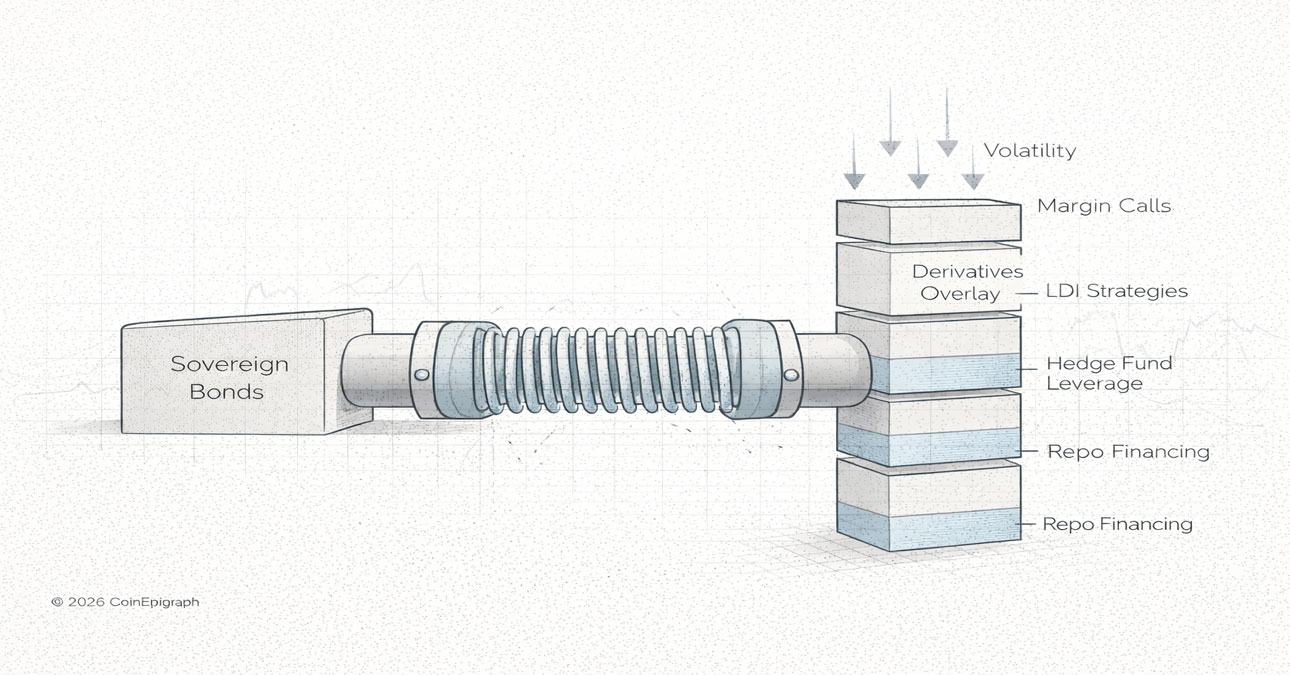
From repo fragility to LDI stress, the vulnerability was never the bond — it was the buffer
Funding Fragility 2 Part Series: Inside the Architecture of Modern Liquidity
Part I-When the Plumbing Strains: Repo Leverage, Zero Haircuts, and the Quiet Risk in Government Bond Funding
By CoinEpigraph Editorial Desk | February 25, 2026
In September 2022, the UK government bond market — long regarded as one of the safest and most liquid segments of global finance — became the epicenter of a liquidity shock.
It was not a default.
It was not a credit event.
It was not a banking panic.
It was leverage meeting volatility inside the safest collateral in the system.
The episode offers a useful case study as funding vulnerabilities re-emerge in global repo markets. If Part 1 examined thin haircuts and concentrated leverage in Treasury financing, the UK gilt crisis shows what happens when a sovereign bond market becomes the shock absorber for leveraged strategies operating just beneath the surface.
The Setup: Liability-Driven Investment
Defined benefit pension schemes in the United Kingdom widely adopted a strategy known as liability-driven investment (LDI).
The goal was straightforward:
- Match the duration of pension liabilities
- Hedge interest-rate risk
- Stabilize funding ratios
To do this efficiently, pension funds used derivatives and repo financing to gain leveraged exposure to long-dated gilts. The leverage allowed them to hedge large liabilities without holding equivalent physical bond inventory.
In stable markets, this structure appeared disciplined and mathematically sound.
But stability was the hidden assumption.
The Catalyst
In late September 2022, following a fiscal announcement by the UK government, long-dated gilt yields rose sharply — in some cases more than 100 basis points within days.
For highly leveraged LDI structures, rising yields meant falling bond prices.
Falling prices triggered margin calls.
Margin calls required liquidity.
Liquidity required asset sales.
The system began to feed on itself.
The Feedback Loop
The vulnerability was not the gilt.
The vulnerability was the funding architecture.
LDI funds, faced with margin calls, began selling gilts to raise cash. Those sales pushed gilt prices lower and yields higher. Higher yields triggered further margin calls. The loop tightened.
Within days, the Bank of England announced a temporary emergency bond-buying program to restore market functioning.
The central bank was not defending fiscal policy.
It was stabilizing the collateral system.
Why This Matters for Funding Markets Today
The parallels to repo leverage are structural, not superficial.
In both cases:
- Sovereign bonds were used as collateral.
- Leverage amplified sensitivity to price moves.
- Margin mechanics accelerated stress.
- Liquidity evaporated faster than fundamentals deteriorated.
- Central bank intervention became the circuit breaker.
The 2022 gilt episode was a reminder that government bond markets are not immune to volatility-driven instability when embedded inside leveraged structures.
Safe assets can become transmission channels.
The Non-Bank Leverage Question
One of the defining features of the gilt crisis was that the stress did not originate in traditional banks.
It originated in pension funds — non-bank financial institutions operating within regulatory perimeters but outside the classic banking capital framework.
This matters because much of today’s leverage also sits outside traditional bank balance sheets:
- Hedge funds financing Treasury basis trades
- Asset managers using derivatives overlays
- Pension and insurance balance-sheet optimization structures
- Repo-funded relative value strategies
The leverage is often transparent in aggregate, but opaque in its concentration.
When volatility arrives, margin requirements do not negotiate.
Liquidity vs. Solvency
The gilt market did not collapse because the UK was insolvent.
It destabilized because leveraged hedging strategies required more liquidity than was immediately available.
Liquidity stress in sovereign markets can:
- Tighten financial conditions
- Force deleveraging across asset classes
- Distort yield curves
- Elevate collateral costs
- Trigger cross-market volatility
The event was resolved not through capital repair, but through liquidity intervention.
That distinction is critical.
The Sovereign Bond Paradox
Government bonds are treated as the safest collateral in modern finance.
They underpin:
- Repo markets
- Derivatives margin systems
- Pension hedging
- Bank liquidity management
- Central bank operations
Yet when those same bonds are embedded in leveraged structures, they can become volatility amplifiers.
The risk is not credit risk.
It is funding fragility.
Lessons for 2026
The repo article highlighted a structural concern: leverage in government bond-backed funding markets with minimal haircuts and concentrated participation.
The UK gilt episode demonstrates how quickly:
- Buffers can thin
- Margin calls can cascade
- Liquidity can evaporate
- Central banks can become market makers of last resort
The question for allocators is not whether another gilt-style event is imminent.
The question is whether funding structures are robust to volatility in an environment of:
- Higher sovereign issuance
- Elevated global debt
- Reduced central bank balance sheet expansion
- Increased participation by leveraged non-bank actors
The infrastructure is stronger than in past cycles.
But leverage remains leverage.
The Quiet Signal
The gilt crisis was resolved within weeks. Markets normalized. Yields stabilized. Pension funds recapitalized.
The event faded from headlines.
But structurally, it revealed something durable:
Safe assets can destabilize markets when leverage is layered on top without sufficient liquidity buffers.
That lesson applies across sovereign bond markets.
It applies across repo financing.
It applies across any structure that relies on stable collateral assumptions in volatile conditions.

Closing Reflection
The repo market does not require a credit event to strain.
The gilt market did not require a default to break.
In both cases, the stress point was not the asset.
It was the funding buffer.
Markets do not always fracture at the speculative edge.
Sometimes they fracture at the core — in the plumbing that makes everything else possible.
Understanding that plumbing is not alarmism.
It is risk management.
At CoinEpigraph, we are committed to delivering digital-asset journalism with clarity, accuracy, and uncompromising integrity. Our editorial team works daily to provide readers with reliable, insight-driven coverage across an ever-shifting crypto and macro-financial landscape. As we continue to broaden our reporting and introduce new sections and in-depth op-eds, our mission remains unchanged: to be your trusted, authoritative source for the world of crypto and emerging finance.
— Ian Mayzberg, Editor-in-Chief
The team at CoinEpigraph.com is committed to independent analysis and a clear view of the evolving digital asset order.
To help sustain our work and editorial independence, we would appreciate your support of any amount of the tokens listed below. Support independent journalism:
BTC: 3NM7AAdxxaJ7jUhZ2nyfgcheWkrquvCzRm
SOL: HxeMhsyDvdv9dqEoBPpFtR46iVfbjrAicBDDjtEvJp7n
ETH: 0x3ab8bdce82439a73ca808a160ef94623275b5c0a
XRP: rLHzPsX6oXkzU2qL12kHCH8G8cnZv1rBJh TAG – 1068637374
SUI – 0xb21b61330caaa90dedc68b866c48abbf5c61b84644c45beea6a424b54f162d0c
and through our Support Page.
🔍 Disclaimer: CoinEpigraph is for entertainment and information, not investment advice. Markets are volatile — always conduct your own research.
COINEPIGRAPH™ does not offer investment advice. Always conduct thorough research before making any market decisions regarding cryptocurrency or other asset classes. Past performance is not a reliable indicator of future outcomes. All rights reserved | 版权所有 ™ © 2024-2029.