


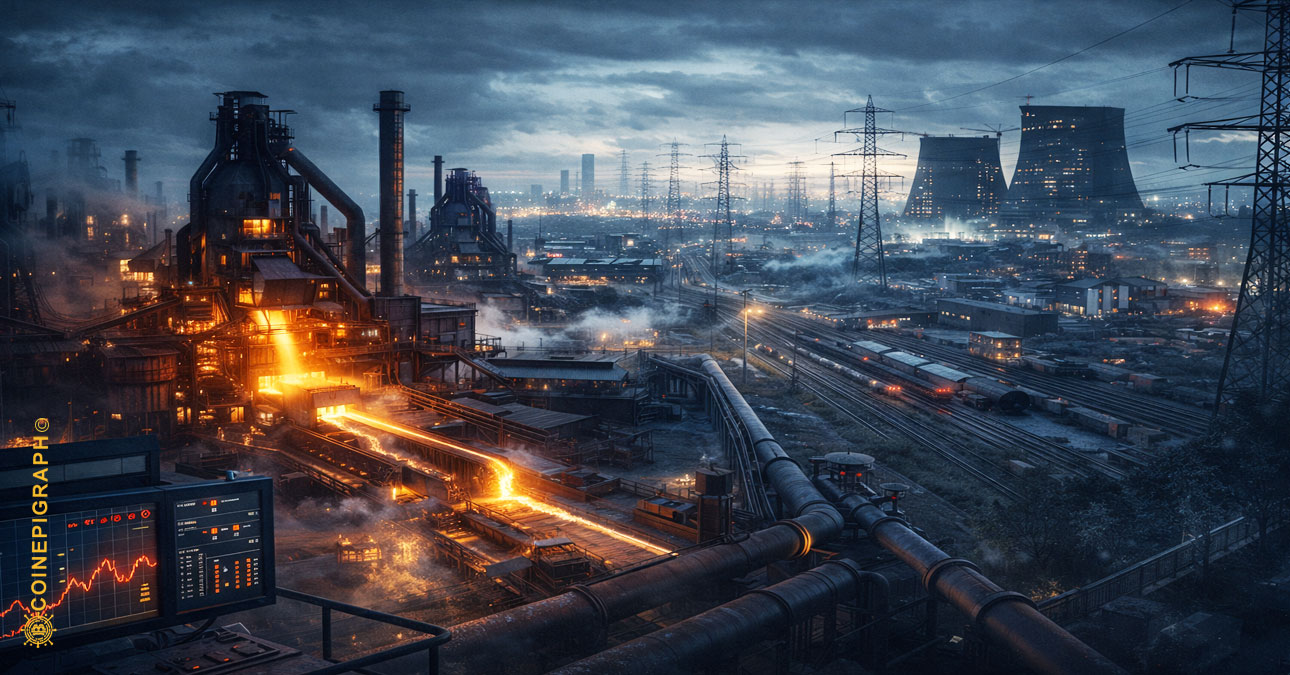
Energy disruption is colliding with Europe’s industrial backbone, exposing structural vulnerabilities that could reverberate across global manufacturing and capital allocation.
By CoinEpigraph Editorial Desk | March 17, 2026
For decades, Germany stood as Europe’s industrial anchor — a manufacturing powerhouse powered by precision engineering, export strength, and a steady flow of affordable energy. That model is now under intense strain.
The catalyst is not merely rising energy costs or geopolitical tension. It is the growing role of force majeure declarations across energy supply contracts, which have effectively reshaped the reliability assumptions underpinning Germany’s industrial economy.
As energy supply uncertainty spreads through the system, the consequences are becoming most visible in steel production and its downstream manufacturing ecosystem, raising broader questions about Europe’s long-term industrial competitiveness.
Energy Shock Meets Industrial Reality
Germany’s industrial sector was built on a structural advantage that persisted for decades: stable and relatively inexpensive natural gas imports, particularly from Russia.
Natural gas serves multiple roles within the industrial economy:
- powering furnaces and manufacturing facilities
- generating electricity used by heavy industry
- serving as feedstock for chemicals and industrial processes
The sudden disruption of pipeline gas supplies following geopolitical tensions in Eastern Europe shattered this equilibrium.
Force majeure claims by energy suppliers, pipeline interruptions, and sanctions-related constraints forced companies into volatile spot markets where energy costs surged dramatically.
For energy-intensive industries, the shift was immediate and severe.
Steel production quickly emerged as one of the most exposed sectors.
Steel: The Foundation of the Industrial Stack
Steel sits at the base of the industrial value chain. Virtually every manufacturing ecosystem depends on it.
Germany’s steel industry supports a wide network of downstream sectors including:
- automotive manufacturing
- machinery and industrial equipment
- infrastructure construction
- defense production
Modern steel production requires enormous and continuous energy input. Even brief disruptions can halt production cycles or damage furnaces.
As electricity and natural gas prices surged across Europe, German steelmakers faced production costs dramatically higher than those faced by competitors in regions such as the United States or the Middle East.
This cost imbalance has begun to ripple through supply chains.
The implications extend well beyond the steel sector itself.
Industrial Relocation Pressures
The deeper concern emerging within European policy circles is the possibility of industrial migration.
Energy-intensive manufacturers are now evaluating whether production should remain in Europe or move to regions where energy prices remain structurally lower.
The United States, for example, benefits from abundant shale gas resources and comparatively stable electricity pricing.
Other regions — including parts of the Middle East and Southeast Asia — are also attracting industrial investment by offering cheaper energy and regulatory incentives.
If significant production capacity relocates, the impact could reshape Europe’s manufacturing landscape for decades.
Industrial ecosystems, once disrupted, are notoriously difficult to rebuild.
The Strategic Dimension: Industrial Sovereignty
Germany’s steel sector is not simply another industrial segment. It represents a key pillar of national and regional economic resilience.
Steel underpins critical infrastructure, transportation networks, and defense supply chains.
As global supply chains become increasingly fragmented by geopolitical competition, industrial capacity itself is becoming a strategic asset.
Europe’s reliance on external energy sources has therefore revealed a structural vulnerability.
Energy security is rapidly emerging as a prerequisite for industrial sovereignty.
Transition Plans and Structural Constraints
Germany is attempting to address the challenge through a long-term transition toward hydrogen-based “green steel” production, which aims to reduce dependence on fossil fuels while lowering carbon emissions.
The approach involves replacing traditional blast furnace processes with hydrogen-powered direct reduction technology powered by renewable electricity.
However, the transition faces several constraints:
- hydrogen production infrastructure remains limited
- renewable electricity generation is intermittent
- industrial-scale deployment will take years to develop
In the interim, companies must navigate a volatile energy environment while remaining competitive in global markets.
The Market Signal
From a market perspective, Germany’s industrial stress offers a broader signal about the evolving structure of the global economy.
Three structural trends are now intersecting:
- Energy markets are becoming increasingly geopolitical.
Supply disruptions are no longer viewed as temporary shocks but as persistent strategic risks. - Industrial geography is beginning to shift.
Energy cost differentials are influencing where factories are built and where capital flows. - Supply chain resilience is replacing efficiency as a primary economic priority.
These trends are already influencing investment decisions across commodities, infrastructure, and digital asset markets.

Strategic Implications for Global Markets
Germany’s industrial adjustment highlights a deeper reality emerging across advanced economies: energy and industrial capacity are once again central to geopolitical competition.
For investors and macro allocators, the implications extend across multiple asset classes.
Commodity markets, energy infrastructure investment, and supply chain logistics are all likely to experience structural repricing as economies re-calibrate their industrial foundations.
In that sense, the disruption unfolding in Germany’s steel sector may represent an early signal of a broader shift.
The era in which globalization guaranteed cheap energy and frictionless industrial production is fading.
What replaces it will shape the next phase of global economic competition.
At CoinEpigraph, we are committed to delivering digital-asset journalism with clarity, accuracy, and uncompromising integrity. Our editorial team works daily to provide readers with reliable, insight-driven coverage across an ever-shifting crypto and macro-financial landscape. As we continue to broaden our reporting and introduce new sections and in-depth op-eds, our mission remains unchanged: to be your trusted, authoritative source for the world of crypto and emerging finance.
— Ian Mayzberg, Editor-in-Chief
The team at CoinEpigraph.com is committed to independent analysis and a clear view of the evolving digital asset order.
To help sustain our work and editorial independence, we would appreciate your support of any amount of the tokens listed below. Support independent journalism:
BTC: 3NM7AAdxxaJ7jUhZ2nyfgcheWkrquvCzRm
SOL: HxeMhsyDvdv9dqEoBPpFtR46iVfbjrAicBDDjtEvJp7n
ETH: 0x3ab8bdce82439a73ca808a160ef94623275b5c0a
XRP: rLHzPsX6oXkzU2qL12kHCH8G8cnZv1rBJh TAG – 1068637374
SUI – 0xb21b61330caaa90dedc68b866c48abbf5c61b84644c45beea6a424b54f162d0c
and through our Support Page.
🔍 Disclaimer: CoinEpigraph is for entertainment and information, not investment advice. Markets are volatile — always conduct your own research.
COINEPIGRAPH™ does not offer investment advice. Always conduct thorough research before making any market decisions regarding cryptocurrency or other asset classes. Past performance is not a reliable indicator of future outcomes. All rights reserved | 版权所有 ™ © 2024-2029.