


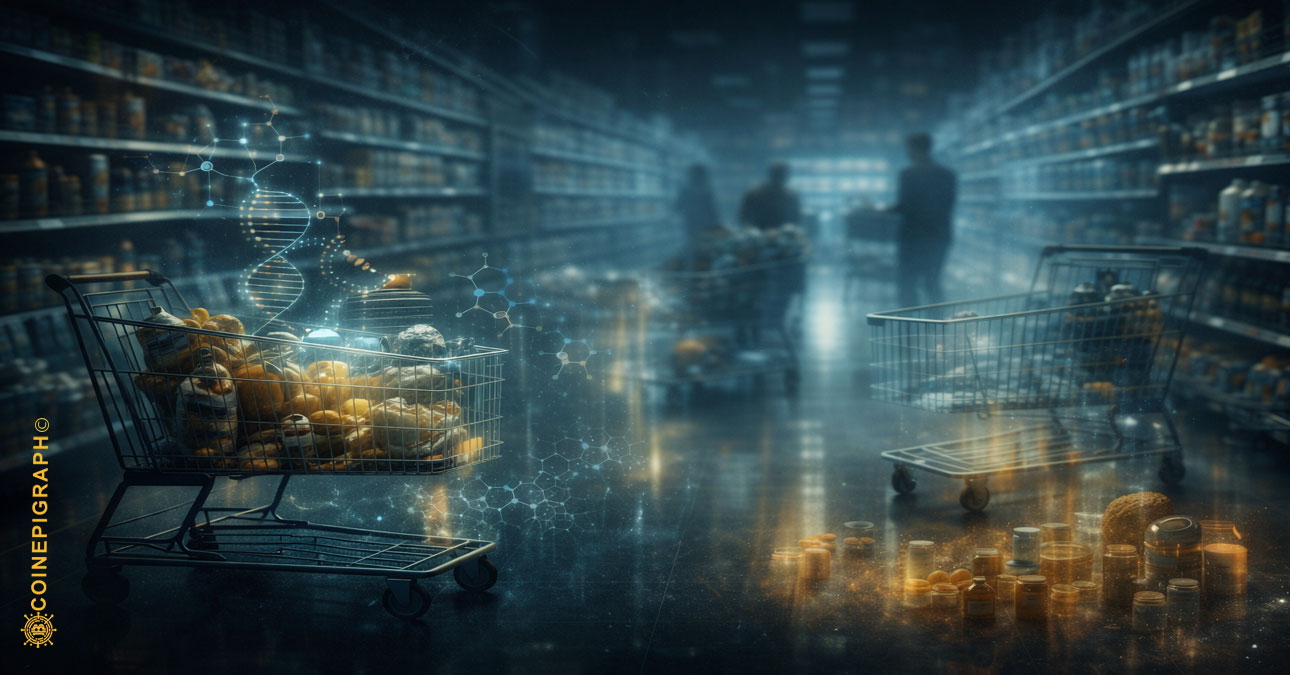
It doesn’t start in the grocery aisle.
It starts before the decision is even made.
By CoinEpigraph Editorial Desk | April 6, 2026
A new class of drugs is altering consumption patterns at the biological level. Early signals suggest the effects are already reaching retail, food manufacturing, and supply chains. What looks like a health trend may be something more structural.
The Shift That Doesn’t Announce Itself
There’s no headline event here.
No sudden collapse in demand.
No single quarter where everything changes at once.
Instead, the signals come in smaller forms.
A lighter shopping cart.
A skipped impulse purchase.
A preference that wasn’t there before.
Individually, they’re easy to dismiss.
Together, they begin to look like direction.
Where It Starts
Drugs like Ozempic, Wegovy, and Mounjaro are designed to regulate appetite.
They do more than that.
They change how consumption feels.
Cravings diminish.
Portions shrink.
Certain categories—sugar, alcohol, ultra-processed foods—lose their pull.
Not through discipline.
Through chemistry.
The First Layer of Impact
Retailers are already seeing it.
Executives at companies like Walmart have acknowledged subtle shifts:
- Fewer calories purchased
- Different category mixes
- Lower overall food spend per customer
Nothing dramatic.
But enough to register.
And enough to suggest that something underneath the data is changing.
When Demand Stops Behaving Normally
Traditional demand models rely on familiar drivers:
- Price
- Income
- Preference
GLP-1 drugs introduce something else.
A biological override.
Consumption is no longer just a function of choice.
It’s influenced—directly—by how the body responds to food.
That changes the equation.
Quietly at first. Then structurally.
The Ripple That Moves Outward
Food manufacturers are watching.
So are beverage companies.
So are suppliers further up the chain.
Because even small reductions in consumption—spread across millions of users—don’t stay small.
They compound.
- Portion sizes adjust
- Product formulations shift
- High-margin categories face pressure
And over time, the system re-calibrates.
The Categories Most Exposed
Not all food is affected equally.
Early signals point toward:
- Snack foods
- Sugary beverages
- Alcohol
Categories built on:
- Frequency
- Impulse
- Habit
Those are the ones most sensitive to change.
When the impulse weakens, the model changes with it.
The Part That’s Harder to Measure
There’s a second-order effect that doesn’t show up immediately in sales data.
Behavioral consistency.
If users:
- Snack less
- Drink less
- Buy less
And continue to do so over time…
then the baseline itself begins to shift.
Not temporarily.
Permanently.
The Market Hasn’t Fully Priced It
For now, this sits at the edge of consensus.
Acknowledged, but not fully modeled.
Because the variables are still moving:
- Adoption rates
- Long-term adherence
- Pricing and accessibility
But markets don’t wait for certainty.
They move on trajectory.
And the trajectory here is becoming harder to ignore.
The Question Beneath the Trend
This isn’t just about weight loss.
Or even health.
It’s about what happens when consumption—one of the most stable inputs in the economy—becomes variable in a new way.
What happens when biology starts influencing demand at scale?
That’s not a question most models are built to answer.

Closing Signal: The System Adjusts—Even If It Doesn’t Notice Immediately
The food economy was built on assumptions:
That appetite is stable.
That behavior is predictable.
That demand, while cyclical, follows recognizable patterns.
GLP-1 drugs don’t break those assumptions overnight.
They bend them.
And over time, that bend becomes visible.
Not as disruption.
As adjustment.
The kind that starts quietly—and then shows up everywhere.
At CoinEpigraph, we are committed to delivering digital-asset journalism with clarity, accuracy, and uncompromising integrity. Our editorial team works daily to provide readers with reliable, insight-driven coverage across an ever-shifting crypto and macro-financial landscape. As we continue to broaden our reporting and introduce new sections and in-depth op-eds, our mission remains unchanged: to be your trusted, authoritative source for the world of crypto and emerging finance.
— Ian Mayzberg, Editor-in-Chief
The team at CoinEpigraph.com is committed to independent analysis and a clear view of the evolving digital asset order.
To help sustain our work and editorial independence, we would appreciate your support of any amount of the tokens listed below. Support independent journalism:
BTC: 3NM7AAdxxaJ7jUhZ2nyfgcheWkrquvCzRm
SOL: HxeMhsyDvdv9dqEoBPpFtR46iVfbjrAicBDDjtEvJp7n
ETH: 0x3ab8bdce82439a73ca808a160ef94623275b5c0a
XRP: rLHzPsX6oXkzU2qL12kHCH8G8cnZv1rBJh TAG – 1068637374
SUI – 0xb21b61330caaa90dedc68b866c48abbf5c61b84644c45beea6a424b54f162d0c
and through our Support Page.
🔍 Disclaimer: CoinEpigraph is for entertainment and information, not investment advice. Markets are volatile — always conduct your own research.
COINEPIGRAPH™ does not offer investment advice. Always conduct thorough research before making any market decisions regarding cryptocurrency or other asset classes. Past performance is not a reliable indicator of future outcomes. All rights reserved | 版权所有 ™ © 2024-2029.