


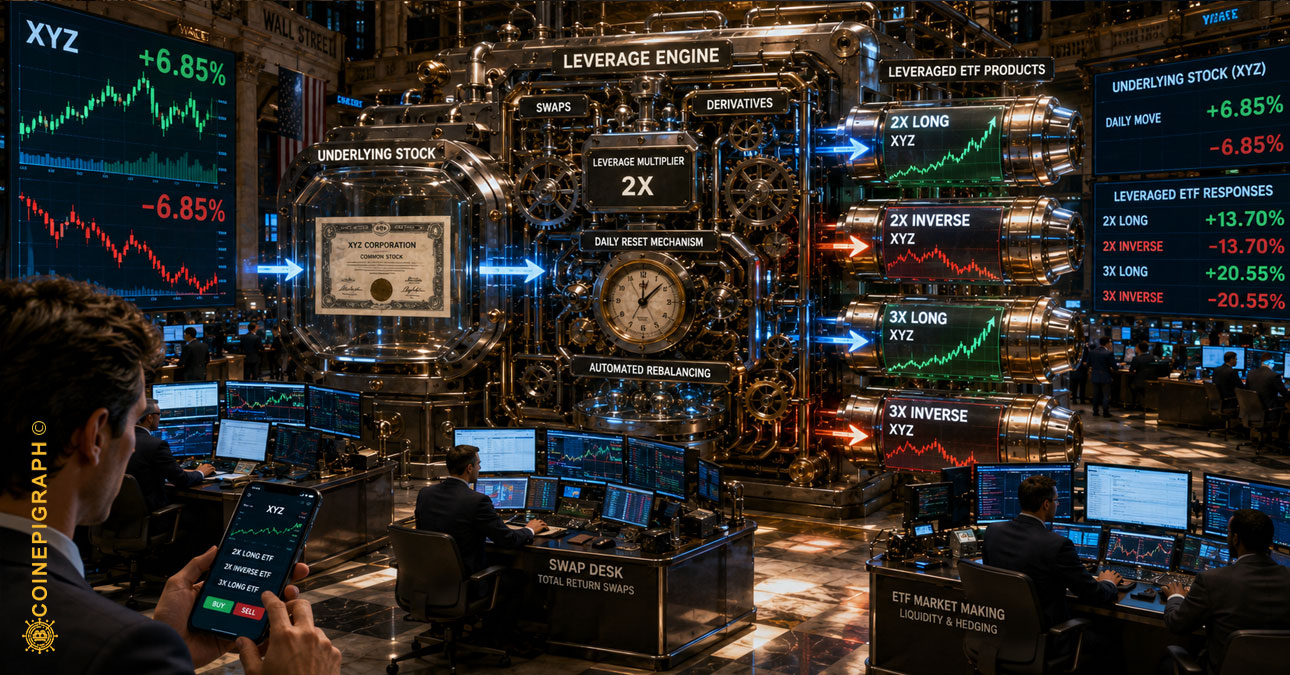
Single-stock leveraged ETFs turn the price movement of one company into a tradable instrument. Behind the simple ticker sits a machinery of derivatives, dealer hedging, daily resets and compounding that can behave very differently from owning the stock itself.
By CoinEpigraph Editorial Desk
Buying a share of a company once represented a relatively straightforward transaction.
The investor acquired an economic interest in a business. Its value rose or fell as markets reassessed earnings, growth, risk and expectations for the future.
Modern markets have built something considerably more elaborate around that relationship.
Investors can now buy funds designed to amplify the daily performance of a single company. They can purchase inverse exposure to its shares, extract income from its volatility, trade options against it or gain exposure through products whose behavior may differ substantially from simply owning the stock.
Single-stock leveraged ETFs offer one of the clearest examples.
A fund targeting twice the daily performance of a stock is not attempting to identify whether that company is undervalued. Its objective is mechanical: deliver approximately 200% of the underlying security’s daily return, before fees and tracking differences.
That single word—daily—changes almost everything.
A Stock Wrapped in Financial Engineering
Consider a hypothetical 2× ETF tracking a stock that begins the day at $100.
If the stock gains 5%, the fund targets approximately 10%. If the stock falls 5%, the target becomes approximately negative 10%.
The investor gets amplified exposure without personally arranging margin financing or constructing a derivatives position.
That simplicity exists largely at the interface.
Behind it sits a more complicated structure.
Single-stock leveraged ETFs can use swaps and other derivatives to establish the exposure necessary to pursue their stated objective. Those contracts introduce counterparties, financing costs and hedging activity into a transaction that appears to the investor as little more than buying another ticker.
The ETF wrapper has effectively packaged a leveraged trading strategy as a security.
And unlike owning the underlying stock, that strategy must continually be maintained.
The Investment Can Be Passive. The Leverage Cannot.
Suppose a 2× fund begins with $100 million in net assets and approximately $200 million of exposure to its underlying stock.
Now suppose the stock declines 10% in one trading session.
Ignoring fees and tracking differences, the fund targets a 20% decline, reducing its net assets to roughly $80 million.
The fund no longer needs $200 million of exposure.
To begin the next session at its intended 2× leverage ratio, it needs approximately $160 million.
Exposure therefore has to be reduced.
The opposite occurs after gains. If the fund’s net assets increase, its required exposure increases with them.
This is the mechanism at the center of leveraged ETF rebalancing.
The manager is not deciding that a falling stock should be sold or a rising stock deserves additional capital. The fund is restoring a mathematical relationship.
The investment decision may be passive. Maintaining the leverage is not.
That distinction matters because these adjustments can create transactions independent of any new assessment of the underlying company.
What the Investor Sees Is Only the First Layer
The ETF’s rebalancing is not necessarily the end of the transaction.
If the fund obtains part of its exposure through swaps, financial institutions stand on the other side of those contracts. Dealers may manage the resulting risks using the underlying shares, options, futures or other instruments.
The transmission can therefore become considerably longer than the original trade suggests.
An investor buys a leveraged ETF.
The fund establishes derivative exposure.
A dealer provides that exposure.
The dealer manages its resulting risk.
Changes in the underlying stock alter the ETF’s net assets.
The fund resets its leverage.
Counterparties adjust again.
None of this means a leveraged ETF mechanically determines the direction of the underlying stock. Dealer books contain multiple positions, and hedging requirements depend on the complete exposure rather than one product in isolation.
But as these products grow, their mechanically generated flows become another element of market structure—particularly around heavily traded, volatile stocks.
The product does not merely react to the market.
Its maintenance can generate activity within that market.
Daily Leverage Is Not Long-Term Leverage
The daily reset also creates one of the most misunderstood characteristics of these funds.
A 2× ETF targets twice the daily return. It does not promise twice the stock’s return over a month or year.
Consider a stock beginning at $100.
A 10% gain takes it to $110. A 10% decline the following day leaves it at $99—a two-day loss of 1%.
A corresponding 2× fund beginning at $100 would target a 20% first-day gain, reaching $120. A 20% decline from there leaves $96.
The stock lost 1%.
The leveraged fund lost 4%.
Nothing necessarily malfunctioned.
Compounding changed the result.
That effect is often described broadly as volatility decay, but the description requires qualification. Repeated back-and-forth movement can erode leveraged ETF performance. Persistent movement in the same direction can produce the opposite effect, allowing compounding to increase returns beyond a simple multiple of the underlying stock’s cumulative performance.
The path matters.
That makes a daily leveraged ETF fundamentally different from simply owning twice as many shares for an extended period.
When Price Behavior Becomes the Product
The larger significance extends beyond leveraged ETFs.
Financial markets increasingly manufacture products around specific characteristics of securities rather than merely the securities themselves.
Investors can own a company.
They can amplify its daily movement.
They can bet against that movement.
They can monetize its volatility.
They can exchange upside potential for income.
They can obtain structured downside protection.
The underlying business has not changed.
Its market behavior has become raw material.
That represents an important evolution in financial engineering.
For decades, Wall Street primarily packaged assets into funds. Increasingly, it can package behaviors of assets—direction, leverage, volatility, income and protection—and make each available through a separate ticker.
Single-stock leveraged ETFs bring that transformation directly into the retail brokerage account.

The Price-Discovery Question
This raises a broader question for modern markets.
What happens as a larger share of trading activity originates from instruments responding mechanically to price rather than investors making judgments about the value of the underlying business?
Traditional price discovery assumes competing views about future cash flows, growth, risk and valuation eventually meet in the market.
Modern price formation contains those judgments alongside passive index flows, options hedging, volatility strategies, algorithmic execution and leveraged products that rebalance according to predetermined formulas.
None necessarily invalidates price discovery.
They change the environment in which it occurs.
And that distinction becomes more important as financial engineering makes increasingly complex strategies accessible through increasingly simple interfaces.
A single-stock leveraged ETF can look like another equity ticker on a brokerage screen.
It is better understood as something else.
It is a daily derivatives strategy packaged as an ETF, continuously recalibrated around the changing price of one company.
The investor sees the ticker.
Underneath it, the machinery keeps moving.
And as markets continue turning the behavior of financial assets into products of their own, understanding that machinery may become as important as understanding the stock itself.
At CoinEpigraph, we are committed to delivering digital-asset journalism with clarity, accuracy, and uncompromising integrity. Our editorial team works daily to provide readers with reliable, insight-driven coverage across an ever-shifting crypto and macro-financial landscape. As we continue to broaden our reporting and introduce new sections and in-depth op-eds, our mission remains unchanged: to be your trusted, authoritative source for the world of crypto and emerging finance.
— Ian Mayzberg, Editor-in-Chief
The team at CoinEpigraph.com is committed to independent analysis and a clear view of the evolving digital asset order.
To help sustain our work and editorial independence, we would appreciate your support of any amount of the tokens listed below. Support independent journalism:
BTC: 3NM7AAdxxaJ7jUhZ2nyfgcheWkrquvCzRm
SOL: HxeMhsyDvdv9dqEoBPpFtR46iVfbjrAicBDDjtEvJp7n
ETH: 0x3ab8bdce82439a73ca808a160ef94623275b5c0a
XRP: rLHzPsX6oXkzU2qL12kHCH8G8cnZv1rBJh TAG – 1068637374
SUI – 0xb21b61330caaa90dedc68b866c48abbf5c61b84644c45beea6a424b54f162d0c
and through our Support Page.
🔍 Disclaimer: CoinEpigraph is for entertainment and information, not investment advice. Markets are volatile — always conduct your own research.
COINEPIGRAPH™ does not offer investment advice. Always conduct thorough research before making any market decisions regarding cryptocurrency or other asset classes. Past performance is not a reliable indicator of future outcomes. All rights reserved | 版权所有 ™ © 2024-2029.