


A fresh FSB warning revives questions first exposed in 2019 — but today’s leverage sits on thinner buffers
By CoinEpigraph Editorial Desk | April 1, 2026
The repurchase agreement market — the short-term funding backbone of global capital markets — rarely commands headlines. It functions quietly beneath equity rallies, beneath bond volatility, beneath even central bank policy shifts.
Yet when it breaks, it breaks systemically.
In September 2019, the U.S. repo market experienced an acute funding shock. Overnight borrowing rates spiked unexpectedly. Dealers struggled to finance Treasury holdings. The Federal Reserve intervened with emergency liquidity operations, injecting tens of billions of dollars to stabilize what many initially described as a “technical dislocation.”
It was not technical.
It was structural.
Now, in 2026, the Financial Stability Board (FSB) has released a report titled Vulnerabilities in Government Bond-backed Repo Markets, noting that repo exposures have grown to roughly $16 trillion globally — with a substantial portion of transactions reportedly occurring at minimal or zero haircuts.
The issue is not headline leverage.
The issue is leverage without cushion.
What Is a Repo, and Why It Matters
A repurchase agreement is effectively a secured short-term loan. One party sells a security — often a U.S. Treasury — with an agreement to repurchase it at a slightly higher price the next day or shortly thereafter.
For large dealers and hedge funds, repo financing enables:
- Balance sheet flexibility
- Treasury inventory financing
- Basis trade strategies
- Liquidity management
Because Treasuries are considered high-quality collateral, repo transactions often carry very low haircuts — meaning the borrower posts minimal additional buffer beyond the collateral itself.
In normal markets, this functions smoothly.
In stressed markets, haircuts matter.
The Haircut Mechanism
A “haircut” is the discount applied to the collateral’s value when determining how much can be borrowed. A 2% haircut means that for every $100 in Treasuries, $98 can be borrowed. The 2% difference is a buffer against price movement.
When haircuts approach zero, leverage increases.
Zero-haircut structures imply that even minor price volatility can trigger margin calls or forced deleveraging.
The FSB’s concern is not that leverage exists. Leverage is intrinsic to modern markets.
The concern is the thinness of the buffer.
The Treasury Basis Trade
One strategy that relies heavily on repo funding is the Treasury basis trade. In simplified terms:
- An investor buys a Treasury security.
- Simultaneously, they sell a related futures contract.
- They finance the Treasury purchase through repo.
- They capture the yield spread between the two instruments.
When funding remains stable, the trade can appear low-risk and steady.
When funding tightens, leverage magnifies stress.
If repo rates spike or haircuts widen abruptly, investors may be forced to unwind positions rapidly — potentially amplifying volatility in the Treasury market itself.
Lessons from 2019
The September 2019 dislocation demonstrated how quickly liquidity can evaporate when structural funding mismatches accumulate.
At the time:
- Repo rates spiked dramatically.
- Dealers were unable to intermediate smoothly.
- Treasury inventories strained balance sheets.
- The Federal Reserve intervened with overnight and term repo operations.
The episode occurred before the pandemic. It was not triggered by a macro shock. It was a liquidity imbalance within the funding system.
The lesson was clear: the plumbing matters.
That lesson remains relevant.
Concentration and Invisible Leverage
One risk flagged by regulators is concentration.
If a small number of leveraged participants dominate Treasury basis strategies, a funding shock could force simultaneous unwinds.
Invisible leverage becomes visible only during stress.
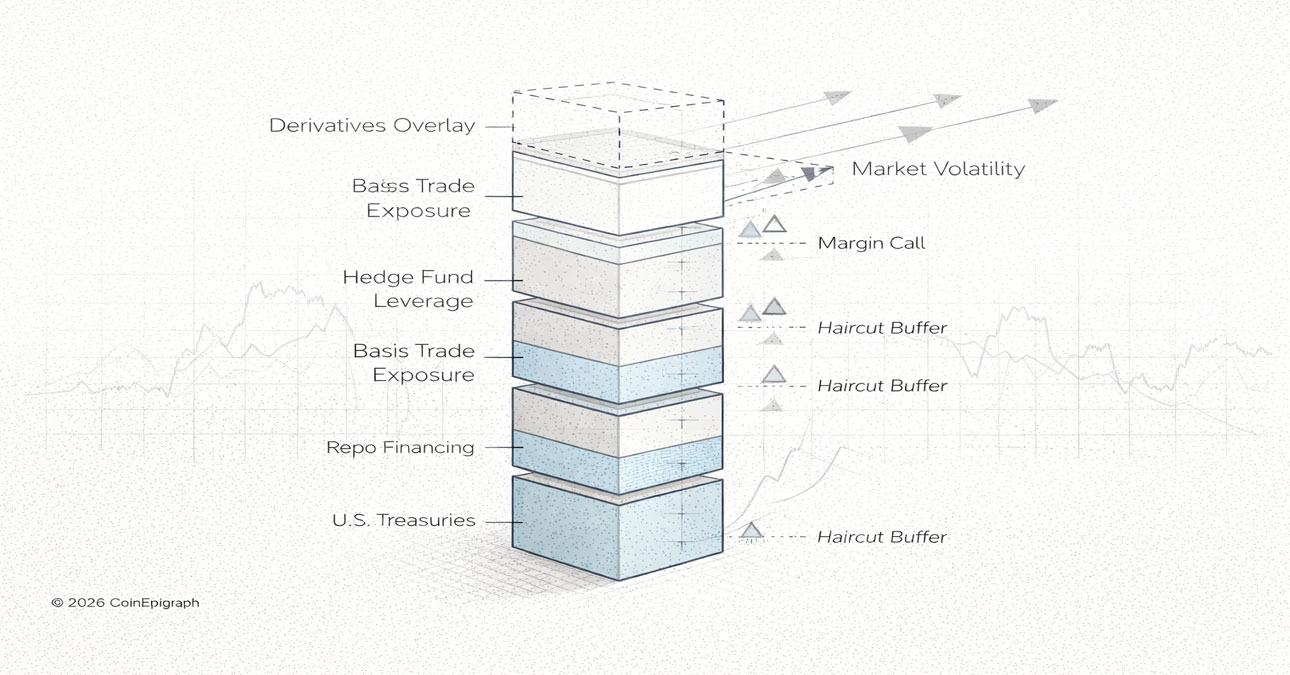
Modern markets are layered:
- Cash Treasury markets
- Futures markets
- Repo funding channels
- Derivatives overlays
When funding lines tighten, the transmission channel can move faster than the underlying asset reprices.
Liquidity evaporation, not credit deterioration, becomes the trigger.
Does This Imply Crisis?
Structural vulnerability is not inevitability.
Today’s environment differs from 2019 in several respects:
- Central banks are more attuned to funding market fragility.
- Standing repo facilities exist in some jurisdictions.
- Regulatory awareness has increased.
However, higher structural leverage combined with thin haircuts increases sensitivity to volatility.
The repo market does not need to “collapse” to influence broader conditions.
A modest funding shock can:
- Tighten financial conditions
- Force asset sales
- Compress basis spreads
- Influence Treasury yields
- Spill into risk asset pricing
When funding stress emerges in the safest asset class in the world, the signal carries weight.
Why This Matters Beyond Bonds
Treasuries serve as global collateral.
If Treasury repo funding tightens:
- Bank balance sheets adjust
- Hedge fund leverage compresses
- Risk parity strategies recalibrate
- Liquidity premia widen
Digital assets, equities, and credit markets all exist downstream from funding conditions.
Liquidity is not sector-specific.
It is systemic.
The Structural Question
The repo market’s size alone does not determine fragility.
Buffer design does.
High leverage with adequate haircuts can remain stable.
High leverage without safety margins becomes sensitive to volatility shocks.
The FSB report does not predict crisis. It identifies vulnerabilities.
Those vulnerabilities resemble features present prior to 2019 — though on a larger scale.
The appropriate framing is not alarm.
It is monitoring.

A Funding Market in an Era of Structural Repricing
As fiscal deficits expand and Treasury issuance grows, dealer balance sheets carry more inventory.
As hedge funds seek yield in compressed environments, basis trades proliferate.
As liquidity concentrates, buffers thin.
Funding markets do not fail because of headlines.
They strain because of structure.
The repo market is not dramatic. It is infrastructural.
But when infrastructure tightens, asset prices respond.
The question is not whether leverage exists.
It is whether the buffer is sufficient when volatility returns.
At CoinEpigraph, we are committed to delivering digital-asset journalism with clarity, accuracy, and uncompromising integrity. Our editorial team works daily to provide readers with reliable, insight-driven coverage across an ever-shifting crypto and macro-financial landscape. As we continue to broaden our reporting and introduce new sections and in-depth op-eds, our mission remains unchanged: to be your trusted, authoritative source for the world of crypto and emerging finance.
— Ian Mayzberg, Editor-in-Chief
The team at CoinEpigraph.com is committed to independent analysis and a clear view of the evolving digital asset order.
To help sustain our work and editorial independence, we would appreciate your support of any amount of the tokens listed below. Support independent journalism:
BTC: 3NM7AAdxxaJ7jUhZ2nyfgcheWkrquvCzRm
SOL: HxeMhsyDvdv9dqEoBPpFtR46iVfbjrAicBDDjtEvJp7n
ETH: 0x3ab8bdce82439a73ca808a160ef94623275b5c0a
XRP: rLHzPsX6oXkzU2qL12kHCH8G8cnZv1rBJh TAG – 1068637374
SUI – 0xb21b61330caaa90dedc68b866c48abbf5c61b84644c45beea6a424b54f162d0c
and through our Support Page.
🔍 Disclaimer: CoinEpigraph is for entertainment and information, not investment advice. Markets are volatile — always conduct your own research.
COINEPIGRAPH™ does not offer investment advice. Always conduct thorough research before making any market decisions regarding cryptocurrency or other asset classes. Past performance is not a reliable indicator of future outcomes. All rights reserved | 版权所有 ™ © 2024-2029.