


Markets move on belief—
until they are forced to move on limits.
By CoinEpigraph Editorial Desk | April 23, 2026
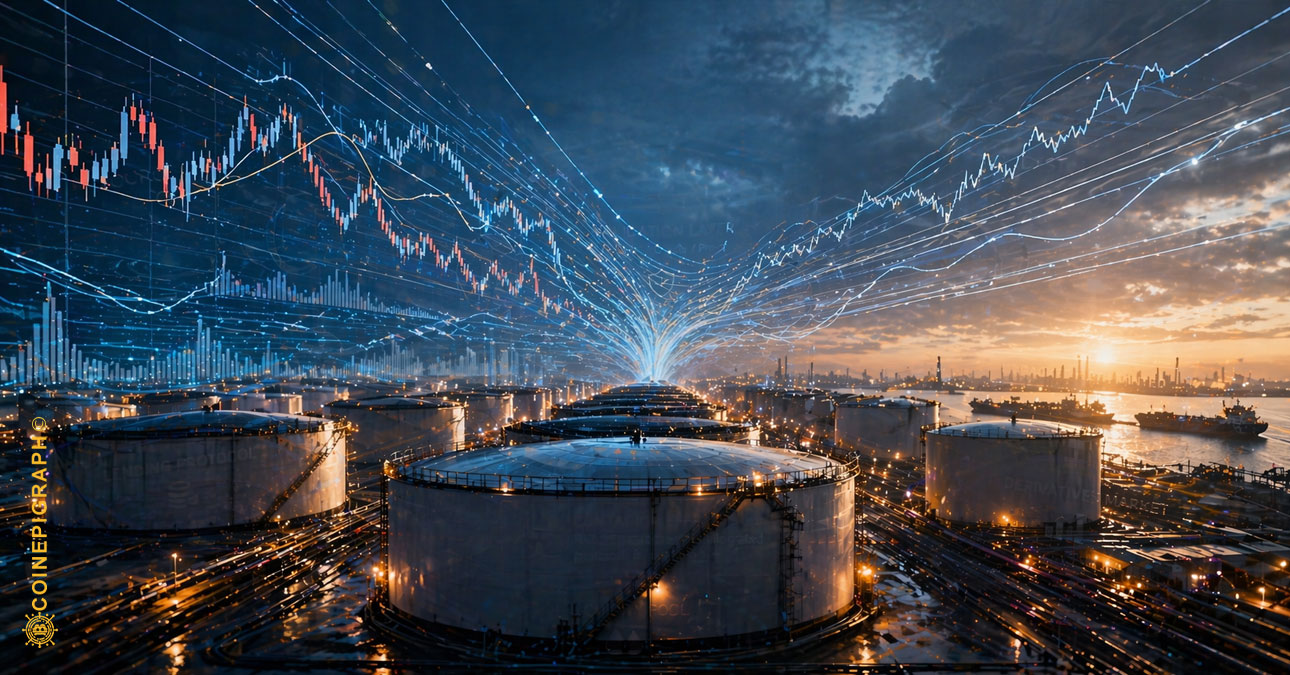
Oil is one of the most actively traded financial assets in the world, yet it remains fundamentally physical. When large-scale positioning in futures and derivatives converges with real-world constraints—storage, transport, and delivery—markets can shift abruptly from continuous pricing to discontinuous repricing. This intersection defines the moments when volatility accelerates and liquidity disappears.
The Two Markets That Are One
Oil is often described as having both a “paper market” and a physical market. In practice, these are not separate systems—they are two expressions of the same system operating at different speeds.
The financial layer—futures, options, and swaps—trades continuously on venues such as CME Group. It is deep, liquid, and responsive. Prices adjust in real time to expectations, positioning, and macro signals.
The physical layer moves differently.
Barrels must be stored, transported, and delivered. Infrastructure—pipelines, tank farms, and shipping routes—introduces constraints that cannot adjust instantaneously. Capacity exists in finite form.
Under normal conditions, these layers remain aligned.
Under stress, they diverge.
Where the Collision Occurs
The point of tension is not theoretical. It is mechanical.
Futures contracts ultimately converge toward physical settlement—either through delivery or position rollover. When positioning grows large relative to the system’s ability to absorb or deliver barrels, the alignment between financial pricing and physical reality is tested.
This is where collision occurs:
- when long positions outnumber deliverable supply
- when short positions rely on access to constrained inventory
- when storage or transport capacity is fully utilized
At that point, price ceases to reflect expectation.
It begins to reflect constraint.
Liquidity as Illusion
In financial markets, liquidity is often assumed to be abundant. Orders can be placed, positions can be scaled, and exposure can be adjusted with minimal friction.
That assumption holds—until it doesn’t.
Liquidity in futures markets is conditional. It depends on the ability of counter-parties to absorb risk and, ultimately, on the system’s capacity to reconcile contracts with physical settlement.
When that capacity is strained, liquidity becomes fragile.
It does not fade gradually.
It withdraws.
The transition from liquid to illiquid is not linear.
It is abrupt.
The Moment of Repricing
What happens when paper positioning cannot be reconciled with physical limits?
The market does not adjust smoothly.
It reprices.
Repricing in this context is not a directional move. It is a structural shift:
- bid-ask spreads widen
- price gaps emerge
- volatility accelerates
- participants exit positions not by choice, but by necessity
The most visible expression of this dynamic occurred during the 2020 WTI negative oil price event, when front-month futures traded below zero. The underlying cause was not a collapse in the value of oil itself, but a constraint in storage capacity at the delivery point.
The system could not absorb additional barrels.
Contracts became liabilities.
Feedback and Acceleration
Once the collision begins, it feeds on itself.
- rising volatility forces position reduction
- position reduction removes liquidity
- reduced liquidity amplifies price movement
This reflexive loop compresses time.
Events that might otherwise unfold over days or weeks can occur within hours. The system transitions from price discovery to forced adjustment.
Markets stop negotiating value.
They begin enforcing limits.
Capital Markets Implication
For capital markets, this dynamic extends beyond oil.
Any system where:
- financial exposure exceeds underlying capacity
- liquidity depends on continuous participation
- settlement ultimately requires real-world reconciliation
is susceptible to similar dislocations.
The distinction between paper liquidity and real capacity is not unique to commodities. It appears in:
- leveraged financial products
- structured credit
- digital asset markets
Understanding where that distinction exists—and how it resolves under stress—is central to risk assessment.

Closing Signal: Where Markets Become Real
Markets operate efficiently as long as belief and capacity remain aligned.
The paper layer allows for continuous expression of expectation.
The physical layer enforces the boundaries of possibility.
When those layers diverge, the market is forced to reconcile them.
That reconciliation does not occur gradually.
It occurs at the point where contracts meet constraint.
The question is not whether such moments will happen.
They are inherent to the system.
The question is where the next constraint will emerge—
and how much positioning will be forced to adjust when it does.
At CoinEpigraph, we are committed to delivering digital-asset journalism with clarity, accuracy, and uncompromising integrity. Our editorial team works daily to provide readers with reliable, insight-driven coverage across an ever-shifting crypto and macro-financial landscape. As we continue to broaden our reporting and introduce new sections and in-depth op-eds, our mission remains unchanged: to be your trusted, authoritative source for the world of crypto and emerging finance.
— Ian Mayzberg, Editor-in-Chief
The team at CoinEpigraph.com is committed to independent analysis and a clear view of the evolving digital asset order.
To help sustain our work and editorial independence, we would appreciate your support of any amount of the tokens listed below. Support independent journalism:
BTC: 3NM7AAdxxaJ7jUhZ2nyfgcheWkrquvCzRm
SOL: HxeMhsyDvdv9dqEoBPpFtR46iVfbjrAicBDDjtEvJp7n
ETH: 0x3ab8bdce82439a73ca808a160ef94623275b5c0a
XRP: rLHzPsX6oXkzU2qL12kHCH8G8cnZv1rBJh TAG – 1068637374
SUI – 0xb21b61330caaa90dedc68b866c48abbf5c61b84644c45beea6a424b54f162d0c
and through our Support Page.
🔍 Disclaimer: CoinEpigraph is for entertainment and information, not investment advice. Markets are volatile — always conduct your own research.
COINEPIGRAPH™ does not offer investment advice. Always conduct thorough research before making any market decisions regarding cryptocurrency or other asset classes. Past performance is not a reliable indicator of future outcomes. All rights reserved | 版权所有 ™ © 2024-2029.