


The Early Activity on Robinhood Chain Reveals a Familiar Truth About New Financial Networks: Infrastructure Creates Capacity, but Culture Often Creates the First Wave of Demand
By CoinEpigraph Editorial Desk
Robinhood Chain was built with ambitions extending far beyond speculative tokens. Its architecture points toward tokenized securities, real-world assets, continuous markets, lending, and programmable finance. Yet early trading activity has delivered a familiar reminder from crypto’s history: sophisticated infrastructure may attract institutions, but memes can mobilize retail liquidity with remarkable speed.
Robinhood spent years building one of the most recognizable gateways between retail investors and financial markets.
Now it is attempting something considerably larger.
Robinhood Chain moves the company beyond operating an application through which customers access markets. It creates an opportunity for Robinhood to participate in the infrastructure upon which future markets themselves may operate.
The public mainnet, launched July 1, is built using Arbitrum technology and designed around tokenized assets, on-chain applications, and high-speed settlement. Robinhood describes the network as permissionless, EVM-compatible, capable of 100-millisecond block times, and intended to support everything from trading and lending to tokenized real-world assets and AI-agent transactions.
That is the institutional vision.
Then retail arrived.
And once again, memes demonstrated how quickly culture can turn infrastructure into a marketplace.
A Financial Blockchain Meets Crypto’s Attention Economy
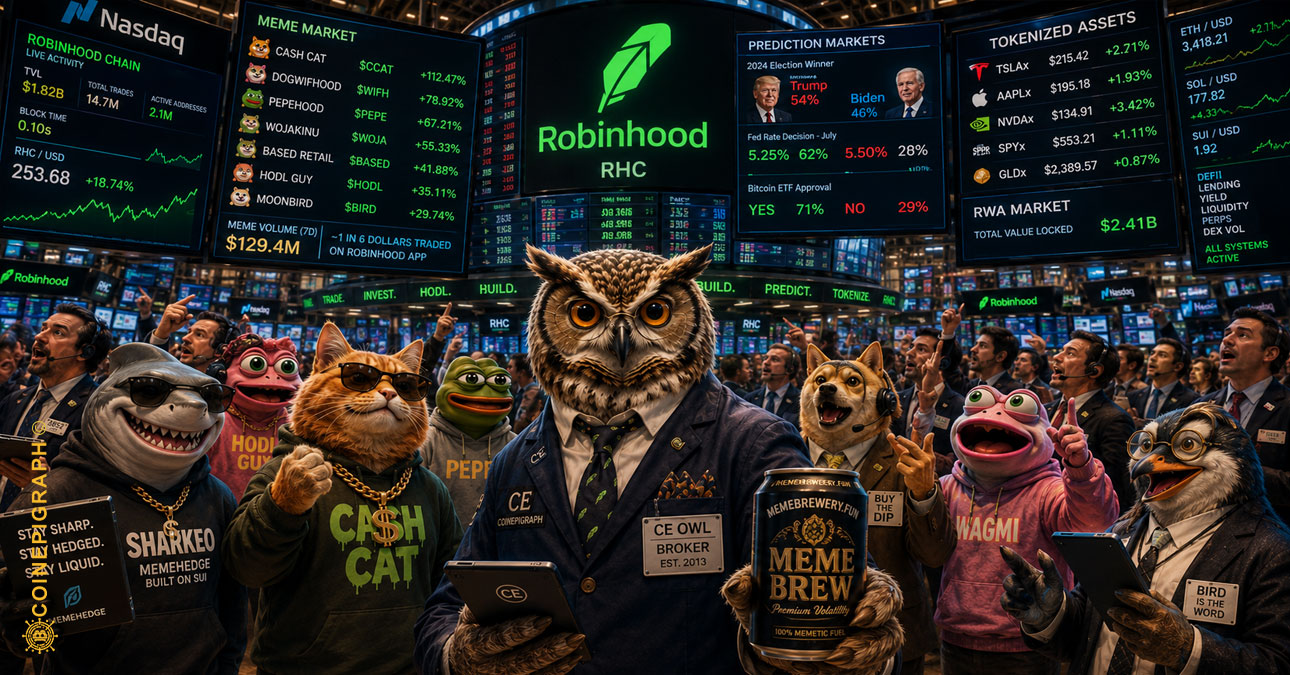
Early trading surrounding Cash Cat and other meme assets has reportedly produced substantial volume, with figures circulating around $129 million during the network’s opening week and claims that meme activity approached roughly one dollar of every six traded through the relevant Robinhood environment.
Those precise ratios should be treated cautiously until Robinhood or comprehensive on-chain analytics independently confirms them. But the broader activity is difficult to dismiss. Cash Cat alone emerged rapidly as a heavily traded asset, while early reports around Robinhood Chain point toward hundreds of millions of dollars in decentralized-exchange activity.
The significance is not that another meme token became popular.
Crypto has seen that before.
The significance is where the activity appeared.
Robinhood Chain was conceived as infrastructure capable of supporting a considerably more sophisticated financial future. Its stated ambitions include tokenized real-world assets, Stock Tokens, lending, yield, self-custody, seamless asset movement and an open environment for developers.
Yet some of its earliest visible velocity has come from one of crypto’s least institutional asset classes.
That apparent contradiction may reveal more about market structure than it does about memes.
Markets Need Infrastructure. Networks Need Reasons to Transact.
A blockchain can be technically exceptional and economically quiet.
Throughput does not create demand.
Low fees do not create communities.
Fast settlement does not guarantee liquidity.
Infrastructure creates the possibility of activity. Something else must persuade participants to use it.
Throughout crypto’s development, speculative markets have repeatedly performed that function.
Ethereum’s early growth was accelerated by token issuance.
DeFi expanded through liquidity incentives and yield markets.
NFTs brought entirely new communities on-chain.
Solana demonstrated how memes could generate extraordinary transaction activity while introducing large numbers of retail participants to decentralized exchanges, wallets, liquidity pools and token creation.
Robinhood Chain may now be encountering its own version of that pattern.
The institutional future can be built around tokenized securities.
The first traffic does not have to be.
The One-in-Six Question
If the reported one-in-six-dollar ratio proves durable—or even approximately representative of the network’s early activity—it deserves attention beyond the meme market.
A ratio of that magnitude would demonstrate that speculative assets are not merely peripheral entertainment surrounding the financial infrastructure.
They are contributing materially to its transactional economy.
That creates a more complicated relationship between speculation and infrastructure.
Memes generate turnover.
Turnover generates fees and liquidity opportunities.
Liquidity attracts market makers.
Active markets attract developers.
Developers create applications.
Applications expand the utility of the network.
None of this means meme speculation automatically produces sustainable economic value. Most newly created tokens will never develop lasting markets, and extraordinary trading volume can disappear as rapidly as it arrives.
But transaction velocity has value to a young network.
The first challenge confronting any new financial infrastructure is not merely building capacity.
It is overcoming emptiness.
Robinhood Begins With Something Most New Chains Spend Years Trying to Build
Most blockchain networks launch with technology first and users second.
They build the chain.
Fund developer programs.
Incentivize liquidity.
Attract applications.
Then spend years attempting to assemble a sufficiently large community to make the network economically relevant.
Robinhood enters from the opposite direction.
The company brings an existing base of roughly 25 million to 27 million funded or customer accounts, depending on the reporting metric and period, connected to an established financial platform. More importantly, those customers already operate within a regulated environment built around identity verification and financial-market participation.
That is not simply an audience.
It is distribution infrastructure.
A new blockchain-native application typically begins by asking users to discover the product, create or connect a wallet, acquire assets, navigate a bridge, understand network fees, and finally complete a transaction.
Robinhood has the potential to compress much of that journey.
Its customers already arrive with an established financial relationship. They already understand the interface. Many already trade equities, options, cryptocurrencies, futures, or prediction markets. The distance between discovering an asset and transacting can therefore become dramatically shorter.
This changes the economics of launching a blockchain.
Robinhood Chain does not necessarily have to spend years searching for its first millions of potential participants. A substantial population already exists at the edge of the infrastructure.
The question is how effectively Robinhood can bring them on-chain.
And that makes the early meme activity considerably more significant.
If reports that meme trading has represented roughly one dollar in every six of early activity prove accurate, then memes are not merely arriving on a newly launched blockchain. They are encountering a financial distribution network with tens of millions of existing customers.
That combination is unusual.
Infrastructure provides capacity.
Distribution provides access.
Memes provide attention.
When all three exist simultaneously, network effects can develop much faster than they would on a conventional blockchain launch.
This also sharpens the point relevant to the broader launchpad market—including the ecosystem we’re building around our own two meme launchers. Token creation is rapidly becoming commoditized. Distribution and transaction velocity are not.
The strategic lesson is not to imitate Robinhood. Few platforms can arrive with tens of millions of existing financial customers. The lesson is that a launcher must develop its own equivalent of distribution: communities, recurring discovery, cross-platform circulation, creator incentives, liquidity pathways, and reasons for traders to return after the launch itself.
The Infrastructure and the Casino Can Occupy the Same Block
Financial markets have always contained speculation.
Options markets serve sophisticated hedging strategies and highly speculative short-term trades simultaneously.
Equity exchanges finance productive enterprises while accommodating momentum traders.
Commodity markets support commercial risk management alongside leveraged speculation.
The presence of speculative activity does not invalidate financial infrastructure.
The question is whether infrastructure can transform temporary activity into a durable ecosystem.
Robinhood now faces that test.
If meme trading merely produces an explosive opening period before liquidity migrates elsewhere, the activity will become another episode in crypto’s long history of speculative rotations.
If those traders remain, explore other assets, provide liquidity, use applications and create persistent transaction demand, memes may have performed a more consequential function.
They may have helped bootstrap the network.
A Complicated Lesson for Token Launchers
There is also a lesson here for the broader token-launch economy.
Meme launchers frequently compete as though the primary product is token creation.
It is not.
Creating a token has become almost frictionless.
The scarce resources are attention, distribution, liquidity and recurring transaction activity.
A successful launcher therefore cannot merely make creation easier. It must create an environment in which communities have reasons to form, markets have reasons to remain active, and traders have reasons to return after the initial speculation fades.
Robinhood’s advantage is not simply that it now operates blockchain infrastructure.
It possesses distribution.
That distinction should matter to every launchpad, exchange and emerging network attempting to compete for the next generation of retail activity.
The strongest platforms may ultimately be those capable of converting cultural attention into sustained financial participation.

The Two Robinhoods Are Beginning to Converge
Robinhood Chain should not be judged by its first week of meme trading.
Its larger ambitions are considerably more important.
Robinhood began issuing Stock Tokens in Europe before the launch of its own chain, initially using Arbitrum while planning for its proprietary Layer 2 to support a broader tokenized financial environment. The company has now launched a network explicitly designed to extend that architecture into an open ecosystem.
That creates two parallel forces.
From above, institutions are moving toward tokenization, programmable assets and continuous settlement.
From below, retail participants are bringing speculation, memes and cultural liquidity.
Robinhood Chain sits between them.
That may ultimately be more important than whether Cash Cat, or any individual meme, survives the next market cycle.
The experiment underway is whether one financial environment can accommodate the speculative energy that has historically driven crypto adoption while simultaneously building infrastructure capable of supporting tokenized global markets.
If it can, Robinhood will have accomplished something considerably more consequential than launching another Layer 2.
It will have begun connecting two markets that financial institutions have traditionally treated as separate.
One is driven by assets.
The other is driven by attention.
Modern digital markets increasingly require both.
Robinhood built the rails for the future of finance.
The first passengers may simply be telling us something about how that future actually arrives.
At CoinEpigraph, we are committed to delivering digital-asset journalism with clarity, accuracy, and uncompromising integrity. Our editorial team works daily to provide readers with reliable, insight-driven coverage across an ever-shifting crypto and macro-financial landscape. As we continue to broaden our reporting and introduce new sections and in-depth op-eds, our mission remains unchanged: to be your trusted, authoritative source for the world of crypto and emerging finance.
— Ian Mayzberg, Editor-in-Chief
The team at CoinEpigraph.com is committed to independent analysis and a clear view of the evolving digital asset order.
To help sustain our work and editorial independence, we would appreciate your support of any amount of the tokens listed below. Support independent journalism:
BTC: 3NM7AAdxxaJ7jUhZ2nyfgcheWkrquvCzRm
SOL: HxeMhsyDvdv9dqEoBPpFtR46iVfbjrAicBDDjtEvJp7n
ETH: 0x3ab8bdce82439a73ca808a160ef94623275b5c0a
XRP: rLHzPsX6oXkzU2qL12kHCH8G8cnZv1rBJh TAG – 1068637374
SUI – 0xb21b61330caaa90dedc68b866c48abbf5c61b84644c45beea6a424b54f162d0c
and through our Support Page.
🔍 Disclaimer: CoinEpigraph is for entertainment and information, not investment advice. Markets are volatile — always conduct your own research.
COINEPIGRAPH™ does not offer investment advice. Always conduct thorough research before making any market decisions regarding cryptocurrency or other asset classes. Past performance is not a reliable indicator of future outcomes. All rights reserved | 版权所有 ™ © 2024-2029.