


How Dual-Class IPOs Quietly Rewrote the Relationship Between Founders and Public Investors
By CoinEpigraph Editorial Desk
Public markets were built around a relatively intuitive bargain: investors provide capital, receive ownership, and gain a voice proportional to their stake. Dual-class share structures altered that equation. As founder-controlled companies, private markets, and tokenized securities reshape capital formation, the separation between economic ownership and actual control is becoming increasingly important to understand.
For generations, the idea of owning stock carried an apparently straightforward meaning.
An investor purchased a piece of a company.
That ownership provided participation in its economic fortunes and, through voting rights, some measure of influence over its governance. The larger the ownership position, the greater that influence generally became.
One share.
One vote.
The principle was never universal, but it created an intuitive relationship between financial risk and corporate authority.
Dual-class share structures changed that relationship.
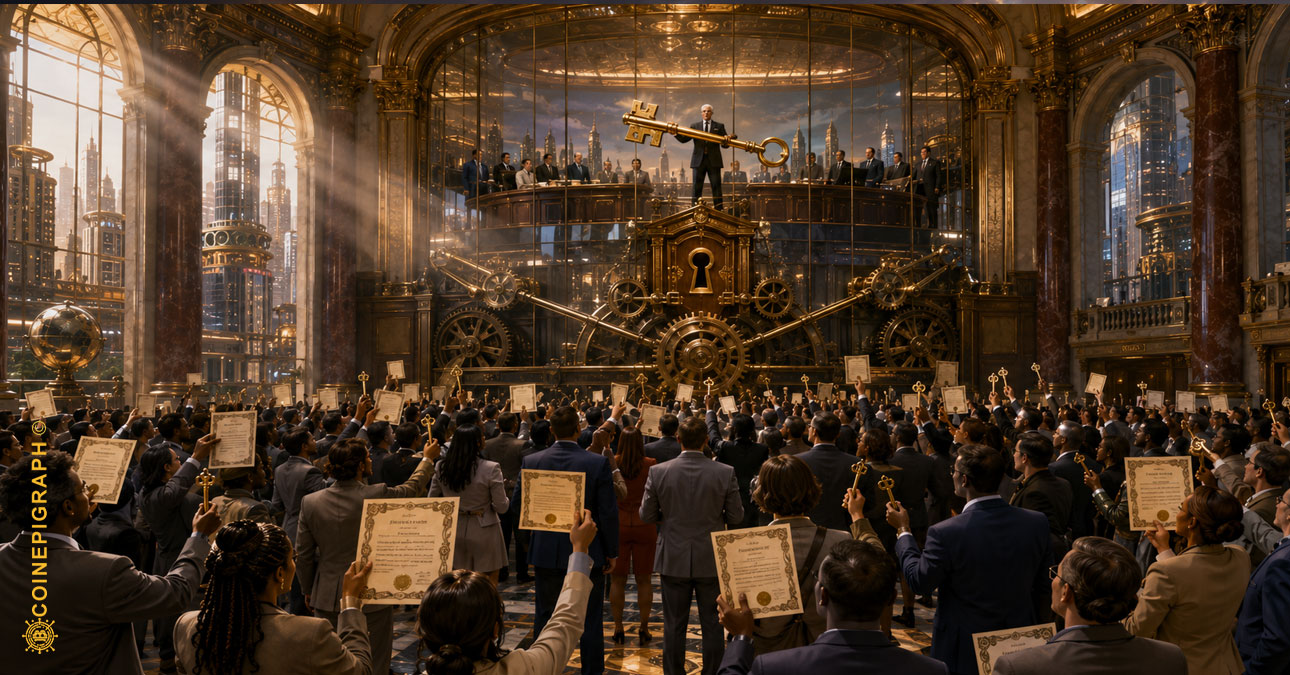
Under these arrangements, companies issue different classes of common stock carrying unequal voting rights. Public investors may receive one vote for each share they purchase, while founders and insiders hold another class carrying ten, twenty, or potentially more votes per share.
The economics can remain similar.
The power does not.
A founder can therefore own a minority of the company’s outstanding equity while retaining effective control over its board, strategic direction, and potentially its future long after outside investors provide most of its public capital.
The arrangement raises a question that reaches well beyond corporate governance.
What exactly does ownership mean when economic participation and control no longer travel together?
The Debate Is Older Than Silicon Valley
Dual-class structures are often associated with modern technology founders, but the tension surrounding unequal voting rights predates the digital economy by nearly a century.
During the early development of American public markets, companies experimented with structures that allowed controlling shareholders to raise capital without surrendering authority. The practice became controversial enough that major exchanges eventually placed significant restrictions on companies issuing nonvoting common stock.
The underlying concern was simple.
If investors supplied capital and absorbed economic losses, should they also possess a meaningful voice in how the company was governed?
The question never disappeared.
Family-controlled companies, media organizations, and other businesses continued using variations of concentrated voting structures to preserve strategic or editorial independence.
What changed decades later was the scale.
Technology companies transformed dual-class ownership from an unusual governance arrangement into a powerful instrument of founder control.
Silicon Valley Changed the Bargain
The modern argument for dual-class structures emerged from a legitimate concern about public markets.
Building transformative companies can take years.
Public investors can be impatient.
Quarterly earnings expectations, activist campaigns, and short-term market pressures can conflict with strategies requiring enormous investment and uncertain returns.
Founder-controlled voting structures offered protection.
Google’s 2004 public offering became an important milestone in that evolution. Its founders defended a governance structure designed to preserve the company’s ability to pursue long-term objectives without allowing short-term market pressure to dictate every strategic decision.
Other technology companies followed.
The implicit bargain changed.
Investors could participate in the company’s economic growth.
They simply could not assume that economic ownership would translate into proportional control.
For companies with extraordinary growth prospects, markets frequently accepted the arrangement.
Capital wanted access.
Founders had leverage.
The Founder Becomes an Institution
Dual-class structures become more consequential as companies mature.
A founder with superior voting shares may retain control even as their economic ownership declines through new stock issuance, employee compensation, acquisitions, and personal share sales.
The company can become increasingly owned by the public while remaining governed by a comparatively small group.
That creates an unusual corporate architecture.
Economic risk becomes dispersed.
Authority remains concentrated.
Supporters see continuity.
A founder protected from short-term pressure can pursue strategies that conventional management teams might abandon. Expensive investments can be made without immediate returns. Unpopular decisions can survive temporary market resistance.
Critics see a different danger.
The same structure protecting a visionary founder can protect an ineffective one.
Markets have mechanisms for correcting poor leadership when voting power follows ownership. Those mechanisms become considerably weaker when control is structurally insulated from the shareholders carrying most of the economic exposure.
Dual-class structures therefore solve one governance problem by creating another.
They protect companies from shareholder short-termism.
They can also protect controlling shareholders from accountability.
Public Capital Without Public Control
The most revealing development may be how comfortable modern capital markets have become with that trade.
Investors routinely purchase shares in companies where their collective economic ownership substantially exceeds their practical governance influence.
In extreme structures, public shareholders may possess little or no voting authority at all.
This suggests that the public market has gradually begun separating two concepts once assumed to belong together.
Ownership as economic participation.
Ownership as control.
A shareholder may receive the first without meaningfully possessing the second.
That distinction becomes increasingly important as financial markets evolve beyond conventional equities.
Ownership Is Being Unbundled
The transformation underway across digital finance makes the dual-class debate more relevant, not less.
Tokenized securities can represent economic interests on programmable networks.
Governance tokens can provide voting authority without conventional equity ownership.
Exchange-traded products can provide financial exposure to assets investors do not directly possess.
Private-market platforms are expanding access to companies before traditional public offerings.
Decentralized organizations experiment with entirely different mechanisms for distributing governance.
Each structure separates and recombines familiar characteristics of ownership.
Economic rights.
Voting rights.
Custody.
Access.
Transferability.
Governance.
Control.
These characteristics were once commonly packaged together. Increasingly, financial engineering allows them to be divided and distributed independently.
Dual-class shares were an early expression of that evolution.
The difference is that the broader financial system may now be moving much further in the same direction.
The Question of Time
One possible compromise has emerged through sunset provisions.
Under these arrangements, founders receive enhanced voting rights for a defined period or until specific conditions are reached. The structure acknowledges that concentrated control may benefit a company during its formative years without assuming that extraordinary voting authority should continue indefinitely.
The concept introduces another important question.
At what point does a founder’s creation become a public institution?
There is no simple answer.
A company may owe its existence to the vision of its founder while eventually employing tens of thousands of people, managing enormous amounts of public capital, and becoming deeply embedded within the wider economy.
The founder built the institution.
Public investors increasingly own it.
Dual-class structures determine which of those realities ultimately governs.

The Meaning of a Share Is Changing
The debate surrounding dual-class IPOs is not fundamentally about whether founders are good stewards or public shareholders make better decisions.
History provides ample evidence of failure on both sides.
The larger issue concerns the architecture of ownership itself.
Modern capital markets increasingly allow investors to separate exposure from possession, economics from governance, and ownership from control.
That evolution may accelerate as tokenization introduces even greater flexibility into how financial rights are designed and distributed.
The share certificate once represented a relatively understandable bundle of claims.
The future may be considerably more fragmented.
Investors may own the economics of an asset without controlling it.
They may govern a network without owning conventional equity.
They may gain exposure without possessing the underlying asset.
They may provide capital without receiving proportional authority.
None of these arrangements is inherently defective.
But each requires a clearer understanding of what, precisely, is being purchased.
Because as financial markets become increasingly programmable, the most important question may no longer be whether an investor owns something.
It may be which rights that ownership actually contains.
At CoinEpigraph, we are committed to delivering digital-asset journalism with clarity, accuracy, and uncompromising integrity. Our editorial team works daily to provide readers with reliable, insight-driven coverage across an ever-shifting crypto and macro-financial landscape. As we continue to broaden our reporting and introduce new sections and in-depth op-eds, our mission remains unchanged: to be your trusted, authoritative source for the world of crypto and emerging finance.
— Ian Mayzberg, Editor-in-Chief
The team at CoinEpigraph.com is committed to independent analysis and a clear view of the evolving digital asset order.
To help sustain our work and editorial independence, we would appreciate your support of any amount of the tokens listed below. Support independent journalism:
BTC: 3NM7AAdxxaJ7jUhZ2nyfgcheWkrquvCzRm
SOL: HxeMhsyDvdv9dqEoBPpFtR46iVfbjrAicBDDjtEvJp7n
ETH: 0x3ab8bdce82439a73ca808a160ef94623275b5c0a
XRP: rLHzPsX6oXkzU2qL12kHCH8G8cnZv1rBJh TAG – 1068637374
SUI – 0xb21b61330caaa90dedc68b866c48abbf5c61b84644c45beea6a424b54f162d0c
and through our Support Page.
🔍 Disclaimer: CoinEpigraph is for entertainment and information, not investment advice. Markets are volatile — always conduct your own research.
COINEPIGRAPH™ does not offer investment advice. Always conduct thorough research before making any market decisions regarding cryptocurrency or other asset classes. Past performance is not a reliable indicator of future outcomes. All rights reserved | 版权所有 ™ © 2024-2029.