


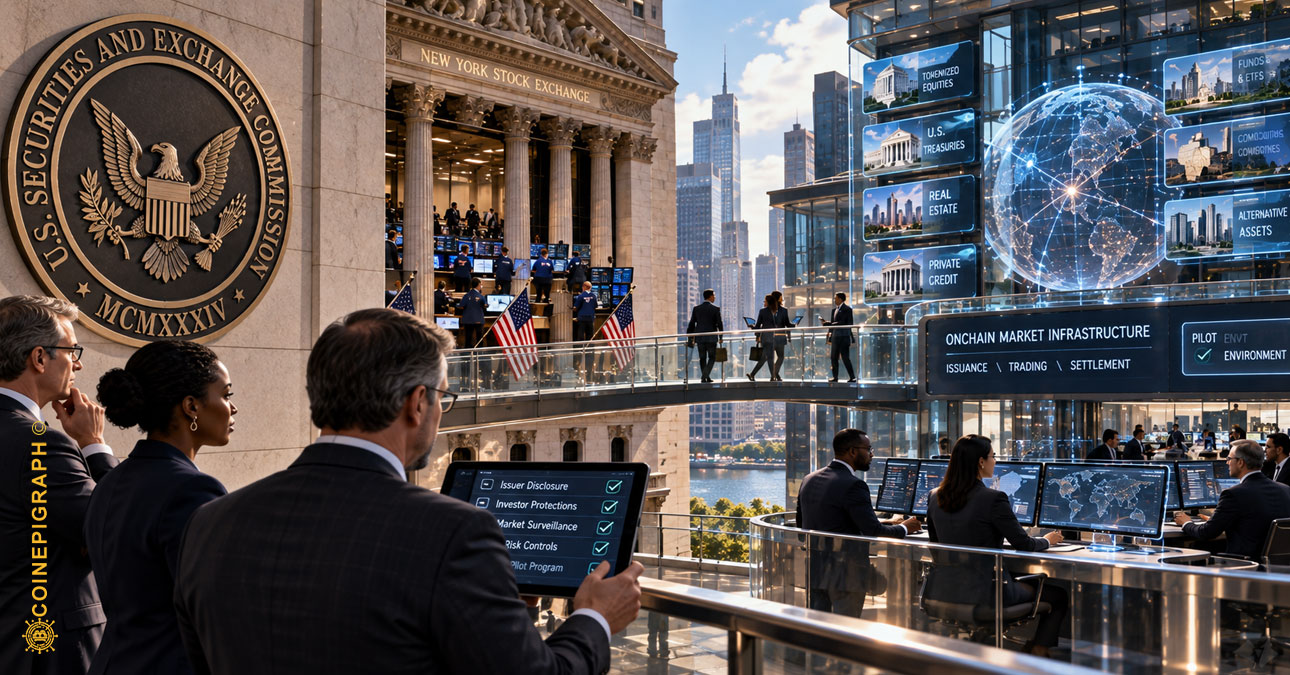
A five-year exemption for tokenized U.S. stocks does more than move securities onto blockchains. It gives regulated markets room to test automated market makers and liquidity pools on public networks, placing programmable market infrastructure alongside the traditional architecture of American equities.
By CoinEpigraph Editorial Desk
For most of modern market history, changing the form of a security did not necessarily change the machinery through which it traded.
Paper certificates became electronic records. Trading floors became screens. Settlement became increasingly automated. Orders moved faster, clearing became more sophisticated and the physical infrastructure of Wall Street gradually disappeared behind software.
Yet much of the institutional architecture remained recognizable. Exchanges brought buyers and sellers together. Brokers provided access. Market makers supplied liquidity. Clearing and settlement completed the transaction.
Tokenization has often been presented as the next stage of that technological progression: put the security on a blockchain, improve settlement, extend trading hours and make ownership more programmable.
The Securities and Exchange Commission is now allowing an experiment that reaches deeper.
On September 17, the SEC granted temporary conditional relief allowing qualifying Tokenized Securities Venues, or TSVs, to facilitate trading in tokenized National Market System stocks through permissioned automated market makers and liquidity pools. The exemption lasts five years and includes conditional relief not only from the Exchange Act definition of an exchange, but also from dealer registration for certain firms supplying proprietary capital to those pools.
The stock becoming programmable is one development.
The market around the stock becoming programmable is another.
The Experiment Is Narrow by Design
The SEC has not opened an unrestricted blockchain market for U.S. equities.
The exemption applies to tokenized NMS stocks and imposes a controlled framework around their secondary trading. Participants must meet access requirements. Venues must satisfy disclosure, recordkeeping, technology, transparency and trading-stoppage conditions. Anti-fraud and anti-manipulation provisions continue to apply. The program also contains symbol and trading-volume limits intended to constrain the experiment while regulators observe it.
There is another important boundary.
Qualifying tokenized stocks must preserve the rights associated with their conventional counterparts, including dividends and voting rights. Synthetic exposures do not qualify. Issuers also have an opportunity to object to their securities being traded through a TSV.
That distinction matters because the tokenized-equity market is already developing through several different legal structures.
Some products provide economic exposure through debt instruments, wrappers or other claims tied to an underlying security. The SEC’s exemption is aimed at something more specific: tokenized NMS stock carrying the rights and privileges of the traditional security.
The blockchain does not erase the securities architecture underneath the token.
It carries that architecture into a different market environment.
The More Important Change Is the Market Mechanism
Automated market makers are familiar to decentralized finance.
Rather than depending exclusively on the traditional order-book structure in which bids and offers are matched, an AMM can use assets committed to liquidity pools and software-defined pricing mechanisms to facilitate transactions.
The SEC’s order explicitly allows TSVs to use AMM liquidity pools. It also recognizes that those systems need not rely on the constant-product formula associated with early DeFi markets; pricing mechanisms can incorporate external pricing sources and market data.
That makes this more than a tokenization experiment.
It is a market-structure experiment.
Consider the architecture being assembled.
A U.S.-listed equity retains its shareholder rights. Its tokenized form can exist on distributed-ledger infrastructure. Access to the trading venue remains permissioned. Liquidity can be supplied to pools. Smart contracts can participate in determining how transactions occur.
The regulatory perimeter remains.
Parts of the market machinery inside that perimeter begin to change.
That is a more consequential proposition than simply recording shares on a blockchain.
Permissionless Infrastructure Does Not Mean Permissionless Securities Trading
The distinction between infrastructure and access may become one of the defining features of regulated onchain finance.
Public blockchain infrastructure can provide the underlying technological environment while securities trading itself remains subject to identity, eligibility and regulatory controls.
That architecture challenges an increasingly unhelpful binary between traditional finance and decentralized finance.
The SEC itself is careful about the distinction. Commissioner Hester Peirce argued that the order should not simply be characterized as a DeFi exemption. The TSV framework addresses a particular intermediary-based model for trading tokenized securities, while genuinely permissionless peer-to-peer systems raise a different set of regulatory questions.
That qualification is important.
Wall Street is not simply becoming DeFi.
Instead, some mechanisms developed in blockchain markets are beginning to be tested inside regulated financial structures.
The resulting architecture may be neither conventional exchange trading nor unrestricted decentralized finance.
It may become something between them.
The Exchange Is Being Unbundled
That possibility deserves attention because an exchange has historically bundled several functions into a recognizable institutional structure.
It creates a venue. It establishes participation rules. It organizes price discovery. It connects liquidity. It maintains market standards. Surrounding infrastructure handles custody, clearing, settlement, surveillance and record-keeping.
Blockchain architecture makes it possible to reconsider where some of those functions reside.
Settlement can occur through distributed ledgers. Ownership records can become programmable. Smart contracts can execute market rules. Liquidity can sit inside pools rather than solely behind conventional market-maker quotations.
None of this means exchanges disappear.
It means the functions historically concentrated around exchanges can potentially be separated, recombined and distributed across different technological layers.
That is why the SEC’s five-year window matters.
The experiment can begin producing evidence about which functions can move onchain without weakening the protections that developed around conventional securities markets.
Five Years of Market Data
The exemption has another feature that may ultimately prove as important as the trading itself.
TSVs must make dollar-denominated transaction information available, including price, size, transaction time, pool address, end-of-day pool size and daily trading volume. The SEC says those requirements are intended to reduce information asymmetries, facilitate monitoring and help regulators study how securities trading under the exemption actually works.
That turns the five-year period into something approaching a live market laboratory.
Regulators will be able to observe questions that have largely remained theoretical.
How effectively can automated pools price equities?
How much capital will liquidity providers commit?
How tightly will tokenized and conventional markets remain aligned?
What happens to liquidity during volatility?
How do trading halts propagate into onchain markets?
Can public blockchain records improve market surveillance?
And perhaps most importantly, will investors and institutions actually use the infrastructure?
The answers matter because the SEC has explicitly described the exemption as an interim step toward more durable rulemaking. Chairman Paul Atkins said the Commission does not intend to cement today’s technology as tomorrow’s standard. It intends to allow markets to develop while using the resulting experience to inform the regulatory framework that follows.
There is precedent for that approach. Commissioner Mark Uyeda pointed to money-market funds, index funds and exchange-traded funds as products whose development benefited from earlier uses of SEC exemptive authority before regulatory structures matured around them.
The exemption therefore should not be read as a five-year prediction about which technology wins.
It is permission to generate evidence.

Tokenization Is Moving Down the Stack
The progression in tokenized finance is becoming easier to see.
The first question concerned the asset itself.
Can a stock, Treasury security, fund interest or other traditional claim be represented onchain?
The second concerned ownership.
What legal and economic rights does the token actually convey?
Then came composability.
What happens when tokenized traditional assets can interact with smart contracts, liquidity pools and financial applications their original issuers did not design?
The SEC’s exemption introduces another layer.
What happens when the market mechanism itself becomes programmable?
Those questions are connected, but they should not be collapsed into one story.
A tokenized stock is not automatically a new market structure. An AMM is not automatically a replacement for an exchange. Public blockchain infrastructure does not automatically make a market decentralized. And moving settlement onchain does not make the legal claims surrounding the security disappear.
What is changing is the number of financial functions that software can potentially perform.
The Market After the Token
For years, tokenization has been discussed primarily as a transformation of assets.
That framing may eventually prove too narrow.
The larger transformation could occur when the infrastructure surrounding those assets begins changing with them.
A stock can become programmable. Liquidity can become programmable. Market access can be encoded. Trading rules can move into smart contracts. Settlement and ownership records can increasingly occupy the same digital environment in which transactions occur.
The institutional challenge is determining which portions of that architecture can change without losing the protections embedded in the system it is replacing.
The SEC has not answered that question.
It has created an environment in which the market can begin producing evidence.
Five years from now, the most important result of the Innovation Exemption may not be how many U.S. stocks were tokenized or how much volume passed through blockchain venues. It may be what regulators and market participants learned about the functions once assumed to require the traditional exchange.
The stock becoming a token was only the first layer.
The more consequential experiment begins when the market around it becomes software.
At CoinEpigraph, we are committed to delivering digital-asset journalism with clarity, accuracy, and uncompromising integrity. Our editorial team works daily to provide readers with reliable, insight-driven coverage across an ever-shifting crypto and macro-financial landscape. As we continue to broaden our reporting and introduce new sections and in-depth op-eds, our mission remains unchanged: to be your trusted, authoritative source for the world of crypto and emerging finance.
— Ian Mayzberg, Editor-in-Chief
The team at CoinEpigraph.com is committed to independent analysis and a clear view of the evolving digital asset order.
To help sustain our work and editorial independence, we would appreciate your support of any amount of the tokens listed below. Support independent journalism:
BTC: 3NM7AAdxxaJ7jUhZ2nyfgcheWkrquvCzRm
SOL: HxeMhsyDvdv9dqEoBPpFtR46iVfbjrAicBDDjtEvJp7n
ETH: 0x3ab8bdce82439a73ca808a160ef94623275b5c0a
XRP: rLHzPsX6oXkzU2qL12kHCH8G8cnZv1rBJh TAG – 1068637374
SUI – 0xb21b61330caaa90dedc68b866c48abbf5c61b84644c45beea6a424b54f162d0c
and through our Support Page.
🔍 Disclaimer: CoinEpigraph is for entertainment and information, not investment advice. Markets are volatile — always conduct your own research.
COINEPIGRAPH™ does not offer investment advice. Always conduct thorough research before making any market decisions regarding cryptocurrency or other asset classes. Past performance is not a reliable indicator of future outcomes. All rights reserved | 版权所有 ™ © 2024-2029.