


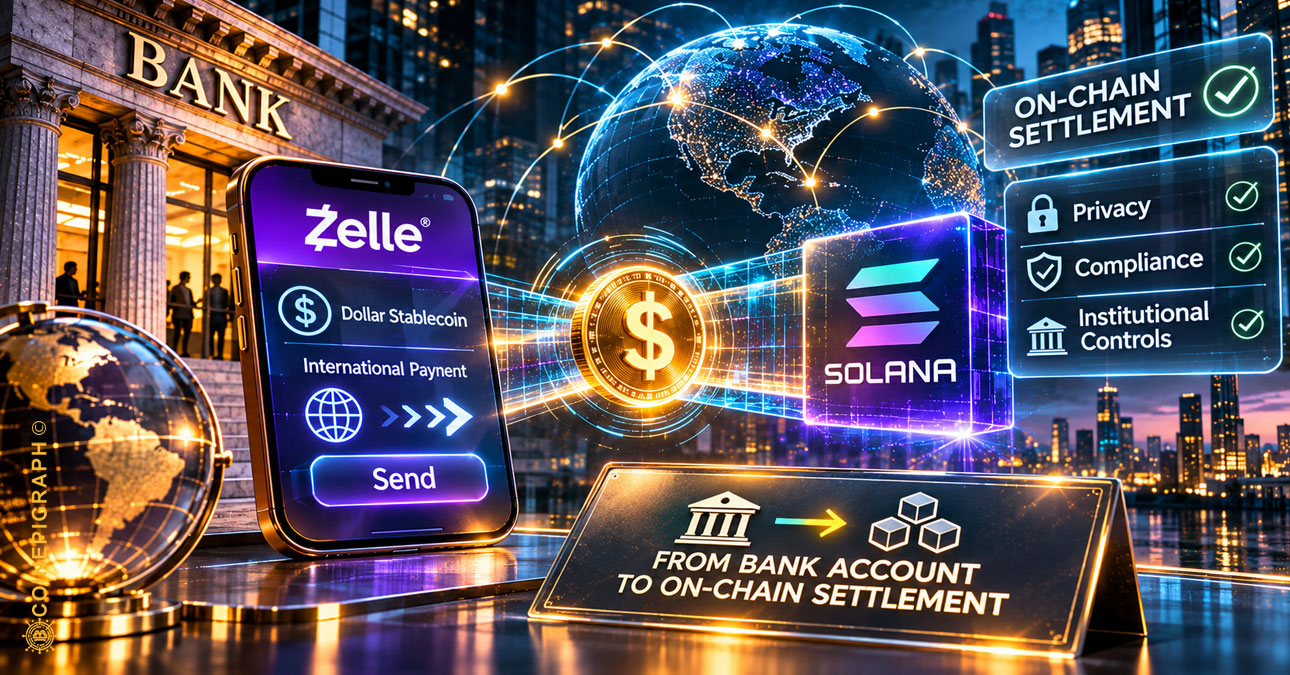
Zelle is preparing a dollar-backed stablecoin for international payments and has selected Solana as part of the infrastructure behind it. A confidential-transfer demonstration at Breakpoint points toward something larger: banks may be able to connect customers to public blockchain settlement without surrendering the privacy, compliance and institutional controls that kept those systems separate.
By CoinEpigraph Editorial Desk
For most people, moving money onto a public blockchain still requires crossing a boundary.
The money begins in a bank account. An exchange or another intermediary receives it. Dollars are converted into a digital asset. The asset can then move into a wallet and onto blockchain infrastructure.
Zelle is experimenting with a different architecture.
Early Warning Services, the bank-owned company that operates Zelle, announced ZelleUSD earlier this year as part of its expansion into international payments. The dollar-backed stablecoin is issued by Anchorage Digital Bank and is redeemable one-for-one for U.S. dollars.
At Solana’s Breakpoint conference in London, Zelle disclosed another piece of the architecture: ZelleUSD will use Solana, and the companies are experimenting with confidential transfers that can conceal transaction amounts from the public blockchain while preserving visibility for authorized institutions.
The demonstration itself was limited. It used test tokens on Solana’s devnet rather than moving customer money on the production network.
But the architecture being tested deserves attention.
Zelle is not a crypto exchange trying to connect itself to banks. It is a payments network owned by Bank of America, Capital One, JPMorgan Chase, PNC, Truist, U.S. Bank and Wells Fargo.
That reverses the direction of travel.
Instead of asking how crypto companies can get closer to the banking system, the more interesting question is what happens when the banking system begins building its own route toward blockchain settlement.
The Boundary Has Always Required a Bridge
Crypto exchanges became important partly because two financial systems developed alongside one another.
Banks held dollars.
Blockchains held digital assets.
Something had to connect them.
Exchanges became one of the principal bridges. A customer could send money from a bank, purchase cryptocurrency or stablecoins and then move those assets into the blockchain economy.
That role was never the entirety of an exchange’s business. Exchanges provide liquidity, execution, custody, asset discovery and other services.
But onboarding became strategically important because it controlled a point of passage between conventional money and blockchain money.
ZelleUSD suggests that passage may become less distinct.
Early Warning says its international strategy is intended to allow consumers to send money abroad through banks and credit unions they already use. India is expected to become Zelle’s first international corridor. ZelleUSD is intended to support future international payment capabilities in other markets.
There is no evidence yet that an ordinary Zelle customer will simply press a button and send bank deposits into an unrestricted self-custodied wallet.
That would be getting ahead of what has actually been announced.
What is visible, however, is the construction of a payment system in which a bank-connected network can originate dollar value and use public blockchain infrastructure as part of the route by which that value moves.
The bank account and the blockchain are beginning to share infrastructure.
Public Does Not Have to Mean Transparent
For financial institutions, moving money on a public blockchain creates an immediate problem.
Public ledgers were designed to make transactions independently verifiable. That transparency is useful for markets and settlement, but it is not necessarily appropriate for ordinary financial activity.
A corporation may not want competitors observing the size of every treasury transfer.
A bank cannot treat customer payment information as something the entire world should be able to inspect.
A consumer sending money to a family member should not have to publish the amount for anyone monitoring the blockchain.
The Breakpoint demonstration addressed precisely that conflict.
Solana’s confidential-balance technology can encrypt transfer amounts and token balances while leaving the underlying accounts visible on the network. The system can also incorporate an auditor key, allowing a designated party to decrypt transaction amounts.
That creates a different privacy model from both conventional public blockchain transactions and completely opaque financial activity.
The public network can verify the transaction without necessarily seeing its value.
The parties can see what they need to see.
An authorized auditor can be given access to information required for oversight.
Privacy, in this model, does not require removing institutional visibility. It changes who receives it.
That distinction may prove more important to financial adoption than raw transaction speed.
Banks Need Selective Visibility
The financial industry’s problem with public blockchains has never been simply that they are public.
The harder problem is that institutions operate under obligations that require different parties to see different information.
A customer should have privacy.
A bank needs enough information to manage risk and meet its legal obligations.
Auditors may require another level of visibility.
Regulators may need access under defined circumstances.
Counterparties need enough information to know that a transaction is valid.
The general public does not necessarily need all of it.
Traditional financial systems solve this largely through databases and institutional access controls. Information resides inside banks, processors, clearing systems and other intermediaries, with permissions determining who can retrieve it.
A public blockchain begins from a different premise: shared infrastructure.
Confidential transactions introduce a way to preserve that shared infrastructure while recreating some of the information boundaries institutions require.
This does not make a public blockchain private.
It makes visibility programmable.
For banks considering public-chain settlement, that could be an important distinction.

ZelleUSD Is Not a Bank Deposit
Another boundary matters.
ZelleUSD should not be confused with money sitting in a customer’s checking account.
It is a dollar-pegged stablecoin issued for Zelle by Anchorage Digital Bank. Anchorage says ZelleUSD is redeemable one-for-one for U.S. dollars and that its reserves are disclosed monthly through attestations provided by a Big Four accounting firm.
The distinction is important because blockchain adoption does not necessarily mean deposits themselves are moving onto public chains.
Different forms of money can be connected while remaining legally and institutionally distinct.
A customer may begin with a bank deposit.
A payment system can convert or represent value through a stablecoin.
The stablecoin can travel across blockchain infrastructure.
Another institution can ultimately deliver local currency or another form of value to the recipient.
What changes is the route.
That is why stablecoins are increasingly interesting to established payment companies. They can become settlement instruments without requiring the consumer to think of the transaction as a cryptocurrency trade.
The blockchain can move underneath the financial product.
The Exchange Does Not Disappear
The Breakpoint commentary surrounding ZelleUSD quickly produced a more dramatic proposition: if banks can connect customers directly to blockchain networks, why would anyone need Coinbase or another exchange?
That conclusion goes too far.
An exchange does considerably more than convert bank deposits into digital assets. Markets still require liquidity, price discovery, execution, custody and access to different assets.
But the competitive boundary could move.
If a consumer wants a digital dollar on a blockchain, the exchange historically provides an obvious route.
If a bank-connected payment network can provide that digital dollar itself, one part of the exchange’s intermediary role becomes less exclusive.
That is a narrower claim, but potentially a more important one.
Financial disintermediation rarely means every intermediary disappears.
More often, a function moves.
The institution that once performed it then has to compete elsewhere.

The Banks Are Not Giving Up Control
Early crypto narratives often assumed that financial institutions would eventually face a binary choice.
Remain inside traditional finance or move onto decentralized infrastructure.
The architecture now emerging is more complicated.
Institutions are learning to use blockchain infrastructure without necessarily accepting the entire institutional philosophy that developed around it.
ZelleUSD can be issued by a federally regulated bank.
Its reserves can be attested.
Its payment network can remain associated with regulated financial institutions.
Transactions can use a public blockchain.
Transaction amounts can be shielded from public observation.
Authorized parties can retain the ability to inspect them.
Those characteristics are not contradictions.
They may be the architecture.
The banks do not have to surrender identity, compliance, privacy controls or institutional accountability merely because part of the transaction travels across a public network.
They can attempt to bring those controls with them.
The Direction of Integration Has Reversed
For much of crypto’s history, companies built around digital assets tried to gain access to traditional finance.
They needed banking relationships.
They needed payment rails.
They needed regulated custody.
They needed fiat on-ramps.
They needed institutions capable of connecting blockchain assets with the existing financial system.
That migration is still occurring.
Coinbase’s national trust charter is one example: a crypto-native company moving deeper into a regulated financial function.
ZelleUSD shows the movement occurring from the other direction.
A bank-owned payments network is adopting a stablecoin and public blockchain infrastructure as it expands beyond the domestic payments system.
Neither side is simply replacing the other.
The two systems are beginning to meet in the middle.
The important question is therefore becoming less about whether traditional finance will use blockchain.
It is which functions will move onto it, which institutions will retain control over those functions, and where the boundaries between bank money and blockchain money will ultimately be drawn.

The Bank May Become the Router
ZelleUSD remains early.
The confidential transaction shown at Breakpoint was a demonstration on a test network. A mainnet launch date for ZelleUSD on Solana has not been established publicly, and the architecture ultimately offered to consumers may differ from what was shown onstage.
Those limitations matter.
But demonstrations can still reveal what institutions believe must be solved before production.
Zelle chose to demonstrate privacy.
That says something.
For public blockchain payments to become ordinary financial infrastructure, institutions cannot expose every transaction to public inspection. At the same time, regulated finance cannot simply make transactions invisible to the institutions responsible for supervising them.
The emerging compromise is not complete transparency or complete opacity.
It is selective visibility.
If that architecture works at scale, the significance extends beyond one stablecoin or one blockchain. Banks and payment networks could gain another way to connect conventional money with programmable settlement while keeping themselves inside the transaction.
The result would not necessarily be the banking system surrendering to crypto infrastructure.
It could be the banking system learning how to use that infrastructure on its own terms.
For years, the exchange stood at one of the most important doors between the bank account and the blockchain.
ZelleUSD raises the possibility that the bank may eventually have a door of its own.
At CoinEpigraph, we are committed to delivering digital-asset journalism with clarity, accuracy, and uncompromising integrity. Our editorial team works daily to provide readers with reliable, insight-driven coverage across an ever-shifting crypto and macro-financial landscape. As we continue to broaden our reporting and introduce new sections and in-depth op-eds, our mission remains unchanged: to be your trusted, authoritative source for the world of crypto and emerging finance.
— Ian Mayzberg, Editor-in-Chief
The team at CoinEpigraph.com is committed to independent analysis and a clear view of the evolving digital asset order.
To help sustain our work and editorial independence, we would appreciate your support of any amount of the tokens listed below. Support independent journalism:
BTC: 3NM7AAdxxaJ7jUhZ2nyfgcheWkrquvCzRm
SOL: HxeMhsyDvdv9dqEoBPpFtR46iVfbjrAicBDDjtEvJp7n
ETH: 0x3ab8bdce82439a73ca808a160ef94623275b5c0a
XRP: rLHzPsX6oXkzU2qL12kHCH8G8cnZv1rBJh TAG – 1068637374
SUI – 0xb21b61330caaa90dedc68b866c48abbf5c61b84644c45beea6a424b54f162d0c
and through our Support Page.
🔍 Disclaimer: CoinEpigraph is for entertainment and information, not investment advice. Markets are volatile — always conduct your own research.
COINEPIGRAPH™ does not offer investment advice. Always conduct thorough research before making any market decisions regarding cryptocurrency or other asset classes. Past performance is not a reliable indicator of future outcomes. All rights reserved | 版权所有 ™ © 2024-2029.