


Robinhood and MetaMask Are Converging on a Financial Architecture That Could Quietly Redefine How Capital Moves, Settles, and Changes Ownership
By CoinEpigraph Editorial Desk
For much of the past decade, blockchain sought acceptance within the traditional financial system. Today, the relationship appears to be changing. Robinhood’s expansion into Layer 2 infrastructure and MetaMask’s evolution beyond digital wallets suggest a broader convergence is underway—one in which blockchain increasingly becomes the infrastructure upon which traditional finance itself may operate.
For years, discussions surrounding cryptocurrency focused on the assets themselves.
Bitcoin.
Ethereum.
Stablecoins.
Memecoins.
Attention gravitated toward price movements, market cycles, and regulatory debates while a quieter transformation unfolded beneath the surface.
The underlying infrastructure continued evolving.
Wallets became more sophisticated.
Settlement became faster.
Tokenization expanded beyond cryptocurrencies into traditional financial assets.
Layer 2 networks matured.
Digital identity, custody, and interoperability steadily advanced.
Individually, these developments appeared incremental.
Collectively, they are beginning to suggest something much larger.
The next chapter of financial innovation may not be defined by creating an alternative financial system.
It may be defined by rebuilding the infrastructure of the existing one.
Every Financial System Has a Stack
Modern finance operates through an extraordinary collection of specialized institutions.
An investor places an order through a brokerage.
The trade reaches an exchange.
A clearinghouse confirms the transaction.
Custodians safeguard ownership.
Settlement systems finalize the transfer.
Banks facilitate the movement of money between counter-parties.
Each participant performs a highly specialized function.
Each occupies a distinct position within the financial stack.
For decades, this architecture has supported the global capital markets remarkably well.
It has also become extraordinarily complex.
Every additional intermediary introduces cost.
Time.
Operational risk.
Reconciliation.
Regulatory oversight.
The architecture reflects decades of financial evolution.
It also reflects decades of accumulated layers.
Blockchain introduced a different possibility.
Rather than replacing markets, it proposed simplifying many of the mechanisms through which markets operate.
Ownership could be recorded directly.
Settlement could occur continuously.
Assets could move across programmable networks.
Verification could become embedded within the infrastructure itself.
The implications extended well beyond digital currencies.
They reached the foundation of financial markets.
Robinhood’s Next Evolution
Robinhood entered financial markets by simplifying access to investing.
Commission-free trading challenged long-standing brokerage economics.
A mobile-first experience attracted millions of new investors.
The company’s latest strategic direction suggests a broader ambition.
Its announcement of a proprietary Layer 2 network built on Arbitrum Orbit signals an expansion beyond brokerage services and into financial infrastructure itself. Designed to support tokenized real-world assets, on-chain settlement, and continuous market accessibility, the initiative positions Robinhood to participate in the infrastructure supporting tomorrow’s capital markets rather than simply providing access to today’s. (Sources to be cited in final publication.)
That distinction matters.
Historically, Robinhood operated primarily at the application layer.
It connected investors to existing financial infrastructure.
A Layer 2 network changes that relationship.
Rather than relying exclusively upon legacy settlement systems, Robinhood is beginning to build part of the infrastructure through which financial assets themselves may eventually move.
The strategic significance extends beyond blockchain.
Infrastructure has historically represented one of the most defensible positions within financial markets.
Applications evolve.
Infrastructure endures.
Beyond Brokerage
The announcement also reflects a broader trend emerging across digital finance.
Increasingly, successful financial companies are seeking to control more than the customer interface.
They are expanding deeper into the operational layers beneath it.
Settlement.
Tokenization.
Asset issuance.
Programmable ownership.
Interoperability.
These capabilities increasingly define how financial markets function rather than simply how investors access them.
That evolution resembles earlier transformations throughout financial history.
Railroads were not ultimately valuable because they built locomotives.
They became valuable because they owned transportation infrastructure.
Telecommunications companies derived enduring value not from individual telephones, but from the networks connecting them.
Cloud computing shifted competitive advantage from software licenses toward the infrastructure supporting digital services.
Financial markets may now be entering a comparable transition.
The question is becoming less about which application investors use.
It is increasingly about which infrastructure those applications ultimately depend upon.
A Different Competitive Landscape
For much of the cryptocurrency industry’s history, blockchain companies competed primarily against one another.
Exchanges sought trading volume.
Wallets sought users.
Protocols sought developers.
Layer 2 networks pursued lower transaction costs.
That competitive landscape is beginning to expand.
Robinhood’s strategy suggests blockchain infrastructure is no longer competing solely within the cryptocurrency industry.
It is increasingly intersecting with the operational architecture of traditional finance itself.
That distinction may prove far more consequential than the launch of any single network.
Because once financial infrastructure begins migrating onto programmable blockchain systems, competition changes.
The conversation no longer centers exclusively on digital assets.
It begins centering on the mechanisms through which ownership is recorded, assets are transferred, and markets ultimately settle.
And that is where the next chapter of financial evolution may already be unfolding.
MetaMask Is Building From the Opposite Direction
Robinhood is not alone in redefining where financial infrastructure resides.
While its strategy moves deeper into settlement, tokenization, and market infrastructure, another company has been quietly expanding from the opposite direction.
MetaMask.
For much of its history, MetaMask was viewed primarily as a cryptocurrency wallet.
It stored digital assets.
Connected users to decentralized applications.
Managed private keys.
Within the blockchain ecosystem, it became one of the industry’s most widely recognized interfaces.
That description no longer captures its broader trajectory.
Today’s MetaMask increasingly resembles a financial operating environment.
Users can interact across multiple blockchain networks.
Manage digital identities.
Access decentralized financial services.
Initiate payments.
Connect traditional payment cards.
Navigate tokenized assets without leaving the same interface.
The wallet has gradually evolved into something larger.
It is becoming the customer’s primary relationship with digital finance itself.
That distinction may prove far more important than any individual feature release.
Building Toward the Same Destination
At first glance, Robinhood and MetaMask appear to occupy very different markets.
One emerged from traditional brokerage.
The other from decentralized finance.
One built its reputation through equities.
The other through self-custody.
One speaks the language of regulated financial markets.
The other was born inside open blockchain ecosystems.
Yet their trajectories increasingly point toward the same destination.
Robinhood is extending downward into blockchain infrastructure.
MetaMask is expanding upward into financial services.
Each continues adding capabilities that historically belonged to different institutions.
One is approaching from Wall Street.
The other from Web3.
The distance separating those worlds continues to narrow.
The Value Is Moving Beneath the Surface
Financial revolutions rarely begin by replacing institutions.
They begin by replacing functions.
The Internet did not eliminate retailers.
It transformed distribution.
Cloud computing did not eliminate software companies.
It changed how software was delivered.
Blockchain may follow a similar pattern.
The most significant changes may occur beneath the applications consumers use every day.
Settlement.
Identity.
Custody.
Asset issuance.
Compliance.
Interoperability.
These functions have traditionally been performed by separate institutions operating within highly specialized financial infrastructure.
Increasingly, they are becoming programmable.
That transition shifts competitive advantage.
Applications remain important.
Infrastructure becomes indispensable.
From Intermediaries to Infrastructure
For generations, financial markets depended upon trusted intermediaries performing sequential responsibilities.
A brokerage executed the trade.
A clearing organization reconciled the transaction.
A custodian recorded ownership.
Settlement occurred according to established market schedules.
Each participant fulfilled a critical role.
Each added another layer to the process.
Blockchain introduces a different operating model.
Ownership can be recorded directly on-chain.
Settlement can occur continuously rather than within defined windows.
Compliance can increasingly become embedded within programmable assets.
Identity, transfer restrictions, and ownership records can travel together.
The objective is not necessarily to eliminate every intermediary.
It is to redesign the infrastructure supporting their functions.
That distinction changes how financial evolution should be viewed.
The conversation shifts away from asking which institution survives.
It begins asking which functions continue requiring independent institutions at all.
The Settlement Layer Is Becoming Strategic
Settlement has rarely attracted public attention.
Markets simply expected it to function.
Yet settlement determines when ownership changes.
When capital moves.
When counterparties assume risk.
When transactions become final.
Historically, this layer remained largely invisible because specialized institutions managed it behind the scenes.
Blockchain makes settlement visible.
More importantly, it makes settlement programmable.
Robinhood’s Layer 2 initiative reflects that evolution.
MetaMask’s expanding financial capabilities complement it from the consumer side.
One focuses on market infrastructure.
The other increasingly owns the customer relationship.
Together, they illustrate a broader trend extending well beyond either company.
Financial value is migrating toward the infrastructure connecting participants rather than merely the institutions standing between them.
The Bridge Is Beginning to Close
For years, observers debated whether blockchain could become part of traditional finance.
The question itself may now be changing.
Robinhood is bringing regulated financial assets onto blockchain infrastructure.
MetaMask is bringing blockchain infrastructure closer to everyday financial activity.

Neither company appears focused on replacing financial markets.
Both are contributing to an environment in which markets increasingly operate through blockchain-native infrastructure.
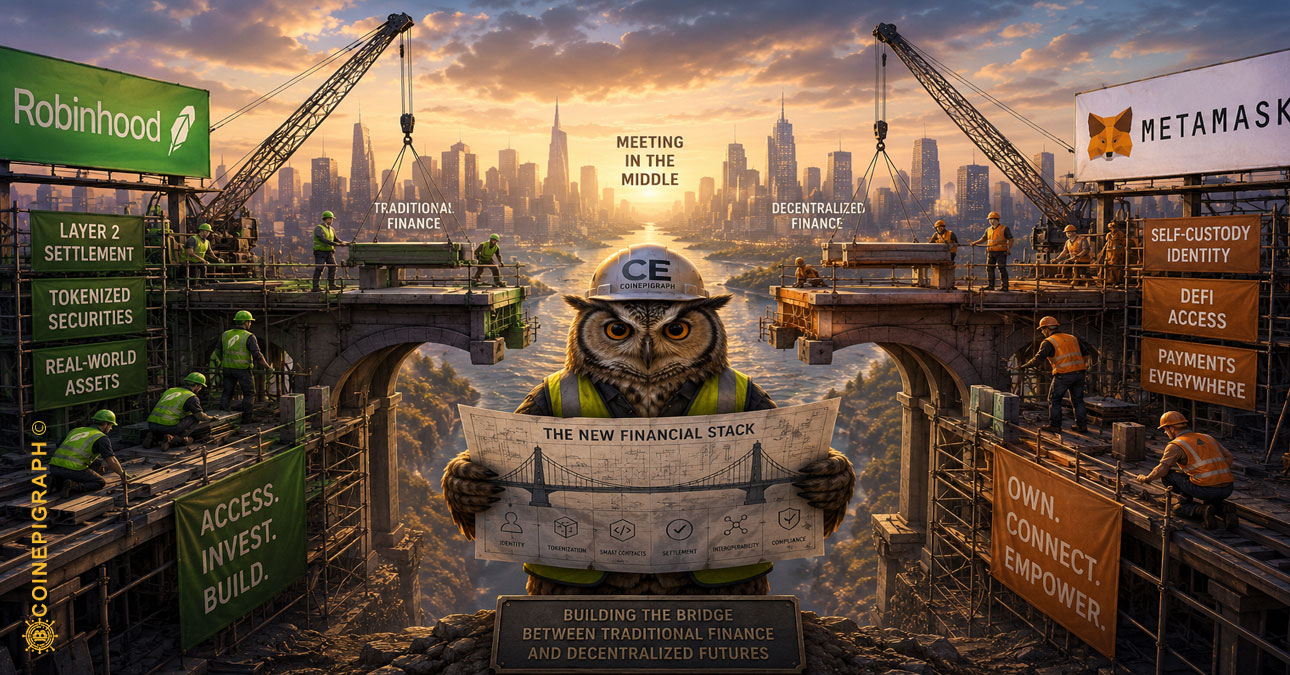
Two bridges are being constructed from opposite sides of the same river.
Neither needs to know precisely where the other will finish.
If both continue advancing, the connection becomes increasingly difficult to ignore.
And once that bridge is complete, the distinction between traditional finance and digital finance may become far less meaningful than it appears today.
Wall Street’s Next Competitor May Not Be a Bank
For decades, financial competition largely occurred within familiar boundaries.
Banks competed with banks.
Brokerages competed with brokerages.
Exchanges competed for listings.
Custodians competed for assets under administration.
Each institution sought greater market share while largely preserving the underlying architecture through which financial markets operated.
That architecture is beginning to evolve.
Increasingly, competition is occurring beneath the institutional layer itself.
The question is becoming less about who executes a trade.
It is becoming about who owns the infrastructure through which that trade ultimately settles.
That distinction changes the nature of competition.
Infrastructure possesses different economics than applications.
Applications compete for customers.
Infrastructure becomes increasingly valuable as more participants depend upon it.
History has repeatedly demonstrated that once critical infrastructure reaches sufficient scale, it often becomes one of the most durable sources of long-term economic value.
Financial markets may now be approaching a similar transition.
The New Financial Stack
Every generation builds its financial system on top of the one it inherits.
For decades, the architecture supporting global capital markets changed far more slowly than the products flowing through it. Investors opened accounts with brokerages. Trades moved through exchanges before passing to clearing organizations, custodians, and settlement systems. Banks remained the connective tissue linking capital, payments, and ownership. Each institution developed specialized expertise, and together they created a financial ecosystem that proved remarkably resilient.
Blockchain does not require that architecture to disappear.
It challenges where many of those functions are performed.
Identity can become digital rather than institution-specific. Ownership can be represented by programmable tokens instead of multiple reconciled records. Settlement can occur continuously rather than according to market schedules. Compliance can increasingly travel with the asset itself instead of being applied after the transaction.
Some of these responsibilities will almost certainly remain with familiar institutions. Others may gradually migrate toward blockchain-native infrastructure designed to operate around the clock, across jurisdictions, and with fewer layers of operational friction.
The transformation is unlikely to arrive through a single technological breakthrough.
It will emerge one function at a time.
And when viewed over time, those incremental changes may prove every bit as significant as the technologies that first inspired them.
Institutions Are Already Adapting
One of the more persistent misconceptions surrounding blockchain has been that it requires traditional finance to disappear before digital finance can succeed.
Recent developments suggest a different path.
Asset managers are tokenizing investment funds.
Banks are experimenting with tokenized deposits.
Payment companies continue expanding digital asset capabilities.
Brokerages are investing in blockchain settlement infrastructure.
Wallet providers are evolving into comprehensive financial interfaces.
These developments are not occurring in isolation.
They represent different responses to the same structural evolution.
The question is no longer whether blockchain will intersect with traditional finance.
That intersection is already taking place.
The more meaningful question concerns which institutions adapt most effectively as financial infrastructure becomes increasingly programmable.
Ownership Is Becoming Software
Perhaps the most significant transformation extends beyond settlement itself.
It reaches the nature of ownership.
Historically, ownership depended upon records maintained by multiple institutions operating across separate systems.
Verification often required reconciliation.
Transfers required coordination.
Settlement followed predetermined schedules.
Blockchain introduces a different operating model.
Ownership becomes programmable.
Transfer restrictions can accompany the asset itself.
Corporate actions may increasingly execute through smart contracts.
Compliance can become embedded within the infrastructure rather than added after the transaction.
Markets have long digitized information.
They are now beginning to digitize ownership itself.
That distinction may ultimately prove more important than the digitization of trading.
The Architecture Matters More Than the Headlines
Individual announcements naturally command attention.
A new Layer 2 network.
An expanded wallet.
A tokenized security platform.
Viewed independently, each appears to represent another product launch within a rapidly evolving industry.
Viewed collectively, they reveal something larger.
The financial stack itself is changing.
Robinhood’s expansion into blockchain infrastructure and MetaMask’s evolution beyond self-custody illustrate opposite approaches to the same destination.
One begins with regulated markets and moves toward programmable settlement.
The other begins with decentralized infrastructure and moves toward everyday financial activity.
Their paths continue narrowing.
The convergence itself may become one of the defining characteristics of modern finance.

The Infrastructure Layer of Tomorrow’s Markets
Financial revolutions rarely announce themselves through a single event.
They emerge through countless incremental decisions that gradually alter how markets function.
A new settlement network.
A more capable wallet.
Tokenized ownership.
Programmable assets.
Continuous markets.
Each development appears modest when viewed independently.
Together, they begin redefining the foundation beneath global finance.
For much of the past decade, blockchain sought legitimacy within the existing financial system.
Increasingly, the existing financial system appears to be adopting the architecture blockchain introduced.
That does not suggest Wall Street is disappearing.
Nor does it imply banks, exchanges, custodians, or clearing organizations suddenly become obsolete.
Financial history rarely unfolds through abrupt replacement.
It advances through gradual reconstruction.
The institutions that define the next generation of capital markets may not be those that simply preserve existing financial infrastructure.
They may be those that understand how to rebuild it.
Because the next great competition in finance may no longer be fought over products.
It may be fought over the infrastructure upon which every future product depends.
At CoinEpigraph, we are committed to delivering digital-asset journalism with clarity, accuracy, and uncompromising integrity. Our editorial team works daily to provide readers with reliable, insight-driven coverage across an ever-shifting crypto and macro-financial landscape. As we continue to broaden our reporting and introduce new sections and in-depth op-eds, our mission remains unchanged: to be your trusted, authoritative source for the world of crypto and emerging finance.
— Ian Mayzberg, Editor-in-Chief
The team at CoinEpigraph.com is committed to independent analysis and a clear view of the evolving digital asset order.
To help sustain our work and editorial independence, we would appreciate your support of any amount of the tokens listed below. Support independent journalism:
BTC: 3NM7AAdxxaJ7jUhZ2nyfgcheWkrquvCzRm
SOL: HxeMhsyDvdv9dqEoBPpFtR46iVfbjrAicBDDjtEvJp7n
ETH: 0x3ab8bdce82439a73ca808a160ef94623275b5c0a
XRP: rLHzPsX6oXkzU2qL12kHCH8G8cnZv1rBJh TAG – 1068637374
SUI – 0xb21b61330caaa90dedc68b866c48abbf5c61b84644c45beea6a424b54f162d0c
and through our Support Page.
🔍 Disclaimer: CoinEpigraph is for entertainment and information, not investment advice. Markets are volatile — always conduct your own research.
COINEPIGRAPH™ does not offer investment advice. Always conduct thorough research before making any market decisions regarding cryptocurrency or other asset classes. Past performance is not a reliable indicator of future outcomes. All rights reserved | 版权所有 ™ © 2024-2029.