


May 1, 2026
The Hidden Transmission Mechanism Behind Modern Asset Cycles
Asset inflation is rarely random. It is a function of discount rates.
By CoinEpigraph Editorial Desk
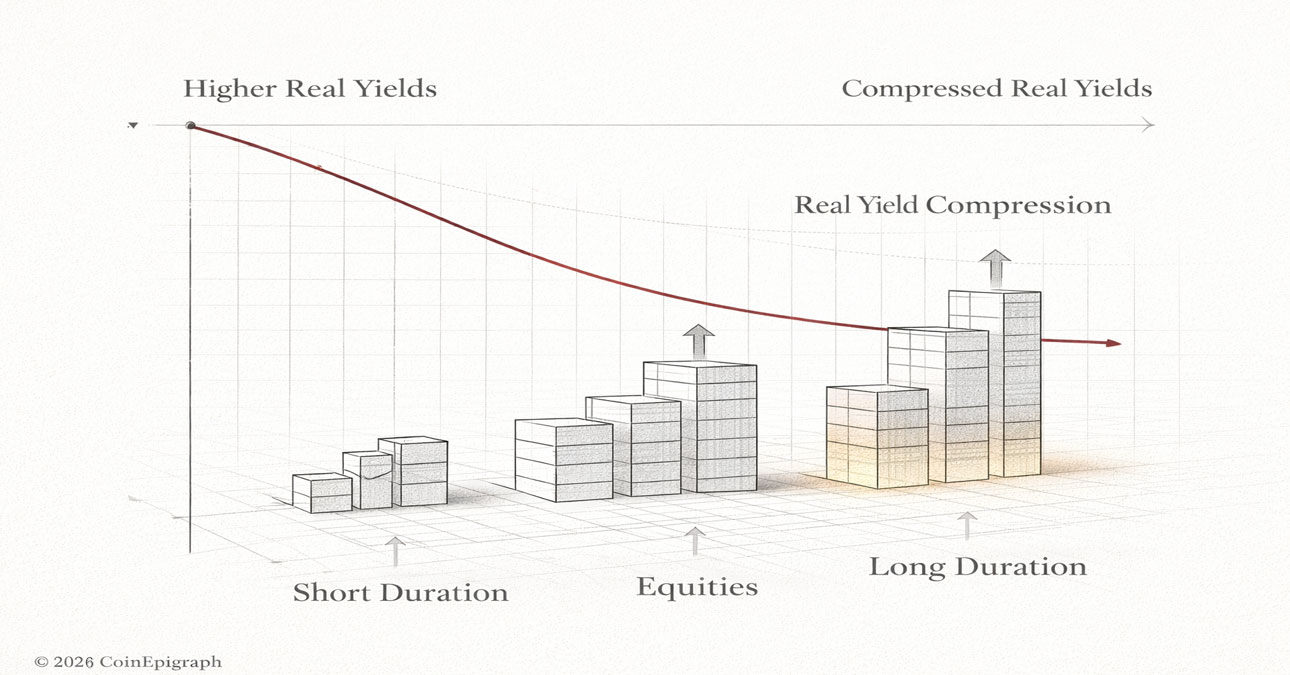
Across market cycles, the most consistent transmission channel linking policy decisions to asset repricing is the real yield — nominal rates adjusted for inflation expectations. When real yields compress or turn negative, the discount rate applied to future cash flows falls. Duration expands. Asset prices reprice upward.
This is not political commentary. It is mechanical.
And over the past two decades, persistent episodes of real yield compression have quietly reshaped wealth distribution and capital allocation across sectors of the global economy.
What Is a Real Yield — and Why It Matters
A real yield is the return on a bond after accounting for inflation. If a Treasury yields 4% and inflation is running at 3%, the real yield is roughly 1%.
When real yields fall toward zero or negative territory, several things occur simultaneously:
- The opportunity cost of holding risk assets declines.
- Discount rates applied to equities compress.
- Long-duration assets reprice upward.
- Non-productive leverage becomes more attractive.
The effect is not immediate, but it is cumulative.
Discount rate compression raises the present value of future cash flows. Growth equities, venture capital, private equity, real estate, and other duration-sensitive assets benefit first.
The repricing is structural, not speculative.
The Duration Trade as a Policy Outcome
When real yields collapse, markets are incentivized to extend duration.
Capital flows toward:
- High-growth technology equities
- Long-duration cash flow profiles
- Private markets with extended liquidity horizons
- Real estate financed at compressed rates
- Venture-backed innovation cycles
In this environment, capital appears abundant. Financing costs decline. Equity multiples expand.
However, this is not a neutral redistribution of capital. It alters relative attractiveness across sectors.
Short-duration sectors — commodities, industrial production, cash-flow generative cyclicals — tend to lag early in liquidity cycles. Long-duration growth dominates.
The market narrative often credits innovation or momentum. The structural driver is frequently discount-rate compression.
Wealth Redistribution Through Asset Inflation
Real yield compression has a second-order effect: it redistributes wealth.
Asset holders benefit first. Those with exposure to equities, private assets, real estate, and venture capital see mark-to-market gains.
Wage earners and cash savers adjust later.
When real yields remain low for extended periods:
- Savings accounts offer limited real return.
- Cash holdings erode purchasing power.
- Asset appreciation outpaces income growth.
This divergence compounds over time.
It is not the result of overt redistribution policy. It is the consequence of monetary transmission mechanics interacting with asset ownership structures.
The financial economy expands faster than the wage economy.
Capital Allocation Distortion
Persistent real yield compression also influences how capital is allocated.
Cheap funding lowers the hurdle rate for investment. Projects that might not clear a higher real-rate environment become viable.
This encourages:
- Leveraged buyouts financed at compressed spreads
- Venture-backed experimentation with extended profitability horizons
- Corporate share repurchases financed through low-cost debt
- Asset accumulation strategies over productivity expansion
In extreme cycles, it produces “zombie capital” — firms sustained by favorable funding conditions rather than durable cash generation.
These distortions are subtle during expansion phases. They become visible during tightening cycles.
The Tightening Phase: Repricing the System
When real yields rise — whether due to inflation normalization or policy tightening — the process reverses.
Discount rates expand. Duration compresses.
The most sensitive assets reprice first:
- Growth equities
- Long-duration private assets
- Highly leveraged structures
Capital that was allocated under a compressed real-rate regime faces repricing pressure.
Funding models built on abundant liquidity confront refinancing risk.
This is not simply volatility. It is structural adjustment.
Cycles that appear to be innovation booms can reveal misallocation under tighter real-rate conditions.
Sectoral Effects Across the Economy
Real yield regimes also influence sector rotation.
Low real yield environments typically benefit:
- Technology
- Venture ecosystems
- Real estate
- Speculative growth narratives
Rising real yield environments tend to favor:
- Commodities
- Energy
- Defensive cash-flow sectors
- Gold and hard assets
This dynamic explains why gold often strengthens when real yields turn negative and weakens when they rise.
It also clarifies why digital assets increasingly correlate with real-rate expectations. Assets perceived as stores of value respond to real yield shifts, not just headline inflation.
The macro lens is consistent across instruments.
The Financial Economy vs. the Real Economy
An extended period of real yield compression can widen the gap between the financial and real economies.
Asset values expand rapidly. Productivity growth may not keep pace.
Capital allocation tilts toward financial engineering rather than physical infrastructure.
The economy may appear healthy through equity indices, even while wage growth and productivity gains lag.
When real yields normalize, that divergence narrows — often abruptly.
This cycle is not new. What is new is its scale.
Global sovereign debt levels and central bank balance sheets have amplified the sensitivity of asset markets to real yield regimes.
Implications for Capital Allocators
For CIOs and multi-asset allocators, the lesson is structural:
- Real yield regimes matter more than nominal rates.
- Duration sensitivity is often mispriced in extended liquidity cycles.
- Asset inflation is frequently a discount-rate phenomenon, not pure growth.
- Tightening cycles expose misallocated capital.
Monitoring:
- Inflation expectations
- Treasury real yield movements
- Central bank balance sheet trajectories
- Credit spread behavior
provides clearer signals than headline volatility.
Liquidity cycles do not eliminate risk. They shift it forward.

The Enduring Question
When real yields compress, markets inflate. When they rise, fragilities surface.
The structural challenge for allocators is distinguishing between durable innovation and discount-rate amplification.
In a world of high sovereign debt and recurring liquidity intervention, real yield regimes will likely remain central to asset pricing dynamics.
The repricing of real wealth is not accidental.
It is embedded in the architecture of liquidity.
And understanding that architecture remains essential for capital allocation in the modern era.
At CoinEpigraph, we are committed to delivering digital-asset journalism with clarity, accuracy, and uncompromising integrity. Our editorial team works daily to provide readers with reliable, insight-driven coverage across an ever-shifting crypto and macro-financial landscape. As we continue to broaden our reporting and introduce new sections and in-depth op-eds, our mission remains unchanged: to be your trusted, authoritative source for the world of crypto and emerging finance.
— Ian Mayzberg, Editor-in-Chief
The team at CoinEpigraph.com is committed to independent analysis and a clear view of the evolving digital asset order.
To help sustain our work and editorial independence, we would appreciate your support of any amount of the tokens listed below. Support independent journalism:
BTC: 3NM7AAdxxaJ7jUhZ2nyfgcheWkrquvCzRm
SOL: HxeMhsyDvdv9dqEoBPpFtR46iVfbjrAicBDDjtEvJp7n
ETH: 0x3ab8bdce82439a73ca808a160ef94623275b5c0a
XRP: rLHzPsX6oXkzU2qL12kHCH8G8cnZv1rBJh TAG – 1068637374
SUI – 0xb21b61330caaa90dedc68b866c48abbf5c61b84644c45beea6a424b54f162d0c
and through our Support Page.
🔍 Disclaimer: CoinEpigraph is for entertainment and information, not investment advice. Markets are volatile — always conduct your own research.
COINEPIGRAPH™ does not offer investment advice. Always conduct thorough research before making any market decisions regarding cryptocurrency or other asset classes. Past performance is not a reliable indicator of future outcomes. All rights reserved | 版权所有 ™ © 2024-2029.