


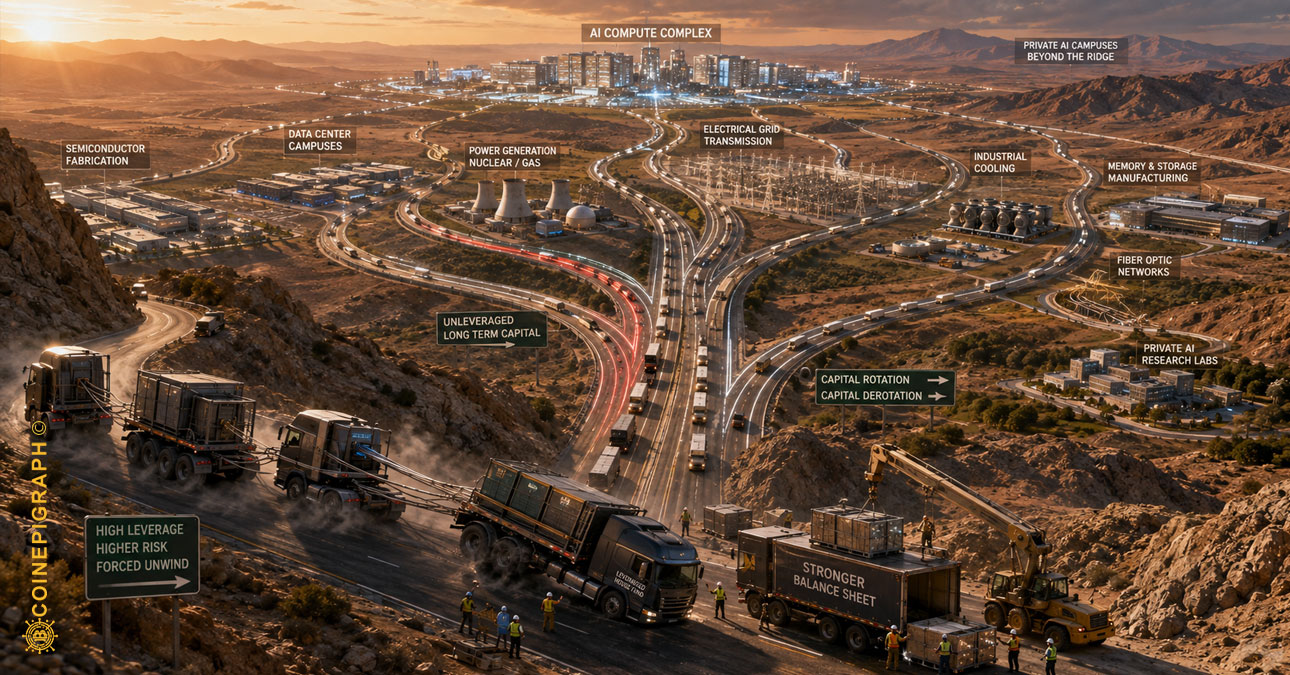
The crisis surrounding Leopold Aschenbrenner’s Situational Awareness fund exposes a larger transition in AI investing. The opportunity is spreading from chips into power, data centers, grids, cooling, memory and private markets—but leverage is revealing the difference between identifying the future and surviving long enough to own it.
By CoinEpigraph Editorial Desk
For much of the artificial-intelligence boom, the trade appeared relatively straightforward.
Own the companies supplying the chips.
Own the hyperscalers buying them.
Own the companies building the models.
That first phase produced some of the most concentrated capital formation in modern markets. But as artificial intelligence moves from software breakthrough to industrial deployment, the investment thesis is becoming considerably more complicated.
Compute needs electricity.
Electricity needs generation.
Data centers need land, grid connections and cooling.
GPU clusters need memory, storage and networking.
All of it needs financing.
Capital is following those requirements downstream, searching for the next bottleneck before everyone else discovers it.
Few investors embraced that thesis more aggressively than Leopold Aschenbrenner.
And few recent episodes better demonstrate its danger.
Situational Awareness Meets a Liquidity Crisis
Aschenbrenner, the 24-year-old former OpenAI researcher whose writings on artificial intelligence made him one of the most closely watched young investors in technology, built his hedge fund around an unusually expansive interpretation of the AI opportunity.
His firm was appropriately named Situational Awareness.
Rather than simply buying the largest semiconductor companies, the portfolio increasingly represented a view about where scarcity would emerge as AI infrastructure expanded.
Public filings showed significant exposure to companies connected to power, data-center infrastructure, storage and compute. At the same time, the fund used substantial put positions against parts of the semiconductor and technology complex. Its first-quarter 2026 filing showed roughly $13.7 billion of reported notional positions, although that number included options exposure and should not be interpreted as equivalent to invested capital.
The strategy initially produced extraordinary results.
Then July arrived.
A sharp reversal across AI-related equities collided with substantial leverage. Situational Awareness suffered severe losses and margin pressure, ultimately selling the bulk of its public-equity portfolio to Citadel in a hurried transaction. Recent reporting puts the fund’s July decline at approximately 67%. Citadel subsequently benefited substantially as some of those securities recovered.
The temptation is to treat the episode as another hedge fund that became too leveraged.
That misses the more interesting story.
The AI thesis and the financial architecture used to express it are not the same thing.
AI Is Becoming a Chain of Scarcity
The original AI trade concentrated enormous attention around GPUs because compute represented the most visible constraint.
That constraint has not disappeared.
But deploying compute at industrial scale exposes the next constraint.
And then another.
The emerging investment map increasingly resembles a physical supply chain:
Models → compute → data centers → electricity → generation → grid capacity → cooling → memory → storage → networking → land → financing
Recent engineering research illustrates how literal this transformation has become. AI data centers are creating unprecedented electricity requirements, while increasingly dense GPU installations are putting pressure on conventional power-delivery architecture. Grid capacity itself is becoming a scarce resource.
That changes where investors search for economic rents.
The company producing the model may capture enormous value.
So may the company supplying the accelerator.
But if electricity becomes the binding constraint, the marginal value of another GPU can depend upon whether anyone can power it.
If grid interconnections take years, access to generation becomes valuable.
If rack density increases dramatically, cooling and power-conversion equipment become increasingly important.
If training and inference consume enormous amounts of data, memory and storage move further into the investment conversation.
AI is therefore becoming less a trade than an economic system.
Capital is beginning to price each component separately.
Rotation Is Not the Same as Derotation
That creates a phenomenon worth distinguishing.
Capital rotation occurs when investors voluntarily move from one expression of the AI thesis toward another.
Semiconductors become expensive, so investors search for data-center operators.
Data centers become crowded, so attention shifts toward power.
Power rerates, and investors begin searching through grid equipment, cooling, memory or natural gas.
The underlying conviction in AI hasn’t disappeared.
Capital is searching for where the next unit of scarcity resides.
But markets can experience something different when leverage enters the equation.
Call it derotation.
Instead of capital voluntarily moving toward a more attractive opportunity, exposure is removed because the financial structure supporting the previous position can no longer tolerate the volatility.
That distinction matters.
An investor might remain completely convinced that AI will produce enormous electricity demand over the next five years while simultaneously being forced to sell a power-related stock today.
The thesis did not change.
The balance sheet did.
Leverage Changes Time
This may be the most important lesson from Situational Awareness.
Suppose an investor correctly identifies an infrastructure company that ultimately becomes one of the major beneficiaries of AI deployment.
The market does not have to recognize that conclusion immediately.
The stock can decline 20%.
It can fall 40%.
A recession can intervene.
Capital expenditure can be delayed.
Interest rates can change.
Another part of the AI complex can temporarily attract capital instead.
An unleveraged investor may have the ability to wait.
A highly leveraged investor may not.
Leverage converts a long-duration thesis into a short-duration survival test.
Once losses become large enough, lenders and counter-parties begin determining the timeline.
Margin requirements rise.
Liquidity must be found.
Positions are reduced.
Assets that an investor may consider deeply undervalued can become precisely the assets that must be sold.
That is where investment analysis collides with financial structure.
Being eventually correct no longer guarantees survival.
The Portfolio and the Trade Are Different Things
There is an unusually revealing comparison emerging from the Aschenbrenner episode.
More than 5,000 retail investors have reportedly been following a version of his disclosed public-equity portfolio through the Autopilot investment platform.
Their experience has been dramatically different.
The copied strategy does not reproduce Situational Awareness’s complete portfolio architecture. It lacks the fund’s leverage, short positions and complex derivatives. Despite suffering during the same AI selloff, Business Insider reported that the Autopilot version remained up approximately 53.4% since its March launch.
That comparison should not be interpreted as proof that the underlying holdings will ultimately succeed. Nor does a simplified copy replicate the timing, execution, private investments or risk management of the hedge fund.
It demonstrates something more fundamental.
A collection of investment ideas is not the same thing as the structure financing those ideas.
Two investors can hold similar securities and experience profoundly different outcomes because one introduces leverage, derivatives, financing costs, liquidity constraints and counter-party requirements.
The securities matter.
So does the architecture around them.
Citadel Became the Other Side of the Trade
The forced sale also introduces another familiar feature of market cycles.
Liquidity crises transfer assets.
They do not necessarily destroy them.
Situational Awareness needed to reduce its public portfolio under pressure. Citadel possessed the capital and flexibility to acquire much of that exposure.
When some of those securities subsequently recovered, the economics shifted toward the buyer that had been able to provide liquidity when the seller needed it most. The Financial Times reports that Citadel generated billions from the episode as the acquired positions rebounded.
That is not simply a story about one fund winning and another losing.
It demonstrates why liquidity itself becomes an asset during forced derotation.
When leverage forces one investor’s clock to accelerate, another investor with a stronger balance sheet can inherit the original thesis at a different valuation.
The future being purchased may be identical.
The entry price and financing structure are not.
The AI Trade Is Also Moving Private
Situational Awareness has not completely abandoned its underlying conviction.
The fund retained private-company exposure even as much of its public portfolio was sold. Recent reporting also indicates that it has committed another $400 million to an undisclosed private company.
That points toward another important division within the AI investment cycle.
Some of the most consequential AI companies remain private.
Model developers, specialized hardware businesses, data-center infrastructure companies and other emerging providers can accumulate enormous valuations before ordinary public-market investors receive direct access.
Capital therefore faces another rotation:
from public AI exposure toward private AI ownership.
Private markets may reduce the constant mark-to-market pressure associated with publicly traded securities, but they introduce different risks—illiquidity, valuation opacity, limited price discovery and difficulty exiting positions during stress.
There is no structure without trade-offs.

The Next AI Trade Will Be Harder
The first stage of the AI investment cycle rewarded recognition.
Artificial intelligence would require extraordinary compute.
Compute required semiconductors.
The market found the obvious beneficiaries.
The next stage requires considerably more judgment.
Investors must determine where scarcity migrates as AI infrastructure expands. They must distinguish temporary shortages from durable economic advantages. They must decide whether future growth is already reflected in today’s valuation.
They must understand what hyperscalers will continue funding—and what happens if those companies eventually become more disciplined with capital expenditures.
They must distinguish capital rotation from forced derotation.
And increasingly, they must decide whether the best opportunities reside in public securities, private markets or the physical infrastructure connecting the two.
The AI trade has not disappeared.
It has fragmented.
Semiconductors are one trade.
Compute is another.
Power is another.
Data centers are another.
Grid infrastructure, cooling, memory, storage, networking, private AI and financing each introduce their own economics, valuations and timelines.
The Aschenbrenner episode does not establish that the broader infrastructure thesis is wrong.
It demonstrates something markets have repeatedly taught investors during periods of technological transformation.
Identifying the future is only the beginning.
Investors must determine where its economics will accrue.
They must avoid paying for too much of that future before it arrives.
And if leverage is involved, they must ensure that their financing survives the volatility between the present and the outcome they expect.
Because the market does not merely require investors to be right.
It requires them to survive the trade.
At CoinEpigraph, we are committed to delivering digital-asset journalism with clarity, accuracy, and uncompromising integrity. Our editorial team works daily to provide readers with reliable, insight-driven coverage across an ever-shifting crypto and macro-financial landscape. As we continue to broaden our reporting and introduce new sections and in-depth op-eds, our mission remains unchanged: to be your trusted, authoritative source for the world of crypto and emerging finance.
— Ian Mayzberg, Editor-in-Chief
The team at CoinEpigraph.com is committed to independent analysis and a clear view of the evolving digital asset order.
To help sustain our work and editorial independence, we would appreciate your support of any amount of the tokens listed below. Support independent journalism:
BTC: 3NM7AAdxxaJ7jUhZ2nyfgcheWkrquvCzRm
SOL: HxeMhsyDvdv9dqEoBPpFtR46iVfbjrAicBDDjtEvJp7n
ETH: 0x3ab8bdce82439a73ca808a160ef94623275b5c0a
XRP: rLHzPsX6oXkzU2qL12kHCH8G8cnZv1rBJh TAG – 1068637374
SUI – 0xb21b61330caaa90dedc68b866c48abbf5c61b84644c45beea6a424b54f162d0c
and through our Support Page.
🔍 Disclaimer: CoinEpigraph is for entertainment and information, not investment advice. Markets are volatile — always conduct your own research.
COINEPIGRAPH™ does not offer investment advice. Always conduct thorough research before making any market decisions regarding cryptocurrency or other asset classes. Past performance is not a reliable indicator of future outcomes. All rights reserved | 版权所有 ™ © 2024-2029.