


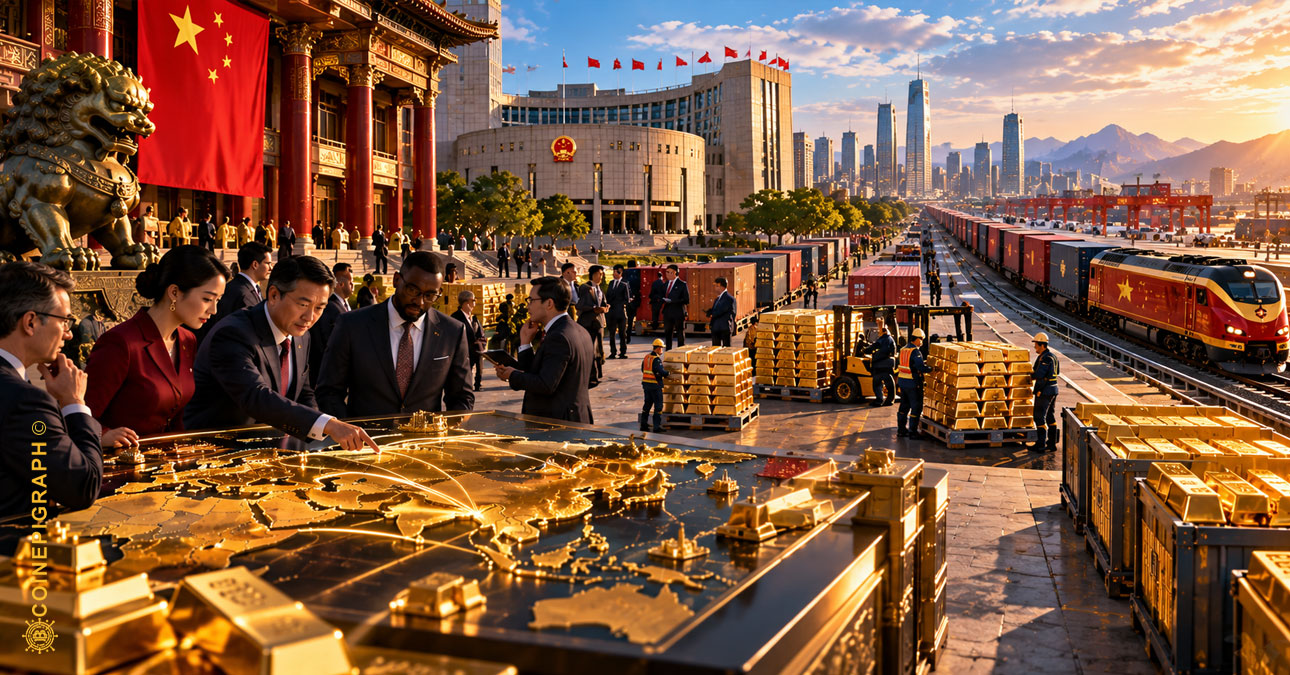
Beijing’s accelerating gold purchases are attracting attention, but the metal may be the least complicated part of the strategy. Around it, China is expanding pricing, custody, clearing, Renminbi settlement and cross-border payment infrastructure that could make its reserves more useful when access to dominant financial networks becomes constrained.
By CoinEpigraph Editorial Desk
China added another 20.2 tonnes of gold to its official reserves in August.
By itself, that number is not especially transformative. China manages trillions of dollars in reserve assets, and 20 tonnes of bullion will not reorder the international monetary system.
The persistence is more interesting.
August marked the 22nd consecutive month in which the People’s Bank of China reported an increase in gold holdings. The addition was its largest since October 2023, taking officially reported reserves to 2,387 tonnes. Gold now represents roughly 9% of China’s foreign-exchange reserves.
At first glance, the trade appears straightforward: China is buying more gold while its holdings of U.S. government debt have declined substantially from their peak.
But treating this simply as a rotation from Treasuries into bullion misses the more consequential development.
Gold is an asset.
China is increasingly building infrastructure around it.
That distinction changes the question from whether Beijing prefers gold to American government debt into something more structural:
What if China’s gold accumulation is partly an investment in the ability to preserve financial options when other channels become unavailable?
Gold Is Expensive Insurance
Gold presents an unusual proposition to a reserve manager.
It pays no interest. It generates no dividend. Physical holdings require custody, security and transportation. In an environment where sovereign bonds offer positive yields, holding gold carries a measurable opportunity cost.
Yet gold has one characteristic a government bond cannot replicate.
It is nobody else’s liability.
A Treasury security is an obligation of the United States. A bank deposit is a liability of a financial institution operating within a legal jurisdiction. A sovereign bond ultimately depends upon the government that issued it.
Physical gold held under a country’s control introduces a different form of reserve asset: one without an issuing counterparty.
That distinction became more visible after Russia’s invasion of Ukraine in 2022. The European Union and its partners subsequently immobilized hundreds of billions of euros in Russian central-bank reserves held within their jurisdictions. The EU says roughly €210 billion remains immobilized inside the bloc.
Whatever governments thought about the justification for those sanctions, the episode demonstrated a characteristic of foreign reserves that had previously received less attention.
The location and legal architecture of a reserve asset can matter almost as much as the asset itself.
Gold does not eliminate geopolitical risk. But physical bullion held where a sovereign can access it changes one dimension of that risk.
The foregone yield can therefore be understood partly as an insurance premium.
China is not alone in paying it.
Central banks have purchased an average of roughly 1,000 tonnes of gold annually during the past four years, about twice the average of the preceding decade. In the World Gold Council’s 2026 survey, 89% of responding central banks expected global official gold reserves to rise during the following year, while a record 45% expected their own institutions to increase holdings.
That suggests a broader reassessment of what constitutes a useful reserve.
But an asset that cannot be mobilized efficiently has limited usefulness during stress.
And that is where China’s strategy becomes more interesting.
A Vault Is Not a Financial System
Imagine a central bank with an enormous pile of gold but no independent mechanism for pricing it, moving it, collateralizing it or converting its value into something required for international trade.
The country possesses wealth.
It does not necessarily possess financial optionality.
China has spent years developing more of the surrounding machinery.
The Shanghai Gold Exchange already provides domestic and international gold-market infrastructure. Hong Kong is expanding its role as an offshore renminbi and precious-metals center. HKEX said this summer that it was exploring an RMB-denominated gold futures contract with physical delivery supported by the Shanghai Gold Exchange.
Separately, Hong Kong’s financial infrastructure is becoming more directly connected to China’s Cross-Border Interbank Payment System, or CIPS.
In July, HKEX and CIPS signed an agreement intended to deepen cross-border Renminbi settlement capabilities. HKEX’s OTC clearing subsidiary plans to apply to become a direct CIPS participant, potentially allowing it to settle Renminbi funds directly through the network. As of June, CIPS had 210 direct participants and reached more than 5,200 banking institutions across 191 countries and regions.
The transaction volumes are already substantial.
During the first eight months of 2026, CIPS processed 6.023 million Renminbi payment transactions worth RMB139.7 trillion. August alone accounted for RMB19.4 trillion.
CIPS should not be described simply as a replacement for SWIFT. The systems perform different functions, and the dollar-based financial network remains vastly more deeply embedded in international finance.
But replacement is not necessary for optionality.
The important development is the creation of additional routes.
The Treasury Story Requires More Care
China’s declining Treasury position naturally encourages a more dramatic interpretation.
At its peak more than a decade ago, China’s reported holdings exceeded $1.3 trillion. By June 2026 they had fallen to roughly $633 billion, and more recent Treasury data put the July figure still lower.
That is a meaningful long-term change.
It is not evidence that the world has stopped financing the United States.
In June, foreign investors collectively made $207.1 billion of net purchases of long-term U.S. securities. Foreign official institutions accounted for $37.3 billion of those purchases. The Treasury also cautions that country-level TIC figures are imperfect because securities held through custodians in third countries may not reveal the ultimate owner.
July continued to show net foreign official purchases of long-term U.S. securities even as overall flows moderated.
China reducing Treasury exposure and international demand for American securities remaining substantial can therefore occur at the same time.
That is precisely why “de-dollarization” can obscure more than it explains.
The more useful concept is diversification of dependence.
Reserve Optionality Is Different From Reserve Replacement
The dollar’s international position rests on considerably more than the amount of U.S. government debt held by any single central bank.
It is supported by deep capital markets, trade invoicing, bank funding, derivatives, collateral networks, dollar deposits and the enormous liquidity of the Treasury market.
Gold cannot reproduce that architecture.
Neither can the renminbi today.
China does not need either one to do so for its strategy to matter.
Suppose the objective is not to replace the dollar system but to reduce the number of transactions for which there is no alternative to it.
That produces a different architecture.
Gold supplies a reserve asset without an issuing sovereign counter-party.
Domestic and offshore vaults provide custody.
Shanghai and Hong Kong provide additional pricing and market infrastructure.
Renminbi clearing provides settlement.
CIPS provides a cross-border payment channel.
Trade conducted in Renminbi provides economic demand at the other end.
No individual component constitutes an alternative international monetary system.
Together, however, they increase the range of circumstances in which China has another option.
That is financial optionality.
The Marginal Buyer Matters
There is also an implication for the United States.
The relevant question is not whether China suddenly liquidates hundreds of billions of dollars of Treasury securities. Such an action would have consequences for China itself and is not what the current evidence shows.
The more durable question concerns the marginal reserve dollar.
If reserve managers gradually allocate a larger portion of incremental reserves toward gold, other currencies or alternative assets, then some portion of capital that historically might have entered dollar securities goes elsewhere.
That does not require a collapse in Treasury demand.
It changes the composition of demand at the margin.
For a United States already financing persistent fiscal deficits, that distinction matters. The Treasury market does not require every historical buyer to remain indefinitely. But when one class of buyer reduces its appetite, another investor must ultimately hold the securities at a market-clearing price.
Reserve diversification therefore connects geopolitics to the cost of capital without requiring a dramatic dollar-crisis narrative.

Gold Is Becoming More Than Something to Hold
There is another reason China’s strategy deserves attention.
Reserve managers elsewhere are also reconsidering where their gold is stored and how readily it can be mobilized. The World Gold Council notes that some central banks are increasing domestic storage while others are diversifying overseas locations. Its interpretation is instructive: security alone is no longer necessarily enough; reserve gold may also need to remain accessible and tradable under stress.
That brings the discussion back to infrastructure.
A reserve asset becomes more useful when it can move.
A payment network becomes more useful when counter-parties accept the currency moving through it.
A currency becomes more useful when markets exist in which it can be exchanged, invested, hedged and settled.
And a parallel financial channel becomes more consequential when it no longer has to be invented during the crisis for which it was intended.
China’s gold accumulation should therefore be viewed alongside the infrastructure being constructed around the country’s broader reserve and settlement architecture.
Not because Beijing has replaced the dollar.
It hasn’t.
Not because gold is about to become the principal currency of international trade.
There is little evidence for that either.
The significance is quieter.
Reserve dominance is not lost only when another system replaces yours. It can become less absolute at the margin when other countries develop credible alternatives for transactions that once had no practical route around it.
China’s 20.2 tonnes of August gold purchases will not change the monetary order.
The more important question is what happens when the metal in the vault is connected to pricing, clearing, settlement, payments and trade—and when those connections are already operating before they are urgently needed.
China may not be building a financial system without the dollar.
It is building more ways to operate when the dollar is not the only available choice.
At CoinEpigraph, we are committed to delivering digital-asset journalism with clarity, accuracy, and uncompromising integrity. Our editorial team works daily to provide readers with reliable, insight-driven coverage across an ever-shifting crypto and macro-financial landscape. As we continue to broaden our reporting and introduce new sections and in-depth op-eds, our mission remains unchanged: to be your trusted, authoritative source for the world of crypto and emerging finance.
— Ian Mayzberg, Editor-in-Chief
The team at CoinEpigraph.com is committed to independent analysis and a clear view of the evolving digital asset order.
To help sustain our work and editorial independence, we would appreciate your support of any amount of the tokens listed below. Support independent journalism:
BTC: 3NM7AAdxxaJ7jUhZ2nyfgcheWkrquvCzRm
SOL: HxeMhsyDvdv9dqEoBPpFtR46iVfbjrAicBDDjtEvJp7n
ETH: 0x3ab8bdce82439a73ca808a160ef94623275b5c0a
XRP: rLHzPsX6oXkzU2qL12kHCH8G8cnZv1rBJh TAG – 1068637374
SUI – 0xb21b61330caaa90dedc68b866c48abbf5c61b84644c45beea6a424b54f162d0c
and through our Support Page.
🔍 Disclaimer: CoinEpigraph is for entertainment and information, not investment advice. Markets are volatile — always conduct your own research.
COINEPIGRAPH™ does not offer investment advice. Always conduct thorough research before making any market decisions regarding cryptocurrency or other asset classes. Past performance is not a reliable indicator of future outcomes. All rights reserved | 版权所有 ™ © 2024-2029.