


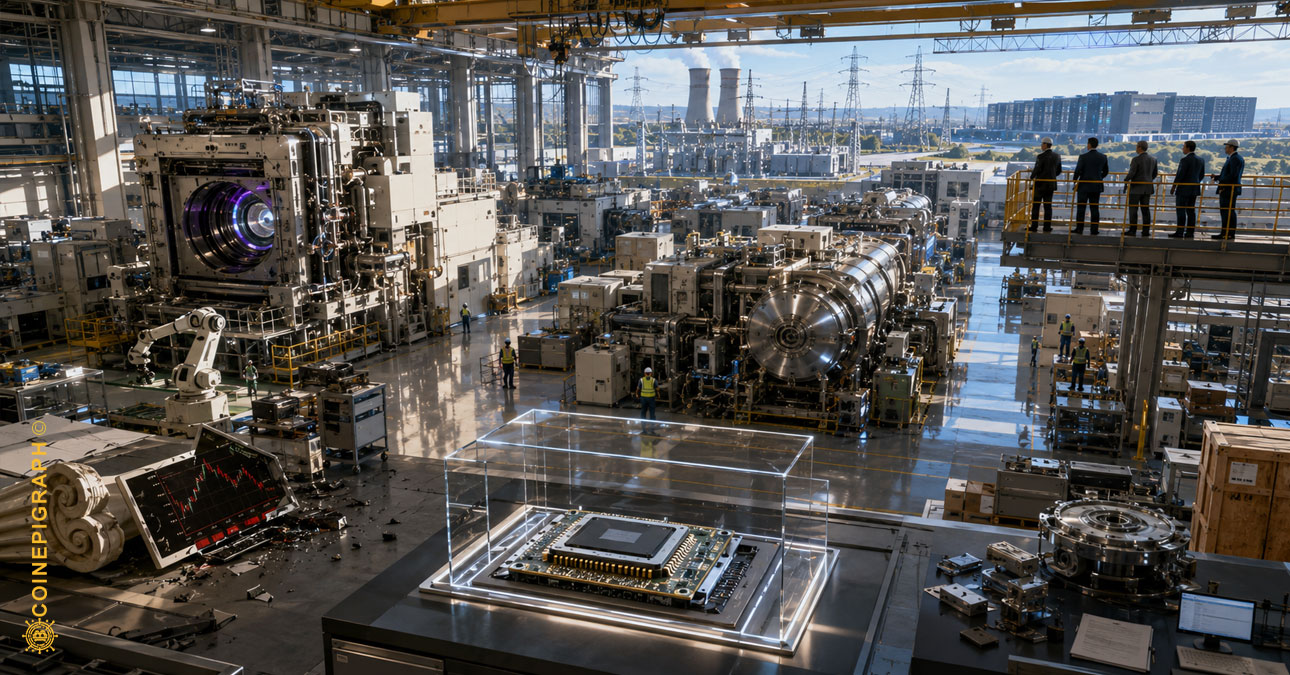
Days after leverage forced Situational Awareness out of much of its public-equity portfolio, Leopold Aschenbrenner committed another $400 million to semiconductor manufacturing technology. The move suggests the AI trade is not simply rotating between stocks. Capital is searching deeper into the industrial bottlenecks that determine how much intelligence can actually be built.
By CoinEpigraph Editorial Desk
Leopold Aschenbrenner just provided an unusual second act to one of the year’s most dramatic investment stories.
His hedge fund, Situational Awareness, spent much of 2026 riding an aggressive thesis around artificial intelligence and the infrastructure required to support it.
Then the structure broke.
A violent reversal across parts of the AI trade collided with substantial leverage. Situational Awareness lost 67% in July and ultimately sold much of its public-equity portfolio to Citadel as margin pressure forced the fund to reduce exposure.
That episode carried an obvious lesson.
A long-term investment thesis can survive while the financing structure used to express it does not.
But what happened next may tell us something equally important.
Aschenbrenner didn’t abandon the AI infrastructure thesis.
He moved deeper into it.
Situational Awareness has now invested another $400 million in Source Foundry, a stealth semiconductor-equipment company attempting to develop new machinery for advanced chip manufacturing. Combined with an earlier investment, the fund’s commitment reportedly reaches approximately $500 million.
The timing makes the decision difficult to dismiss as another routine venture investment.
Days after being forced to surrender much of its public-market exposure, the fund put substantial capital behind one of the deepest layers of the AI supply chain.
Second verse.
Not quite the same as the first.
From Owning Chips to Owning What Makes Chips
The first phase of AI investing made semiconductor companies natural beneficiaries. Once it became clear that increasingly capable models would require extraordinary amounts of compute, the market quickly understood the importance of the processors supplying it. NVIDIA became the most visible expression of that realization, while capital spread across the semiconductor ecosystem surrounding it.
But the expansion of AI is beginning to push investors further back into that supply chain.
Advanced processors cannot simply be designed and ordered into existence. They depend on fabrication plants filled with some of the most sophisticated manufacturing equipment in the world. Lithography may receive most of the attention, particularly because of ASML’s position in extreme ultraviolet systems, but advanced chip production also depends on deposition, etching, inspection, metrology, packaging, materials and increasingly precise process control.
That places another collection of businesses behind the companies normally described as AI’s picks-and-shovels providers.
Source Foundry is attempting to enter this deeper layer. The company is reportedly developing semiconductor-manufacturing equipment aimed at improving portions of the production process currently dependent on highly specialized incumbent technologies. If successful, it would position the company closer to one of AI’s most difficult physical constraints: not designing the next generation of processors, but expanding the machinery capable of producing them.
There is no reason to assume that will be easy. Semiconductor equipment is an industry in which technological advantages are often accumulated over decades. Precision requirements are extraordinary, customers are demanding, qualification cycles can be lengthy, and incumbents possess deeply embedded relationships with the world’s leading chip manufacturers.
That uncertainty is precisely what makes Aschenbrenner’s investment interesting.
Only days removed from a liquidity crisis that forced Situational Awareness to surrender much of its public-market exposure, the fund did not simply return to the familiar AI names that helped define the first stage of the boom. It committed substantial capital farther upstream.
The bet is no longer merely on who makes the AI chip. It is moving toward who makes the machines capable of making more of them.
Every Bottleneck Reveals Another Bottleneck
That is becoming one of the defining characteristics of the AI buildout.
At first, the scarcity appeared to be intelligence.
Then compute.
Then GPUs.
Then advanced memory.
Then data-center capacity.
Then electricity.
Then transformers, turbines, grid interconnections and cooling.
Semiconductor manufacturing introduces the same progression.
Designing more advanced processors accomplishes little if manufacturing capacity cannot keep pace.
Expanding manufacturing capacity becomes difficult if the equipment required to build leading-edge fabrication plants remains concentrated among a relatively small number of suppliers.
The AI investment map therefore keeps expanding backward through its own supply chain.
Models → compute → chips → fabrication → semiconductor equipment → materials
At the same time, it expands outward:
Compute → data centers → power → grid → cooling → networking → land → financing
This is why describing AI as a single investment trade is becoming increasingly inadequate.
It is becoming an industrial system.
And industrial systems create value at bottlenecks.
Rotation Is Moving Down the Stack
Our previous analysis examined the rotation and derotation of AI capital.
The distinction remains important.
Rotation occurs when investors voluntarily move capital toward a part of the AI economy where they believe future returns have not yet been fully priced.
Derotation occurs when capital is removed from an existing position because leverage, liquidity, valuation compression or changing correlations make the position difficult to maintain.
Situational Awareness experienced the second.
Its Source Foundry investment looks considerably more like the first.
And that sequence deserves attention.
The fund was forced to derotate from substantial portions of its public-market portfolio while simultaneously preserving private investments and committing additional capital farther down the infrastructure stack.
That does not prove the strategy will succeed.
It does suggest that the underlying thesis survived the liquidation event.
The expression changed.
Public Markets and Private Markets Run on Different Clocks
There is another reason the Source Foundry investment matters.
Private assets behave differently from publicly traded securities.
A public position is repriced continuously.
When leverage is attached to it, falling prices can generate collateral demands before an investment thesis has had time to mature.
Private investments introduce other risks. Price discovery is weaker. Liquidity can be extremely limited. Valuations can remain stale. Exiting a position quickly may be impossible.
But they are not subjected to the same continuous mark-to-market machinery.
Situational Awareness still holds stakes in private companies including Anthropic, Fluidstack and MatX, and the fund has indicated that private investments can represent a significant portion of its portfolio.
That creates an intriguing evolution in the AI capital cycle.
Some investors may increasingly conclude that the most consequential infrastructure opportunities are developing before public markets can own them directly.
The next AI trade may therefore involve not merely finding another listed stock.
It may involve financing the industrial capacity that eventually creates the listed companies.
The Picks and Shovels Have Picks and Shovels
Markets frequently describe semiconductor companies as the picks-and-shovels providers of artificial intelligence.
That analogy is becoming incomplete.
The shovel has a manufacturer.
The manufacturer needs specialized machinery.
The machinery requires materials, precision components, engineering expertise and supply chains.
And those factories require electricity, water, land and capital.
Each layer can become a bottleneck.
Each bottleneck can become an investment thesis.
This is how one enormous AI trade begins fracturing into dozens of smaller ones.
Not all will work.
Some shortages will prove temporary.
Some companies will attract capital long before they develop durable economics.
Some valuations will assume years of growth that never arrives.
And some technically promising businesses will discover that competing against deeply entrenched industrial incumbents is considerably harder than disrupting software.
But the direction of capital tells us where investors are searching.
Increasingly, they are searching underneath AI.
AI Is Becoming an Industrial Capital Cycle
That may ultimately be the larger development.
The earliest AI boom could still be understood largely through technology companies.
The next stage increasingly resembles an industrial capital cycle.
Factories must be constructed.
Power plants financed.
Transmission expanded.
Data centers built.
Cooling installed.
Semiconductor capacity increased.
Manufacturing equipment developed.
Capital requirements become enormous long before the final economic return is known.
History has seen versions of this before.
Railroads required steel, land and financing.
Electrification required generation, transmission and enormous physical networks.
Telecommunications required fiber.
The internet eventually required hyperscale computing infrastructure.
Transformative technologies rarely remain confined to the product that initially captures public attention.
They reorganize the infrastructure beneath the economy.
AI appears to be entering that phase.

The Second Verse Is Not the Same as the First
This is why Aschenbrenner remains relevant without making the story about Aschenbrenner.
Situational Awareness just demonstrated what can happen when a powerful secular thesis encounters too much leverage.
Its response now provides another data point.
The fund did not simply rebuild the same public portfolio.
It committed another $400 million farther down the AI production chain.
Perhaps that investment proves prescient.
Perhaps Source Foundry discovers how formidable the economics and engineering of semiconductor equipment really are.
That outcome remains unknowable.
The signal is the location of the bet.
The AI capital cycle began with models.
It moved toward GPUs.
Then data centers.
Then electricity.
Now sophisticated capital is probing manufacturing equipment, power infrastructure, cooling, memory, networking and the other physical systems without which increasingly capable AI cannot scale.
The first phase rewarded investors who understood that intelligence would require extraordinary amounts of compute.
The next phase requires identifying what constrains the production of that compute.
And then identifying what constrains the constraint.
That is how capital moves down the stack.
First came software.
Then silicon.
Now come the machines that make the silicon—and behind them, the steel, concrete, copper, electricity and capital required to build the AI economy.
The great AI trade isn’t simply rotating anymore. It is becoming industrial.
At CoinEpigraph, we are committed to delivering digital-asset journalism with clarity, accuracy, and uncompromising integrity. Our editorial team works daily to provide readers with reliable, insight-driven coverage across an ever-shifting crypto and macro-financial landscape. As we continue to broaden our reporting and introduce new sections and in-depth op-eds, our mission remains unchanged: to be your trusted, authoritative source for the world of crypto and emerging finance.
— Ian Mayzberg, Editor-in-Chief
The team at CoinEpigraph.com is committed to independent analysis and a clear view of the evolving digital asset order.
To help sustain our work and editorial independence, we would appreciate your support of any amount of the tokens listed below. Support independent journalism:
BTC: 3NM7AAdxxaJ7jUhZ2nyfgcheWkrquvCzRm
SOL: HxeMhsyDvdv9dqEoBPpFtR46iVfbjrAicBDDjtEvJp7n
ETH: 0x3ab8bdce82439a73ca808a160ef94623275b5c0a
XRP: rLHzPsX6oXkzU2qL12kHCH8G8cnZv1rBJh TAG – 1068637374
SUI – 0xb21b61330caaa90dedc68b866c48abbf5c61b84644c45beea6a424b54f162d0c
and through our Support Page.
🔍 Disclaimer: CoinEpigraph is for entertainment and information, not investment advice. Markets are volatile — always conduct your own research.
COINEPIGRAPH™ does not offer investment advice. Always conduct thorough research before making any market decisions regarding cryptocurrency or other asset classes. Past performance is not a reliable indicator of future outcomes. All rights reserved | 版权所有 ™ © 2024-2029.