


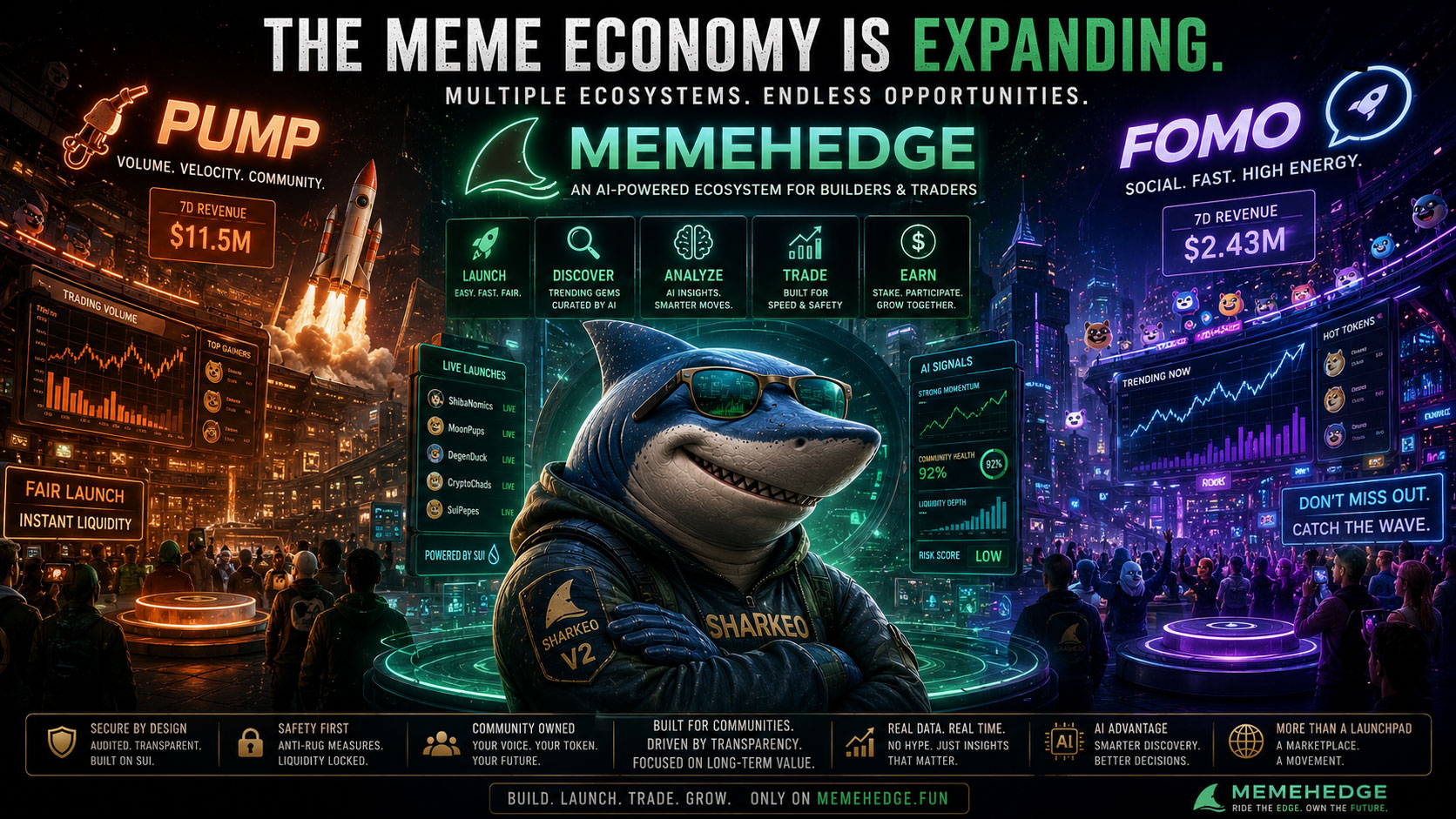
The latest battle between Pump.fun and FOMO isn’t simply another chapter in Crypto X drama. It signals something more important: meme launchpads are beginning to compete the way mature financial platforms compete—for order flow, users, market share and recurring economic activity.
By CoinEpigraph Editorial Desk
Every emerging industry reaches a point where the conversation changes.
At first, participants argue over whether the market itself is real.
Later, they argue over who will lead it.
The meme economy appears to be entering that second phase.
Recent developments surrounding Pump.fun and FOMO illustrate the transition. FOMO has reportedly recorded six consecutive weeks of record trading volume. Pump has responded by introducing additional social features while reports circulated that it was offering incentives designed to attract traders from competing platforms. Public debate followed over fee structures, product features and user experience, while influencers and market commentators quickly joined the discussion. More importantly, both platforms reportedly generated substantial protocol revenue over the past week—approximately $11.5 million for Pump.fun and $2.43 million for FOMO.
Most observers saw another rivalry.
The market may be revealing something larger.
Markets Stop Arguing About Legitimacy
Healthy industries eventually stop debating whether they deserve to exist.
Instead, they begin competing for customers.
Banks compete for deposits.
Brokerages compete for assets.
Exchanges compete for listings.
Streaming platforms compete for subscribers.
Now meme launch platforms are beginning to compete for something equally valuable:
Order flow.
That shift matters because order flow is more than transaction volume.
It represents recurring user participation.
Communities returning.
Builders launching projects.
Traders discovering opportunities.
Liquidity circulating through an ecosystem.
Markets ultimately become durable not because they experience occasional moments of excitement, but because participants continue finding reasons to return.
Competition is often one of the strongest indicators that an industry believes those participants are worth fighting for.
The Product Isn’t Just a Token
Launchpads are frequently described as token factories.
That understates what they actually produce.
They create markets.
They create discovery.
They create liquidity.
They create communities.
They create the first environment where an idea encounters price discovery.
Every successful token begins with someone deciding to build.
The infrastructure simply creates the conditions where builders and communities can find one another.
That distinction becomes increasingly important as launch ecosystems mature.
Competing platforms are no longer differentiating themselves solely by how quickly someone can issue a token.
They are increasingly competing on social engagement, creator tools, discovery mechanisms, user experience, analytics and community development.
Those are characteristics of platforms expecting to exist beyond a single market cycle.
Competition Is Expanding the Market
History rarely supports the belief that one successful platform permanently eliminates every competitor.
Visa did not eliminate Mastercard.
Microsoft did not eliminate Apple.
Coinbase did not eliminate Binance.
Ethereum did not eliminate Solana.
Competition often expands an industry’s total addressable market by encouraging innovation, improving products and giving participants multiple environments in which to operate.
The same dynamic may now be unfolding across meme launch infrastructure.
The emergence of additional successful platforms does not necessarily diminish the leaders.
It can validate the category itself.
If multiple launchpads are generating meaningful economic activity, attracting builders and encouraging communities to participate, the more significant conclusion may not be which platform is winning today’s headlines.
It may be that demand is becoming broad enough to support more than one ecosystem.
The Real Competition Is for Attention
Much of this week’s discussion centered on fees, incentives and product updates.
Those issues matter.
But beneath each of them sits the same objective.
Attention.
In digital markets, attention frequently becomes liquidity.
Liquidity becomes network effects.
Network effects become businesses.
Traditional financial markets have competed for order flow for decades through pricing models, exchange incentives, execution quality and increasingly sophisticated trading infrastructure.
Meme launchpads are beginning to compete using remarkably similar economic principles.
Different technology.
Different assets.
Familiar market mechanics.
That evolution should not be dismissed simply because the underlying assets happen to be memes.
Infrastructure Needs Activity
This development also intersects with a much broader trend across digital finance.
Blockchains require activity.
Transactions.
Users.
Applications.
Developers.
Communities.
Institutional products can contribute enormous transaction size.
Community-driven ecosystems often contribute transaction frequency.
Those are complementary characteristics rather than mutually exclusive ones.
Recent developments across tokenized securities, stablecoins and blockchain-based financial infrastructure suggest that digital capital markets are steadily becoming more institutional.
At the same time, meme ecosystems continue generating remarkable levels of user participation.
One brings credibility.
The other brings engagement.
Healthy networks increasingly appear capable of supporting both.
The Launchpad Wars Are Becoming a Business Story
Perhaps the most interesting aspect of this week’s events is what they reveal about industry priorities.
The conversation is no longer focused exclusively on launching tokens.
It is increasingly about retaining creators.
Improving discovery.
Building communities.
Refining products.
Expanding distribution.
Creating recurring economic activity.
That is how durable businesses are built.
Whether one platform ultimately captures more market share than another will remain an open question.
Markets will answer that over time.
What matters today is that launchpads are beginning to compete like companies expecting to be measured by execution rather than novelty.
That is a meaningful transition.

The Market Is Getting Bigger
Pump.fun’s success helped demonstrate that meme launchpads could become significant businesses.
FOMO’s growth suggests the opportunity may not belong exclusively to one participant.
Others will almost certainly continue entering the space.
Some will fail.
Some will discover underserved communities.
Others will introduce features that reshape user expectations for everyone else.
Competition tends to accelerate that process.
And that is why this week’s developments deserve attention beyond Crypto X.
The story is not simply that two launchpads are competing, but the market is attracting other highly capable launchpads such as MemeHedge.fun and Memebrewery.fun.
It is that an industry once dismissed as speculative experimentation is increasingly exhibiting the characteristics of a competitive market.
Markets stop arguing about legitimacy when they begin arguing about market share.
The meme economy appears to have reached that point.
The winners will not necessarily be the platforms that launch the most tokens.
They will be the ones that build the strongest environments for builders, traders and communities to keep coming back.
That is how ecosystems endure.
And that is why the launchpad wars are becoming far more than a meme story.
They are becoming a market-structure story.
At CoinEpigraph, we are committed to delivering digital-asset journalism with clarity, accuracy, and uncompromising integrity. Our editorial team works daily to provide readers with reliable, insight-driven coverage across an ever-shifting crypto and macro-financial landscape. As we continue to broaden our reporting and introduce new sections and in-depth op-eds, our mission remains unchanged: to be your trusted, authoritative source for the world of crypto and emerging finance.
— Ian Mayzberg, Editor-in-Chief
The team at CoinEpigraph.com is committed to independent analysis and a clear view of the evolving digital asset order.
To help sustain our work and editorial independence, we would appreciate your support of any amount of the tokens listed below. Support independent journalism:
BTC: 3NM7AAdxxaJ7jUhZ2nyfgcheWkrquvCzRm
SOL: HxeMhsyDvdv9dqEoBPpFtR46iVfbjrAicBDDjtEvJp7n
ETH: 0x3ab8bdce82439a73ca808a160ef94623275b5c0a
XRP: rLHzPsX6oXkzU2qL12kHCH8G8cnZv1rBJh TAG – 1068637374
SUI – 0xb21b61330caaa90dedc68b866c48abbf5c61b84644c45beea6a424b54f162d0c
and through our Support Page.
🔍 Disclaimer: CoinEpigraph is for entertainment and information, not investment advice. Markets are volatile — always conduct your own research.
COINEPIGRAPH™ does not offer investment advice. Always conduct thorough research before making any market decisions regarding cryptocurrency or other asset classes. Past performance is not a reliable indicator of future outcomes. All rights reserved | 版权所有 ™ © 2024-2029.