


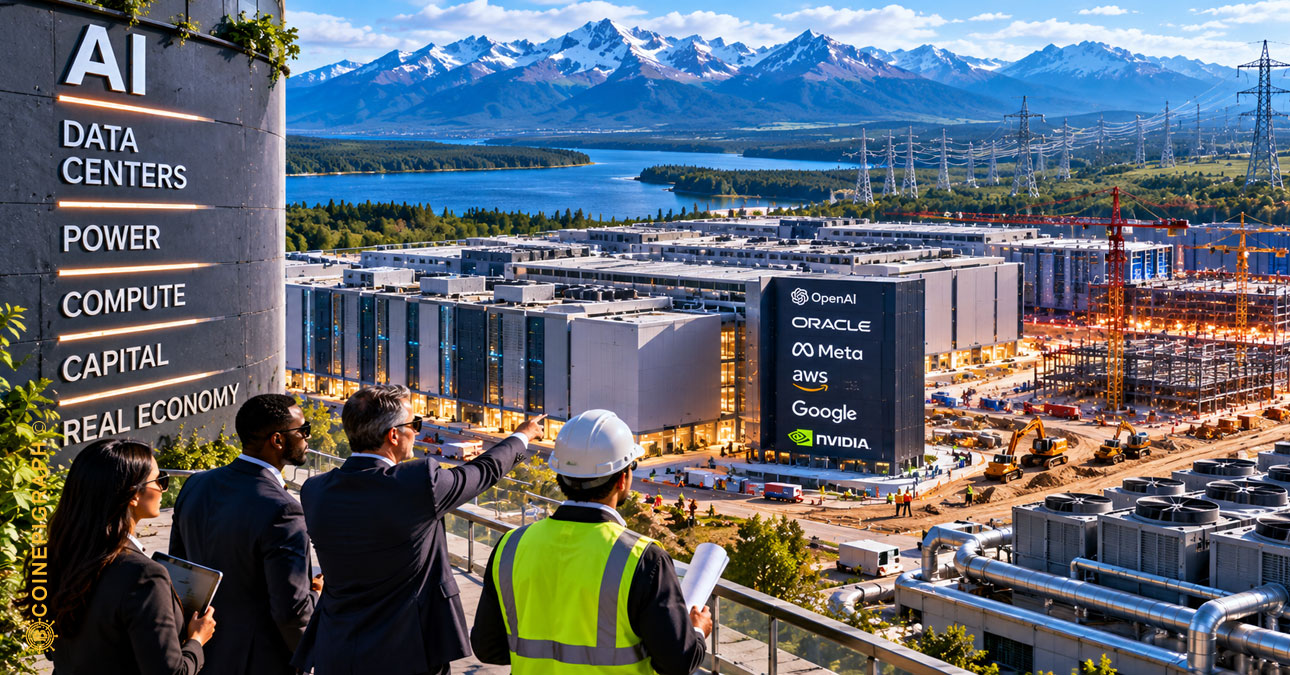
Artificial intelligence began as a technology investment cycle. As data centers, power infrastructure and compute contracts require hundreds of billions of dollars in financing, the boom is increasingly becoming a credit-market experiment—one in which risk can be distributed across securities while remaining concentrated around the same underlying demand.
By CoinEpigraph Editorial Desk
For most of the artificial-intelligence boom, the market has concentrated on what happens inside the model: how much compute produces better performance, which company reaches the next capability threshold, and how quickly businesses and consumers turn those capabilities into revenue.
The more consequential question may now be moving underneath the model.
Someone has to finance the infrastructure.
Oracle offers a useful view into how quickly that problem is changing. At the end of August, the company reported $664 billion of remaining performance obligations, an accounting measure representing contracted revenue that has yet to be recognized. Only about 13% is expected to become revenue during the next twelve months. Another 37% is expected during months 13 through 36, and 34% during months 37 through 60. At the same time, Oracle’s quarterly capital expenditures had climbed to $28.5 billion, from $8.5 billion a year earlier, largely because of data-center expansion.
Those numbers describe more than a rapidly growing cloud business. They reveal one of the central financial problems emerging from the AI infrastructure cycle.
The demand may be contracted years into the future. The infrastructure required to satisfy it must be financed much sooner.
When Backlog Becomes a Capital Requirement
A large backlog can provide valuable visibility into future demand. It does not, however, build the infrastructure required to deliver that demand.
Oracle needs data centers, networking equipment, cooling systems, electrical infrastructure and enormous quantities of accelerated compute. Earlier this year, the company announced plans to raise $45 billion to $50 billion during calendar 2026 through a combination of debt and equity specifically to expand Oracle Cloud Infrastructure for contracted customers including OpenAI, Meta, Nvidia, AMD, TikTok and xAI.
The structure has already begun evolving. By June, Oracle said that customers had prepaid for GPUs or supplied the hardware themselves in several large AI contracts, with those arrangements totaling $75 billion. The company explicitly said this reduced the amount of capital it would otherwise need to raise for its AI data centers.
That detail matters.
The AI capital cycle is not merely getting larger. The participants are beginning to rearrange who carries which portion of the financing burden.
A customer can buy the GPUs. A cloud provider can build the facility. A developer can own the real estate. A utility can finance additional generation or transmission. Private lenders can finance pieces of the infrastructure. Bond investors can fund the corporate balance sheet.
Risk moves through the stack.
It does not disappear.
AI Infrastructure Runs on Several Clocks
This becomes particularly important because the assets underneath artificial intelligence do not share the same economic life.
Land and transmission infrastructure can remain useful for decades. A data-center building can have a long physical life. Debt and leases can extend for years. Compute contracts have their own schedules. The processors inside the facility can move through technological generations much faster.
Power adds another clock.
Moody’s estimates that capital investment by six major U.S. hyperscalers could approach $785 billion in 2026. Its analysis of AI infrastructure financing emphasizes that construction completion alone does not guarantee economic productivity: power availability, utilization, future compute demand and technological relevance can determine whether an asset performs as originally expected.
That creates a distinction capital markets will increasingly have to price.
Physical duration is not technological duration.
A facility can remain physically sound while the economics of the equipment inside it change. A customer can remain contractually committed while its own economics change. A completed data center can exist before sufficient power is available to operate it at intended capacity.
The financing, in other words, may be underwriting several clocks simultaneously.
That is a different problem from deciding whether demand for artificial intelligence is real.
Demand can be enormous and the capital structure built to satisfy it can still be poorly matched to the timing of that demand.

From Technology Capex to Credit Architecture
Oracle is important because its numbers make the transition unusually visible, but the mechanism is much broader.
S&P Global Ratings estimated in May that five major cloud providers—Alphabet, Amazon, Meta, Microsoft and Oracle—would spend roughly $750 billion on capital expenditures in 2026, equivalent to about 38% of their revenue. S&P expected those investments to pressure free cash flow even as AI infrastructure contributed to revenue growth.
By August, S&P was describing a still larger infrastructure cycle in which debt, leases, guarantees and other financing structures were taking a greater role. Its broader projection put combined hyperscaler capital expenditure above $1.3 trillion by 2027.
The financing is consequently migrating beyond the corporate balance sheet.
AI infrastructure exposure is appearing through private credit, asset-based finance, commercial mortgage-backed securities, asset-backed securities and traditional corporate debt. S&P Market Intelligence has warned that this can create an unusual form of concentration: portfolios may appear diversified because they hold different securities while several exposures ultimately depend on demand from the same relatively small group of hyperscalers.
That is where the AI story begins to become a market-structure story.
A pension fund may encounter AI infrastructure through private credit. An insurer may hold corporate bonds. Another institution may own structured debt backed by data-center assets. A private fund may finance power or construction.
The securities are different.
The economic dependency underneath them may not be.
The Bond Market Is Beginning to Notice
This capital requirement is becoming large enough to affect the markets financing it.
Major U.S. hyperscalers have issued roughly $220 billion of bonds over the past year as they expanded AI infrastructure, according to Reuters. The volume has become substantial enough to disrupt some conventional relationships between liquidity, issue size and credit spreads in the investment-grade market.
Oracle offers a more direct example of how the infrastructure cycle is beginning to reach corporate credit quality. S&P Global Ratings lowered the company’s long-term issuer credit rating to BBB- from BBB in July, while assigning a stable outlook. The rating remains investment grade, but now sits at the lowest rung of S&P’s investment-grade scale. The distinction matters less as a verdict on Oracle than as evidence of the financial transmission mechanism taking shape beneath AI: extraordinary contracted demand can support extraordinary infrastructure investment while the capital required to deliver that capacity simultaneously places greater pressure on the balance sheet.
The pressure is becoming more visible. Reuters reported on September 29 that concerns surrounding AI infrastructure financing were increasingly appearing in credit markets, including debt connected to Meta’s Hyperion data-center project. The broader question is no longer confined to whether technology companies can raise capital. It is increasingly what price investors will require to keep supplying it.
That distinction matters because the AI investment cycle is colliding with a less accommodating cost of capital.
The technology can continue improving while financing becomes more expensive. Compute demand can continue increasing while bond investors demand greater compensation. Infrastructure can remain strategically valuable while expected returns decline.
None of those conditions contradict one another.
The Customer Is Part of the Credit Model
There is another layer.
The infrastructure provider ultimately depends on someone being able to purchase the compute.
That customer may itself be financing extraordinary amounts of growth.
This turns the AI infrastructure chain into something more interconnected than the traditional distinction between technology company and customer suggests. A model developer raises capital and commits to compute. A cloud provider uses those commitments to justify infrastructure investment. Capital markets finance portions of that investment. The resulting infrastructure supplies the compute needed for the model developer to expand its products and revenues.
If those revenues materialize at sufficient scale, the system can reinforce itself.
If they develop more slowly, the financial pressure does not necessarily appear first in the model. It can emerge elsewhere in the infrastructure stack.
That is why the most important question surrounding AI capital spending may eventually become less about absolute expenditure than about who owns the duration between investment and monetization.
Compute Is Becoming a Financial Asset Before It Becomes a Financial Market
This also adds another dimension to the emerging machine-native economy.
Compute is becoming measurable, contractible and financeable. Over time, increasingly standardized forms of compute could support more sophisticated markets around capacity, delivery, pricing and risk.
But before compute can become a mature financial market, the physical system producing it must be financed.
That system includes semiconductors, data centers, electricity, transmission, land, cooling, networking and increasingly elaborate contractual relationships among customers, infrastructure providers and capital markets.
AI therefore may be creating two financial transformations simultaneously.
The first is visible: machines are becoming capable of participating more directly in economic activity.
The second is occurring beneath them: the infrastructure supporting those machines is becoming an increasingly important destination for global capital.
The two eventually meet.
A machine-native economy cannot exist without a capital-intensive physical economy underneath it.

The Next AI Benchmark May Be Financial
None of this establishes that the AI infrastructure cycle is unsustainable. Oracle’s expanding contracted obligations provide evidence of extraordinary demand, while customer-supplied and prepaid GPUs demonstrate that financing structures can adapt when capital requirements become unusually large. S&P has also noted that most major hyperscalers retain significant balance-sheet capacity even as their spending increases.
Nor does growing debt automatically signal distress. Infrastructure has always required financing before the economic activity it enables fully develops.
Railroads did.
Telecommunications networks did.
Electric grids did.
The question is whether the duration of the financing can remain aligned with the duration of the economic opportunity.
Artificial intelligence introduces an unusual complication because some of its most expensive productive assets can evolve technologically much faster than the physical infrastructure and financial obligations surrounding them.
That makes Oracle less interesting as a story about one company’s leverage than as an observation deck for the next phase of the AI capital cycle.
The first phase asked whether the models would work.
The second asked whether enough compute could be built.
The next may ask whether hundreds of billions of dollars of infrastructure can be financed, powered and utilized on schedules that allow the economics to work for customers, infrastructure providers and capital markets at the same time.
The AI boom is no longer living only in models, GPUs and technology valuations. It is moving onto balance sheets, into private credit, through structured finance and across the bond market.
The technology may still determine what artificial intelligence can become.
Increasingly, the credit system will help determine how quickly the infrastructure beneath it can get there.
At CoinEpigraph, we are committed to delivering digital-asset journalism with clarity, accuracy, and uncompromising integrity. Our editorial team works daily to provide readers with reliable, insight-driven coverage across an ever-shifting crypto and macro-financial landscape. As we continue to broaden our reporting and introduce new sections and in-depth op-eds, our mission remains unchanged: to be your trusted, authoritative source for the world of crypto and emerging finance.
— Ian Mayzberg, Editor-in-Chief
The team at CoinEpigraph.com is committed to independent analysis and a clear view of the evolving digital asset order.
To help sustain our work and editorial independence, we would appreciate your support of any amount of the tokens listed below. Support independent journalism:
BTC: 3NM7AAdxxaJ7jUhZ2nyfgcheWkrquvCzRm
SOL: HxeMhsyDvdv9dqEoBPpFtR46iVfbjrAicBDDjtEvJp7n
ETH: 0x3ab8bdce82439a73ca808a160ef94623275b5c0a
XRP: rLHzPsX6oXkzU2qL12kHCH8G8cnZv1rBJh TAG – 1068637374
SUI – 0xb21b61330caaa90dedc68b866c48abbf5c61b84644c45beea6a424b54f162d0c
and through our Support Page.
🔍 Disclaimer: CoinEpigraph is for entertainment and information, not investment advice. Markets are volatile — always conduct your own research.
COINEPIGRAPH™ does not offer investment advice. Always conduct thorough research before making any market decisions regarding cryptocurrency or other asset classes. Past performance is not a reliable indicator of future outcomes. All rights reserved | 版权所有 ™ © 2024-2029.