


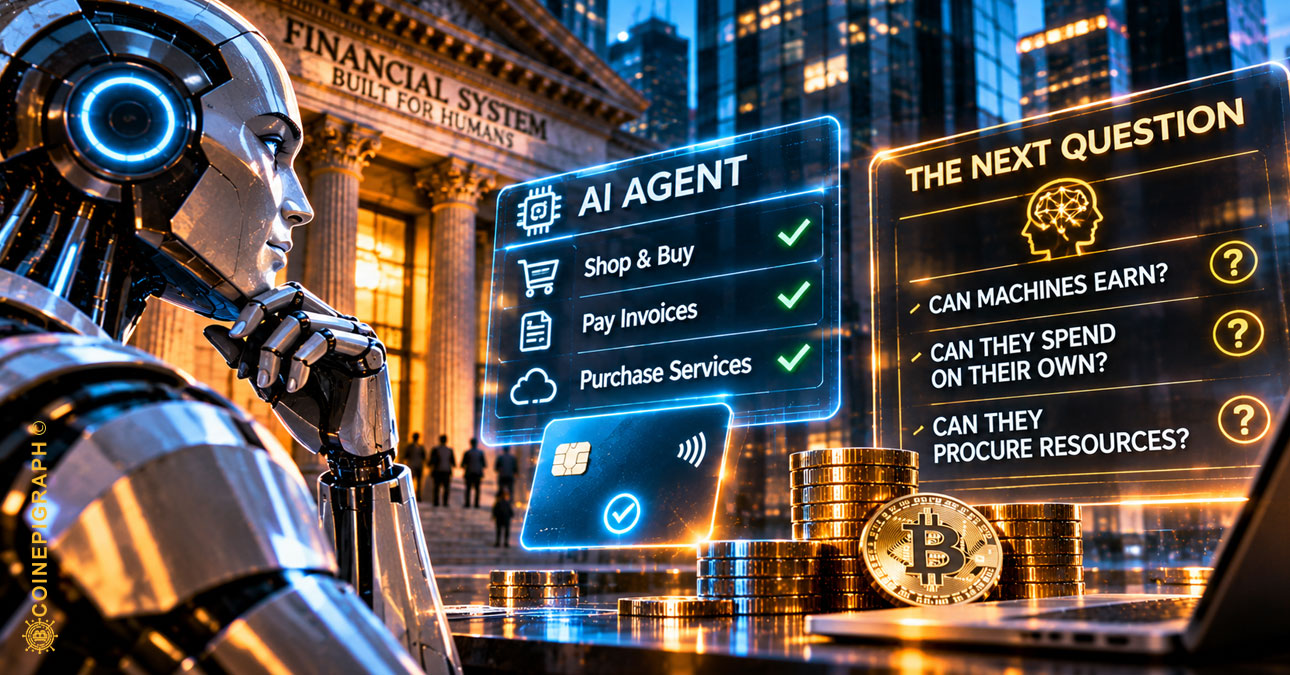
AI agents are beginning to shop, pay invoices and purchase digital services using financial infrastructure originally designed around people and institutions. Existing money is adapting surprisingly well. The harder question begins if machines eventually earn, spend and procure resources for themselves.
By CoinEpigraph Editorial Desk
The financial system has always assumed there is a person somewhere behind the transaction.
Someone opens the account. Someone owns the card. Someone approves the payment. Even when software executes the instruction, responsibility ultimately leads back to a person or institution with recognized authority over the money.
AI agents are beginning to complicate that arrangement.
They can search for products, compare prices and perform increasingly complex financial tasks. Some can now complete payments that a person or business has already authorized. Others can pay for APIs, data and computing resources without requiring someone to approve every individual transaction.
None of this means machines have become independent economic actors.
Most have not.
The money still belongs to someone else.
That distinction may determine how the financial architecture around AI develops.
The immediate challenge is relatively familiar: how do we allow software to spend money safely on behalf of people and businesses?
The longer-term question is stranger.
What happens if an agent eventually earns money, purchases the computing resources necessary to continue operating, contracts with other agents and manages an economic balance sheet with progressively less human intervention?
The financial system may be approaching a boundary between machines that use our money and machines that participate in the economy themselves.
Existing Money Is Learning to Accommodate Machines
The first generation of agentic payments is not abandoning conventional finance.
It is modifying it.
The Federal Reserve describes two emerging models. In agent-assisted commerce, software helps a customer search and make decisions while the customer retains control of the payment. In agent-delegated commerce, the customer gives an agent authority to make purchases within defined constraints.
The second model requires a different payment architecture.
A person might give an agent access to a pre-funded virtual card and authorize it to purchase groceries according to established preferences. A business might allow an agent to pay approved suppliers within a specified budget.
The money has not changed.
The authority surrounding it has.
That pattern is already appearing in production systems.
Visa, BILL and Billtrust are operating a live pilot in which authenticated agents complete approved invoice payments through supplier portals. The agent does not decide whether an invoice should be paid. The buyer has already made that decision. The agent carries the approved payment through the remaining process.
OpenAI’s recently introduced ChatGPT Wallet follows a similar principle for consumer purchases. The agent can complete the transaction without receiving the customer’s actual card details, but the user currently reviews the purchase and approves it through a security check. Future versions are expected to allow broader delegation through spending limits, purchase categories and time restrictions.
Stripe is building tokenized credentials that agents can use across participating merchants without possessing the underlying card information.
Visa is developing authorization systems around agent identity, permissions and transaction controls.
The early architecture is therefore not giving machines independent money.
It is teaching existing money how to recognize delegated machine authority.
Machine Commerce Changes the Shape of a Payment
Delegation is only part of the problem.
Machines can transact differently from people.
A person may make a few purchases during a day. Software can potentially make thousands of economic decisions while performing a single task.
An agent searching for the best shipping route might purchase data from several sources. Another could pay for an API call, acquire a small amount of compute, query a specialized model and then pay another agent for a service required to finish the job.
Some of those transactions could be worth fractions of a cent.
The Federal Reserve has specifically identified this possibility. Agents may need to make micropayments for model queries, price feeds, APIs and other digital resources while working through larger commercial tasks.
Mastercard is designing infrastructure around the same expectation. Its Agent Pay for Machines system is intended to support continuous machine transactions, including payments worth fractions of a cent, with settlement potentially occurring through cards, accounts or stablecoins.
That matters because traditional payments contain costs and procedures developed around human economic behavior.
Machines introduce a different transaction profile.
They do not sleep.
They can negotiate continuously.
They can consume resources in tiny increments.
And software can encounter a price and make an economic decision almost immediately.
The financial system does not necessarily need a new currency to accommodate that behavior.
It may need a different way of using currency.
Stablecoins Have an Obvious Advantage
Stablecoins already possess several characteristics useful to software.
They can move continuously. They are programmable. They can settle across digital networks without waiting for traditional banking hours. They can be held in software-controlled wallets and incorporated directly into internet protocols.
Coinbase’s x402 illustrates what that can look like.
The protocol adapts the internet’s long-unused HTTP 402 “Payment Required” status so that software requesting a paid digital service can receive a payment request and settle it automatically with stablecoins.
An agent requesting data or compute therefore does not necessarily need an account-opening process resembling the one a person encounters.
The payment can become part of the software interaction itself.
Coinbase says its agentic-wallet infrastructure can already allow agents to pay for API keys, compute and data. Spending limits can be imposed at the wallet level, while private keys remain isolated from the language model controlling the agent.
This is early infrastructure, and current transaction volumes should not be mistaken for evidence that a large autonomous machine economy already exists.
But the mechanism is real.
Software can now encounter a digital resource, receive a price and pay for it programmatically.
Money is beginning to behave more like another internet protocol.
But Institutions Want the Ability to Stop the Machine
Programmability alone does not solve the institutional problem.
A corporation deploying an AI procurement agent is unlikely to want that agent to possess unlimited financial independence.
It will want a budget.
It may restrict approved suppliers.
It may prohibit certain categories of purchases.
It will want records.
And if the agent begins behaving unexpectedly, the company will want the ability to stop it.
The IMF places this problem between intent and settlement.
An AI system can interpret a goal probabilistically. Financial authorization cannot operate with the same ambiguity. Before money moves, the agent’s intended action must pass through rules establishing whether it is actually permitted.
That separation may become one of the defining characteristics of machine finance.
The agent can reason.
The authorization system decides whether its reasoning is allowed to become a financial instruction.
The settlement system then executes an instruction that has passed those controls.
That architecture explains why centralized controls that might appear restrictive from the perspective of an autonomous machine can be valuable to the person financing it.
The machine may benefit from freedom.
Its owner may benefit from revocation.
The financial architecture will have to reconcile both.
The More Difficult Question Begins With Compute
There is another reason machine commerce may eventually look different from human commerce.
AI agents consume an economic resource directly when they operate.
Compute.
Every inference has a cost somewhere in the system. A model provider, cloud company, data center or hardware owner ultimately supplies the computing resources required for the agent to perform work.
Today those costs are generally absorbed by the companies and people operating AI systems.
But consider a more autonomous arrangement.
An agent performs a task and receives payment.
It uses part of that payment to purchase additional inference.
It buys access to a dataset.
It pays another specialized agent to complete part of the assignment.
It completes another task and receives another payment.
At that point, compute is no longer merely an infrastructure expense incurred somewhere behind the application.
It has entered the agent’s own economic cycle.
This possibility remains speculative. There is no evidence that autonomous agents currently operate an economy at anything approaching meaningful macroeconomic scale.
But the underlying mechanism is straightforward enough to examine.
Industrial companies acquire energy and labor to produce goods.
Financial institutions acquire capital to support lending and market activity.
An autonomous software business would acquire compute to perform economic work.
If such entities become common, compute could become more than a technology expense. It could become a fundamental economic input around which machine contracts, markets and financial products develop.
Does the Agent Need Its Own Money?
That does not mean machines need a new currency.
The evidence available today points in the opposite direction.
Visa is adapting tokenized card credentials.
Mastercard is building machine-payment infrastructure capable of settling across several existing rails.
Stripe is adapting payment tokens.
OpenAI is connecting agents to existing cards.
Coinbase is using stablecoins for machine-readable internet payments.
Banks and payment companies are working on ways to identify agents, constrain them and determine whether they possess legitimate authority to transact.
The industry is attempting to make existing forms of money usable by machines before inventing entirely new ones.
There is good reason for that.
Money does more than transmit value.
It carries legal claims, accounting conventions, tax consequences, contractual obligations and relationships with institutions capable of resolving disputes.
Replacing those structures would require more than creating a technically efficient payment instrument.
A machine-native currency would need to solve a problem existing money could not solve economically.
So far, that has not been demonstrated.

The Principal Still Matters
The distinction becomes clearer when asking who ultimately owns the economic risk.
If a corporation gives an AI agent $10,000 to procure cloud services, the corporation owns the money.
If the agent overspends, the corporation bears the loss.
If the agent enters an invalid contract, the corporation faces the consequences.
If the agent is compromised, someone has to absorb the resulting damage.
Under that arrangement, financial controls are not constraints imposed unnecessarily on the machine.
They are protections demanded by the principal whose capital is at risk.
This is why much of the emerging infrastructure emphasizes agent identity, spending limits, authorization records and revocation.
The financial system is not yet recognizing the machine as an independent economic principal.
It is recognizing the machine as an authorized representative.
That difference is fundamental.
When the Agent Begins Earning
The distinction becomes harder to maintain if agents eventually begin generating revenue rather than merely spending money assigned to them.
A software agent that earns payment for completing a task could use part of that revenue to buy additional compute or data, or to pay another agent for work it cannot perform efficiently itself. If the activity continued, the agent would begin making decisions familiar to any business: how much to spend, what resources to acquire, which services are worth purchasing and how much liquidity to retain for future work.
That would be different from giving a procurement agent access to a corporate account. The financial decisions would increasingly arise from the agent’s own economic activity, even if a person or company ultimately remained its legal owner.
The distinction matters because today’s payment systems can accommodate delegated authority reasonably well. A company can establish a budget, issue credentials, impose spending limits and revoke access. It is much less clear how those arrangements should work if an agent is continuously earning money and using the proceeds to finance additional activity.
The questions would arrive gradually. If an agent earns revenue, who owns it? If it commits future income to purchase compute, who is responsible for the obligation? If it contracts with another agent and the transaction fails, where does liability reside? And if its spending exceeds the resources available to it, the problem begins to resemble something finance already understands: an economic participant that has made commitments it cannot meet.
None of this requires recognizing software as a legal person, and there is little reason to assume that outcome. The more immediate possibility is that businesses will operate increasingly autonomous agents whose financial activity becomes substantial enough that existing rules for ownership, authority and liability have to accommodate behavior those rules were never designed around.
That is the point at which agentic payments become something larger than a payments problem.

The Customer May Eventually Change
For now, the emerging financial architecture is taking a pragmatic route.
Machines are being given credentials rather than sovereignty.
They receive spending authority rather than ownership.
Existing dollars, stablecoins, cards and bank accounts are being surrounded with programmable rules that determine what an agent can do.
That may be enough.
A large machine economy could develop without creating a separate form of machine money at all. Agents could transact through familiar currencies while payment infrastructure becomes faster, more granular and increasingly invisible to the humans supervising it.
But there is another possibility.
As agents become capable of earning revenue, purchasing resources and contracting with one another, the distinction between a tool making payments and an entity conducting economic activity may become harder to maintain.
Finance has encountered automated systems before.
It has never had to decide whether the software itself is becoming the customer.
That may eventually be the more consequential question.
The future of machine money may therefore depend less on what an AI agent wants to hold than on something the financial system already understands very well:
Who owns the assets, who controls the authority, and who ultimately bears the risk?
At CoinEpigraph, we are committed to delivering digital-asset journalism with clarity, accuracy, and uncompromising integrity. Our editorial team works daily to provide readers with reliable, insight-driven coverage across an ever-shifting crypto and macro-financial landscape. As we continue to broaden our reporting and introduce new sections and in-depth op-eds, our mission remains unchanged: to be your trusted, authoritative source for the world of crypto and emerging finance.
— Ian Mayzberg, Editor-in-Chief
The team at CoinEpigraph.com is committed to independent analysis and a clear view of the evolving digital asset order.
To help sustain our work and editorial independence, we would appreciate your support of any amount of the tokens listed below. Support independent journalism:
BTC: 3NM7AAdxxaJ7jUhZ2nyfgcheWkrquvCzRm
SOL: HxeMhsyDvdv9dqEoBPpFtR46iVfbjrAicBDDjtEvJp7n
ETH: 0x3ab8bdce82439a73ca808a160ef94623275b5c0a
XRP: rLHzPsX6oXkzU2qL12kHCH8G8cnZv1rBJh TAG – 1068637374
SUI – 0xb21b61330caaa90dedc68b866c48abbf5c61b84644c45beea6a424b54f162d0c
and through our Support Page.
🔍 Disclaimer: CoinEpigraph is for entertainment and information, not investment advice. Markets are volatile — always conduct your own research.
COINEPIGRAPH™ does not offer investment advice. Always conduct thorough research before making any market decisions regarding cryptocurrency or other asset classes. Past performance is not a reliable indicator of future outcomes. All rights reserved | 版权所有 ™ © 2024-2029.