


By CoinEpigraph Editorial Desk | December 10, 2025
A quiet shift in attacker behavior is beginning to redefine one of the most overlooked risks in digital-asset infrastructure. Nearly one week ago, a coordinated group used an evolved mimicry form of “address poisoning” to steal $1.1 million in USDT on Ethereum. The incident was not novel because funds were taken – losses happen daily – but because of how the theft occurred.
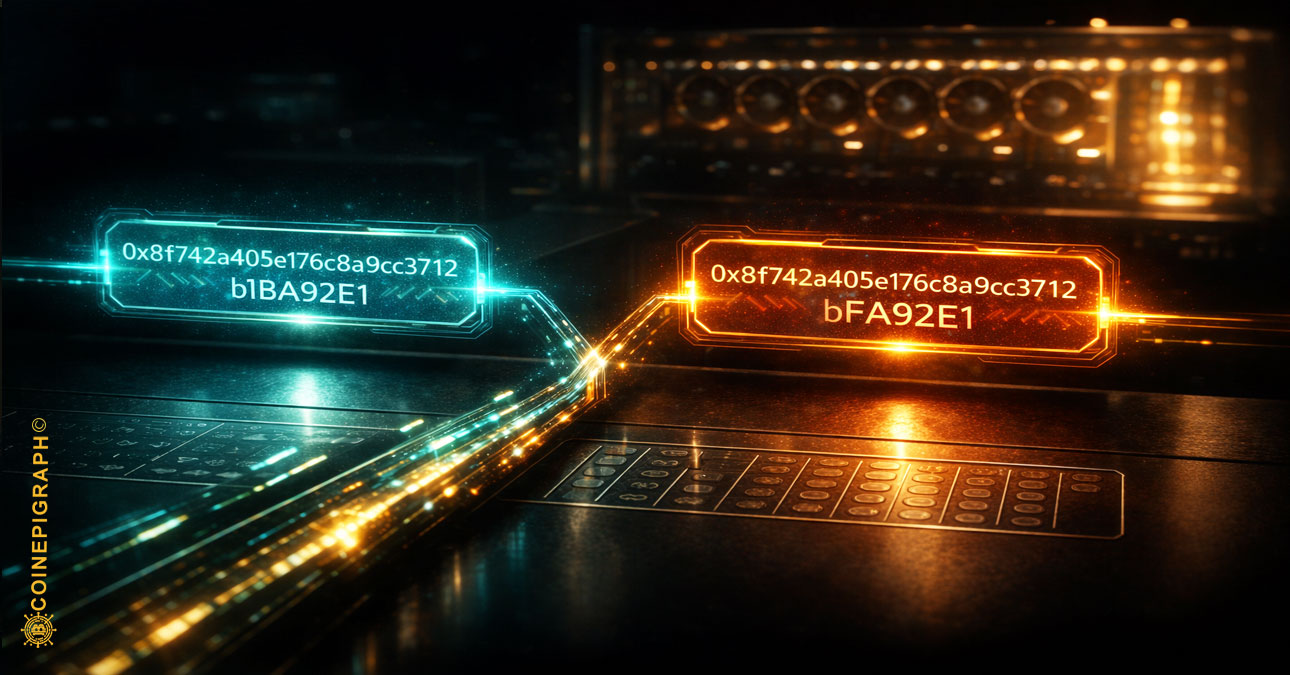
According to analysis from Ramiel Capital’s CIO, the attackers monitored outbound transfers from whale wallets, identified behavioral patterns, and then used GPU-accelerated address-generation systems to create near-identical look-alike addresses. This allowed them to inject counterfeit settlement destinations into environments where human operators or automated processes might not differentiate a legitimate address from an impostor.
What was once a low-effort nuisance has become a computationally enhanced attack vector. And it exposes a deeper truth: address-based settlement architecture is beginning to strain under institutional-scale usage.
A Technical Vulnerability Becomes Operational Risk
Traditional address-poisoning relies on social oversight failures. Attackers send a dust transaction from a spoofed address, hoping that a user later copies it from transaction history. It is unsophisticated and opportunistic. GPU-based mimicry is different. It scales.
With modern hardware, attackers can generate millions of addresses that share:
- identical leading characters,
- mirrored trailing characters,
- visually similar internal patterns,
- or entropy profiles that appear legitimate to both humans and some interfaces.
As these addresses become nearly indistinguishable on mobile displays, multi-wallet dashboards, or partial-address UI formats, the attack surface shifts from retail error to institutional exposure.
The fact that attackers are now monitoring outbound behavior before deploying near-collision addresses shows an escalation in methodology: reconnaissance before insertion. Treasury teams, DAOs, OTC desks, and funds executing large transfers are now meaningful targets, not incidental victims.
The Hidden Weakness: Human-Invisible Address Systems
The current generation of public-key address formats—long alphanumeric strings with no built-in semantic meaning—was never designed for trillion-dollar settlement flows. Their opacity forces operators to rely on:
- manual verification,
- copy/paste workflows,
- context-dependent trust,
- and partial-display UI conventions.
These are brittle controls. When high-value operations rely on human pattern recognition to confirm the legitimacy of a settlement destination, attackers will naturally gravitate toward exploiting the gap.
GPU-based mimicry is simply the newest way to widen that gap.
The Expanding Consequences for Institutional Infrastructure
The implications extend beyond a single theft:
1. Multisig and DAO Governance Flows
When governance operations rely on address whitelists or clipboard workflows, look-alike spoofing presents a direct governance-risk vector.
2. Fund, OTC, and Treasury Execution Pipelines
Large transfers executed under times pressure are vulnerable to even momentary address confusion, especially when internal dashboards truncate or obfuscate the middle of addresses.
3. Exchange Hot-Wallet Operations
Automated or semi-automated withdrawal systems that depend on UI-level verification become susceptible to sophisticated poisoning attempts.
4. Compliance Systems
Risk engines and monitoring tools that rely on prefix/suffix heuristics may fail to differentiate a counterfeit destination from a known address.
The attack does not target the blockchain. It targets the interface layer, where human trust and machine assumptions intersect.
Why the Timing Matters
This escalation comes as digital settlement volumes are increasing and institutional adoption is accelerating. Tokenized treasuries, on-chain collateral, and cross-border digital settlement experiments are expanding. As these flows grow, so does the strategic importance of addressing the fragility in the underlying address paradigm.
The transition from opportunistic retail scams to GPU-orchestrated mimicry indicates that attackers are beginning to treat address exploitation as a viable, systematic revenue model. The sophistication is catching up to the economic footprint.
Where Infrastructure Must Evolve
The industry has several clear paths forward, each of which aligns with the direction of market-structure modernization:
1. Enhanced Address Visualization
Interfaces must move beyond the five-character prefix/suffix pattern. Options include:
- entropy heat maps,
- checksum color encoding,
- standardized human-readable subidentifiers,
- or visual identity commitments baked into address displays.
These are not cosmetic upgrades; they are controls.
2. Native Wallet Warnings
Wallets should warn when an address resembles a known address within a defined entropy proximity. If attackers can generate look-alike patterns, wallets can detect them.
3. Account Abstraction and Smart Identity Layers
Future settlement rails may rely less on raw addresses and more on:
- smart-contract wallets with verifiable identity commitments,
- session keys,
- tagged recipient identifiers,
- or policy-based transaction frameworks.
This reduces reliance on naked hexadecimal strings as the final authority of intent.
4. Institutional Execution Standards
Treasury teams and infrastructure providers can adopt:
- dual-channel verification,
- mandatory address whitelisting,
- pre-transaction settlement fingerprints,
- and automatic entropy-distance checks before releasing funds.
These measures would not eliminate social engineering but would significantly reduce its viability.
The Larger Lesson: Address-Based Settlement Is Becoming Obsolete
The emergence of GPU-driven mimicry attacks is not merely a cybersecurity story. It is a rail story. It highlights the increasing mismatch between:
- the scale of value flowing across digital networks,
- the institutional actors now deploying capital on-chain,
- and the simplicity of the addressing system inherited from early blockchain design.
Markets rarely scale on systems that cannot guarantee intent. As digital infrastructure matures, the settlement paradigm must evolve from opaque identifiers to verifiable, human-auditable identity layers capable of supporting global capital flows.

Bottom Line
The theft of $1.1 million USDT via GPU-accelerated address mimicry is not an isolated incident. It is a signal that attackers are industrializing techniques that exploit a structural weakness in the digital-asset settlement model.
As institutional activity grows, the reliability of address-based transfers becomes a limiting factor. The next phase of digital-asset architecture will require a shift from human-invisible strings to security primitives that support the scale, speed, and precision of modern capital markets.
The attack is not the story.
The system it exposes is.
At CoinEpigraph, we are committed to delivering digital-asset journalism with clarity, accuracy, and uncompromising integrity. Our editorial team works daily to provide readers with reliable, insight-driven coverage across an ever-shifting crypto and macro-financial landscape. As we continue to broaden our reporting and introduce new sections and in-depth op-eds, our mission remains unchanged: to be your trusted, authoritative source for the world of crypto and emerging finance.
— Ian Mayzberg, Editor-in-Chief
The team at CoinEpigraph.com is committed to independent analysis and a clear view of the evolving digital asset order.
To help sustain our work and editorial independence, we would appreciate your support of any amount of the tokens listed below. Support independent journalism:
BTC: 3NM7AAdxxaJ7jUhZ2nyfgcheWkrquvCzRm
SOL: HxeMhsyDvdv9dqEoBPpFtR46iVfbjrAicBDDjtEvJp7n
ETH: 0x3ab8bdce82439a73ca808a160ef94623275b5c0a
XRP: rLHzPsX6oXkzU2qL12kHCH8G8cnZv1rBJh TAG – 1068637374
SUI – 0xb21b61330caaa90dedc68b866c48abbf5c61b84644c45beea6a424b54f162d0c
and through our Support Page.
🔍 Disclaimer: CoinEpigraph is for entertainment and information, not investment advice. Markets are volatile — always conduct your own research.
COINEPIGRAPH™ does not offer investment advice. Always conduct thorough research before making any market decisions regarding cryptocurrency or other asset classes. Past performance is not a reliable indicator of future outcomes. All rights reserved | 版权所有 ™ © 2024-2029.