


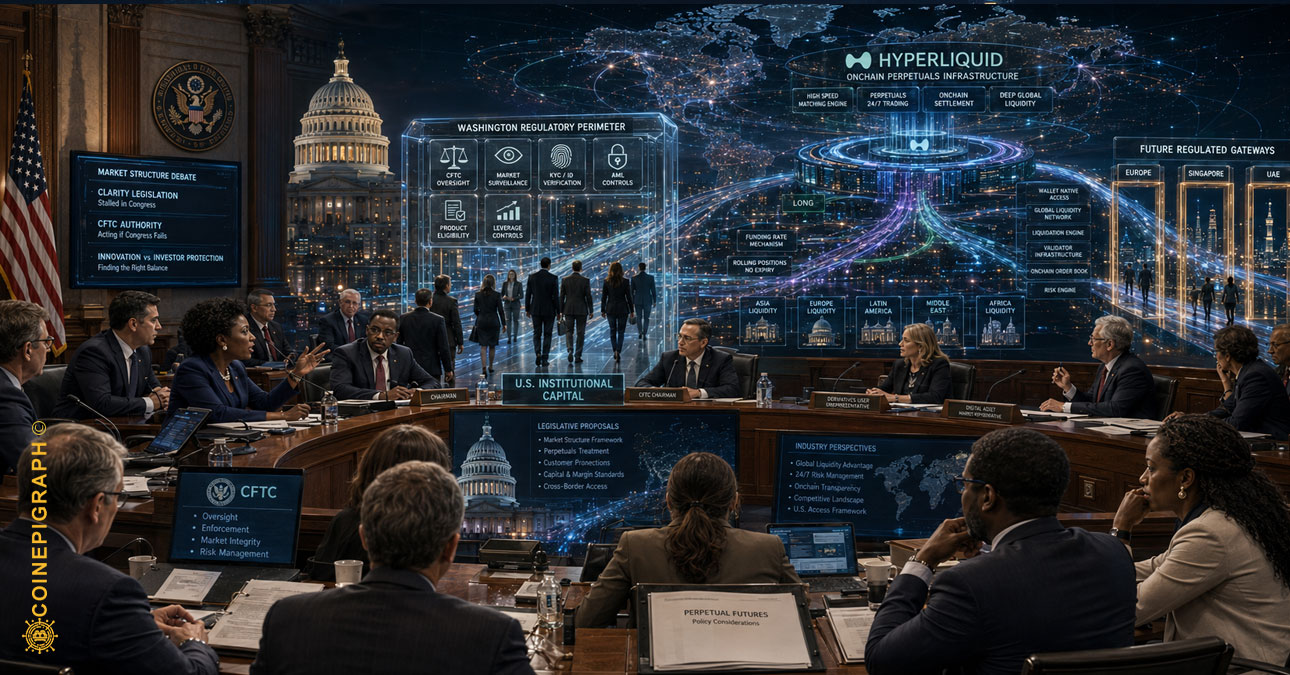
Trump’s Hyperliquid comments may point toward something larger than a U.S. opening for one crypto platform: a financial architecture in which global onchain markets remain distributed while governments regulate the interfaces through which their citizens reach them.
By CoinEpigraph Editorial Desk
When President Donald Trump mentioned Hyperliquid at the White House this week, the market heard a token story.
HYPE rallied sharply. Shares of Hyperliquid-related investment vehicles moved higher. Traders quickly began calculating what access to American capital might mean for a network that has already become one of the most important venues in onchain derivatives.
But the more consequential part of Trump’s statement was not the implied endorsement of HYPE.
It was the architecture hidden inside the language.
“I understand Mike is also working to bring Hyperliquid into the United States in a fully compliant and legal fashion,” Trump said, referring to Commodity Futures Trading Commission Chair Michael Selig.
A day later, Selig gave that comment considerably more policy weight. At the CFTC’s Innovation Advisory Committee meeting, he said the agency was examining how existing authority might be used to create a regulatory category for crypto markets and indicated that staff would engage with developers of onchain financial protocols about compliant pathways into the United States.
There is no Hyperliquid approval yet. No announced U.S. entity. No finalized registration structure. No published product list. No timetable establishing when American customers might gain access.
That distinction matters.
The market is pricing an option.
CoinEpigraph is more interested in what that option could reveal.
Because if Washington ultimately finds a way to provide regulated American access to Hyperliquid without requiring the underlying network to become a conventional American exchange, the regulatory experiment will extend well beyond one protocol.
It would suggest that a different financial architecture is becoming conceivable.
The protocol can be global.
The market can be onchain.
The liquidity can remain distributed.
And the doorway can be regulated.
The Asset and the Infrastructure Are Not the Same Thing
The first distinction is between HYPE and Hyperliquid itself.
They are related, but they are not interchangeable.
HYPE is the native asset embedded in Hyperliquid’s network economics. Hyperliquid is the financial infrastructure through which trading, liquidity, execution and settlement occur.
That distinction has already produced an unusual regulatory condition.
American investors can obtain forms of economic exposure associated with HYPE through investment structures and trading venues accessible from the United States, while Hyperliquid’s principal interface remains unavailable to U.S. persons under its terms. SEC filings for proposed HYPE investment products explicitly acknowledge that distinction: the Hyperliquid interface restricts U.S. persons even though the underlying network can technically be reached through compatible applications or wallets.
In other words, an American investor can potentially gain economic exposure to an asset whose principal utility emerges from financial infrastructure that the same investor cannot ordinarily access through its primary interface.
That is more than a crypto curiosity.
It exposes the growing separation between asset ownership, protocol participation and regulated market access.
Trump’s wording is therefore important because he did not merely discuss making HYPE more accessible.
He named Hyperliquid.
If that distinction proves intentional at the policy level, Washington is confronting a more difficult question than whether another crypto asset should trade in America.
It is asking how Americans might legally enter a financial market whose underlying machinery was not built inside the traditional American financial perimeter.
Perpetuals Left America. Then the Market Changed.
Perpetual futures sit near the center of the problem.
Unlike conventional futures, perpetual contracts have no fixed expiration date. A funding mechanism helps keep the contract aligned with the underlying spot market. They became one of crypto’s dominant trading instruments, but much of that activity developed outside the United States.
Selig himself has described this history.
When the CFTC permitted a true bitcoin perpetual contract on a registered U.S. exchange in May, he argued that the absence of a domestic regulatory pathway had pushed one of crypto’s most liquid market segments offshore.
That history matters because the first phase of regulatory arbitrage was familiar.
Activity moved from one jurisdiction to another.
A trader unable to obtain a product on a U.S. venue could seek it through an exchange somewhere else.
Hyperliquid introduces a different possibility.
Liquidity no longer has to migrate from an American centralized exchange to a foreign centralized exchange.
It can migrate onchain.
Once that happens, the regulatory problem changes.
The market is no longer necessarily sitting inside another country waiting for Washington to negotiate with that country’s institutions. The market may exist across distributed infrastructure, accessible through software, wallets and interfaces from many places at once.
The old map begins losing explanatory power.
And Washington is left with three broad choices.
It can continue trying to keep American participants away from that infrastructure.
It can accept that an increasingly important segment of financial innovation will develop beyond meaningful U.S. participation.
Or it can construct a compliant route through which American capital enters the market.
The Trump and Selig comments suggest that the third option is no longer theoretical.
Onshoring Without Bringing the Engine Ashore
This is where the Hyperliquid story becomes more interesting than Hyperliquid.
“Onshoring” normally implies moving an activity into the United States.
A factory comes home. A supply chain relocates. A company establishes a domestic subsidiary. A financial institution registers, builds local infrastructure and operates within the national regulatory perimeter.
Distributed financial networks complicate that model.
There may be no reason to duplicate the entire underlying financial engine inside every country that wants regulated access to it.
Instead, regulation could increasingly attach itself to the interface.
Imagine the architecture in layers.
At the bottom sits a global financial engine: blockchain infrastructure, validators, matching, execution, liquidity and settlement.
Above it sit jurisdictional gateways.
The American gateway can impose American requirements. Identity verification. AML controls. customer eligibility. leverage restrictions. reporting obligations. market-surveillance requirements. permitted products.
A European interface can apply a different regulatory framework.
Singapore can apply another.
Other jurisdictions can construct their own doors into some portion of the same underlying infrastructure.
The protocol remains global.
The UX becomes jurisdictional.
That would represent a subtle but significant change in how financial regulation is organized.
The regulatory perimeter does not disappear.
It moves.
Regulation at the Doorway
Traditional financial regulation evolved around institutions.
Exchanges, broker-dealers, futures commission merchants, clearing houses, custodians and banks occupy identifiable positions in the market structure. Regulators know where those institutions sit and where obligations can be attached.
Onchain finance separates functions that historically lived inside the same corporate perimeter.
The protocol may execute.
A wallet may provide custody.
A separate application may provide the interface.
Liquidity may come from participants scattered around the world.
Settlement may occur through the network itself.
Governance may sit somewhere else again.
Trying to force that entire architecture into a regulatory framework designed for vertically integrated intermediaries can produce an awkward result: either the network must be reconstructed to resemble the old system, or access is prohibited because the new system does not fit the old categories.
A jurisdictional-interface model offers another possibility.
Instead of demanding that every component of the global machine become American, regulators concentrate many of their requirements at the point where an American participant enters it.
That is not deregulation.
In some respects, it could become a more technologically explicit form of regulation.
The government would regulate the legal relationship between its citizens and a global financial network even when it cannot—or chooses not to—nationalize the network itself.
The internet offers an imperfect but useful analogy.
Countries did not reproduce the internet inside their borders before allowing citizens to use it. They constructed legal regimes around what people and companies could do through globally connected infrastructure: privacy, payments, securities solicitation, intellectual property, identity, commerce and data.
Finance is harder because losses, leverage, custody, manipulation and systemic risk create obligations that cannot simply be delegated to software.
But the architectural question is similar.
Must the infrastructure itself belong to the jurisdiction?
Or can the jurisdiction govern the conditions under which its participants access that infrastructure?
Hyperliquid may become one of the first serious tests of that distinction in global financial markets.
The Liquidity Question
There is another reason the architecture matters.
Regulation has historically fragmented markets partly because jurisdictions create separate venues.
American traders meet inside one regulatory perimeter. European traders may meet inside another. Offshore liquidity develops somewhere else.
The result can be multiple pools of capital trading economically similar instruments through different infrastructure.
A global-engine/local-interface model raises a more provocative possibility.
The compliance layer could fragment without the underlying liquidity fragmenting to the same degree.
That distinction could eventually matter more than token prices.
If multiple regulated gateways can reach common or interoperable liquidity, capital may remain subject to different jurisdictional rules without requiring entirely separate financial engines beneath each jurisdiction.
The potential consequences extend into spreads, collateral efficiency, price discovery, settlement, market depth and the economics of exchange infrastructure itself.
This is also where comparisons with incumbent derivatives institutions become more serious.
Hyperliquid is commonly described as a competitor to crypto exchanges such as Coinbase, Kraken or Binance.
That may eventually prove too narrow.
A market architecture combining continuous trading, wallet-native access, onchain settlement, transparent infrastructure, perpetual contracts and global liquidity begins to compete at the level of financial market design.
That places the long-term comparison closer to the territory occupied by CME Group, Intercontinental Exchange and other operators of conventional market infrastructure.
Not because Hyperliquid is about to replace them.
It is not.
But because the relevant competition may ultimately be between two different architectures for organizing markets: nationally intermediated financial infrastructure and globally shared digital infrastructure accessed through regulated local gateways.
The distinction is considerably larger than crypto exchange market share.
Financial Sovereignty Has a Paradox
For Washington, this creates an uncomfortable policy problem.
Keeping American capital away from globally distributed markets may appear to preserve regulatory sovereignty.
But exclusion has a cost.
If new forms of liquidity, settlement, collateral management, derivatives and tokenized assets develop outside the American regulatory perimeter, the United States can preserve control over the markets Americans are permitted to use while gradually losing influence over the markets the rest of the world is building.
That is the sovereignty paradox.
A country can defend its perimeter so successfully that innovation develops beyond it.
The policy question then changes.
It is no longer merely:
How should America regulate crypto?
It becomes:
How does America prevent the financial infrastructure of the next generation from developing without meaningful American capital, institutions or regulatory influence?
That is financial industrial policy.
Seen through that lens, creating compliant pathways into global onchain markets does not necessarily represent the surrender of American financial sovereignty.
It may represent an attempt to preserve it.
The United States does not have to own every underlying protocol to exert influence over the standards through which American institutions interact with those protocols.
And American capital itself remains a form of market power.
Once major U.S. institutions, intermediaries and investors participate through regulated gateways, the requirements attached to that participation can influence the infrastructure around them.
Washington would be exporting standards through access rather than importing the entire financial engine.
The Engine May Not Need a Passport
The architecture can be reduced to a simple proposition.
The engine may not need a passport. The doorway does.
That does not mean implementation will be simple.
Quite the opposite.
Financial regulation exists because financial failure creates consequences that software architecture cannot wish away.
Who bears responsibility when a liquidation mechanism fails?
Who conducts market surveillance?
Who responds to manipulation?
How are customer assets treated?
What leverage can American participants obtain?
Who responds when regulators demand records?
What happens if protocol governance changes the market after a regulated gateway has been approved?
What happens when a global protocol lists a product that American users cannot legally trade?
And what prevents a participant rejected by the regulated interface from simply constructing or using another interface?
These questions expose the limit of the cleanest version of the global-engine/local-UX thesis.
A regulator can regulate a doorway.
A permissionless network may have many doors.
That means the Hyperliquid experiment, if it proceeds, will test something more difficult than whether the CFTC can authorize another trading venue.
It will test whether jurisdictional financial regulation can be attached effectively to infrastructure that is not itself fully jurisdictional.
That question remains unresolved.
Which Hyperliquid Comes to America?
This is why investors should resist treating Trump’s statement as if U.S. access has already been achieved.
HYPE’s immediate reaction was substantial. Reports put the token’s advance in the double digits after Trump’s remarks, with some measurements approaching 20% as traders interpreted the statement as a potentially material change in Hyperliquid’s regulatory outlook.
But the market is repricing regulatory optionality, not regulatory completion.
There is an enormous difference between those two things.
A compliant American pathway could take several forms.
The existing protocol might remain substantially intact while a regulated American access layer is constructed around it.
A separate U.S. platform could emerge with KYC, leverage limits and a narrower product set.
A CFTC-regulated venue could potentially use portions of Hyperliquid’s infrastructure for execution or settlement.
Licensed American intermediaries could conceivably provide customers with regulated access to liquidity residing deeper in the network.
Selig’s recent comments make the range of possibilities particularly important. The CFTC is reportedly exploring whether existing registrants and currently unregistered crypto exchanges could operate within a new form of designated market structure, while engaging directly with developers of onchain protocols. (CryptoSlate)
Those architectures are not economically equivalent.
A walled-off Hyperliquid U.S. product with separate liquidity would have different implications from an American interface reaching the existing global market.
A licensed intermediary routing activity into Hyperliquid would have different consequences from Hyperliquid itself becoming a regulated venue.
And each model would transmit American participation differently into HYPE’s network economics.
That is the variable investors should watch.
Not merely whether Hyperliquid “comes to America.”
Which Hyperliquid comes to America?
HYPE Is Pricing the Door Opening
There is a rational reason the token responded.
Before this week’s policy signal, the conceptual valuation equation contained an obvious subtraction:
global participation + onchain derivatives + network economics − direct U.S. market access.
A credible compliant pathway changes the equation:
global participation + onchain derivatives + network economics + potential U.S. participation.
The size of American institutional and retail capital makes that optionality meaningful.
But optionality deserves a discount until architecture becomes policy and policy becomes implementation.
Trump’s statement is not a CFTC registration.
Selig’s exploration is not a final rule.
And a regulatory category does not tell investors how much of Hyperliquid’s existing economic model would survive inside the American version.
Those distinctions will eventually matter more to valuation than the initial headline.

Hyperliquid Is the Case Study, Not the Thesis
The larger significance emerges when the model is extended beyond perpetual futures.
If governments discover that globally distributed financial engines can coexist with jurisdiction-specific regulatory interfaces, the same architecture could eventually appear around tokenized securities, commodities, foreign exchange, real-world assets, prediction markets and other digitally native financial instruments.
The details would differ enormously.
Securities law is not derivatives law. Commodity markets introduce their own requirements. Prediction markets raise different jurisdictional questions again. Tokenized real-world assets ultimately connect software to legal claims over assets that exist outside the chain.
But the structural principle would remain recognizable.
Global infrastructure underneath. Jurisdictional regulation above.
Capital would move through locally compliant doors into markets whose underlying architecture may be shared across borders.
That would invert an assumption that has governed financial markets for generations.
Historically, access followed infrastructure.
If an investor wanted to participate in a particular financial system, the investor entered the institutions and jurisdiction in which that system operated.
Distributed networks create the possibility that infrastructure comes first and jurisdiction is applied closer to the participant.
Hyperliquid may or may not become the template.
Its American pathway may prove narrower than markets currently expect. Litigation, statutory limitations, market-surveillance requirements or political change could constrain the experiment. Congress could ultimately establish a framework different from the one regulators are now exploring; Reuters reported this week that the stalled CLARITY legislation has already increased the importance of agency action, while also making those actions potentially less durable than legislation.
But the question Washington is confronting will remain even if Hyperliquid itself does not provide the final answer.
Global financial infrastructure is becoming increasingly capable of existing beyond the borders that historically contained exchanges, brokers and settlement systems.
Capital can move.
Liquidity can move.
Software can move faster.
The regulatory perimeter therefore has to decide whether it will attempt to contain the engine, remain outside the engine, or regulate the doors leading into it.
Trump’s Hyperliquid remark may eventually be remembered as little more than a presidential name-check that sent a token higher.
But if the CFTC succeeds in constructing a compliant American interface into financial infrastructure that remains fundamentally global, the more important development will not be that Hyperliquid came to the United States.
It will be that the United States found a way to enter Hyperliquid without requiring Hyperliquid’s underlying financial engine to become American.
And that would point toward something much larger than the future of HYPE.
It would point toward a world in which financial infrastructure globalizes while regulation becomes the architecture of access.
At CoinEpigraph, we are committed to delivering digital-asset journalism with clarity, accuracy, and uncompromising integrity. Our editorial team works daily to provide readers with reliable, insight-driven coverage across an ever-shifting crypto and macro-financial landscape. As we continue to broaden our reporting and introduce new sections and in-depth op-eds, our mission remains unchanged: to be your trusted, authoritative source for the world of crypto and emerging finance.
— Ian Mayzberg, Editor-in-Chief
The team at CoinEpigraph.com is committed to independent analysis and a clear view of the evolving digital asset order.
To help sustain our work and editorial independence, we would appreciate your support of any amount of the tokens listed below. Support independent journalism:
BTC: 3NM7AAdxxaJ7jUhZ2nyfgcheWkrquvCzRm
SOL: HxeMhsyDvdv9dqEoBPpFtR46iVfbjrAicBDDjtEvJp7n
ETH: 0x3ab8bdce82439a73ca808a160ef94623275b5c0a
XRP: rLHzPsX6oXkzU2qL12kHCH8G8cnZv1rBJh TAG – 1068637374
SUI – 0xb21b61330caaa90dedc68b866c48abbf5c61b84644c45beea6a424b54f162d0c
and through our Support Page.
🔍 Disclaimer: CoinEpigraph is for entertainment and information, not investment advice. Markets are volatile — always conduct your own research.
COINEPIGRAPH™ does not offer investment advice. Always conduct thorough research before making any market decisions regarding cryptocurrency or other asset classes. Past performance is not a reliable indicator of future outcomes. All rights reserved | 版权所有 ™ © 2024-2029.