


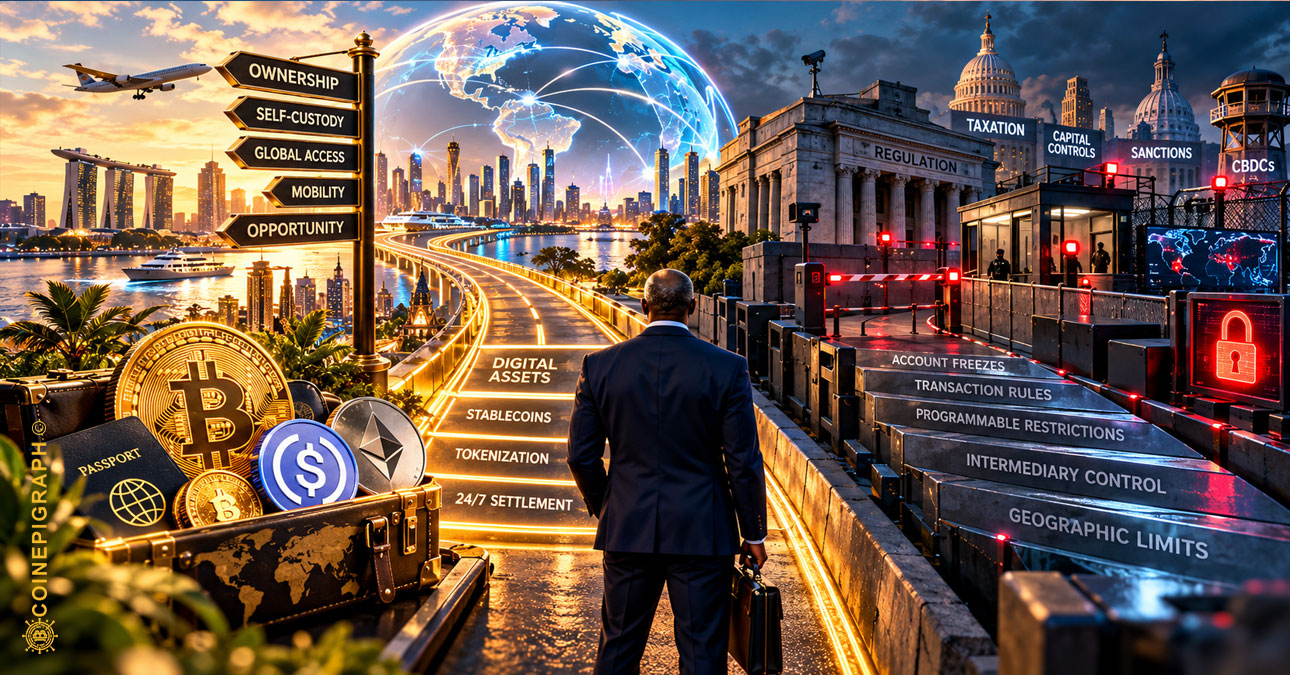
Capital has never been easier to move, tokenize or program. Yet the infrastructure carrying that wealth increasingly determines when it can move, where it can go and who can intervene. The next financial divide may not be between digital and traditional money, but between ownership of capital and authority over it.
By CoinEpigraph Editorial Desk
For generations, financial sovereignty had a relatively intuitive meaning. If a person accumulated wealth, maintained legal ownership of it and could decide where to invest or spend it, that person could reasonably consider the capital under his or her control.
The modern financial system has made that definition harder to sustain.
An investor can own securities while a custodian holds them. A depositor can own a claim on a bank while the bank controls the account through which that claim is exercised. A stablecoin holder can possess tokens in a private wallet even though the issuer may retain the ability to freeze certain addresses. A government can recognize private ownership while simultaneously restricting how much currency leaves the country.
None of this means ownership has become meaningless. It means ownership and control were never quite the same thing.
The distinction is becoming harder to ignore as capital becomes digital, portable and increasingly programmable.
Ownership is a legal condition. Control is increasingly an infrastructural condition.
Capital Is Moving Before the Architecture Is Settled
One of the more visible expressions of this tension is the movement of wealthy individuals and businesses between jurisdictions.
The source material behind this analysis points to recent wealth migration from Britain and Norway toward jurisdictions including Switzerland, Italy, Singapore and the United Arab Emirates. It attributes those movements to combinations of taxation, regulation and changing perceptions of financial risk. It also points to a much older phenomenon: capital tends to become more mobile when its owners believe the rules governing it may become less favorable. Pasted text
There is nothing particularly digital about that behavior.
Families have moved. Companies have relocated. Assets have crossed borders. Corporations have changed domiciles. Capital has always searched for jurisdictions offering some preferred combination of stability, opportunity, taxation and legal protection.
What is different now is the infrastructure available to perform the movement.
Historically, moving significant capital internationally usually meant moving through financial institutions. Banks communicated through networks such as SWIFT, correspondent institutions reconciled obligations, currencies were converted and compliance systems examined the transaction before settlement was completed.
The owner could decide that capital should move. The financial infrastructure still determined how that decision became economically real.
Digital assets have begun to disturb that relationship.
Mobility Is Not the Same as Sovereignty
Stablecoins demonstrate the change particularly well.
A dollar-denominated token can move between blockchain addresses without traversing the same correspondent-banking chain required for a conventional international bank transfer. That changes the geography and speed of dollar movement.
It does not necessarily give the holder complete authority over the asset.
Regulated or centrally issued stablecoins retain relationships with issuers, reserves, redemption mechanisms and legal systems. Some issuers can freeze tokens associated with particular addresses under specified circumstances. The asset can therefore possess characteristics of bearer-like mobility while retaining an institutional control layer.
That is an unusual combination.
The holder controls a private key. The issuer controls aspects of the monetary instrument. The blockchain controls execution according to its protocol. The legal system determines the rights and obligations surrounding the asset.
Control has been distributed rather than eliminated.
That distinction matters because financial sovereignty is often discussed as though money falls neatly into two categories: money an individual controls and money an institution controls.
The emerging system is much messier.
Different actors can possess different forms of authority over the same capital.
Programmability Changes Both Sides of the Equation
The next stage makes the distinction more consequential.
Money is becoming programmable.
Tokenized deposits, stablecoins and experiments involving central-bank money increasingly allow financial instructions to interact with software. Payments can potentially respond to conditions. Settlement can occur automatically. Compliance information can become part of transaction architecture. Smart contracts can determine when assets move without requiring a human operator to initiate every step.
This is usually described as an efficiency story.
It is also a control story.
Programmability expands what capital can do, but the same capability can expand what institutions can tell capital not to do.
Those two developments are not contradictory. They are properties of the same architecture.
A payment system capable of automatically determining that a transaction satisfies specified conditions can also determine that another transaction does not. An asset capable of moving instantly between approved counterparties can potentially be prevented from moving to an unapproved one.
The financial system is therefore acquiring something previous generations of electronic money possessed only imperfectly: the ability to place increasingly granular rules close to the transaction itself.
That does not automatically make programmable money coercive. Many of those rules can protect users, reduce fraud, automate contractual obligations or allow transactions that would otherwise require expensive intermediaries.
But it does change the sovereignty equation.
The question is no longer simply who owns the money.
It is who can write, enforce or alter the rules governing what that money can do.

Bitcoin Represents the Other Architectural Extreme
Bitcoin emerged with almost the opposite design philosophy.
A person controlling the private keys to bitcoin can transfer the asset without asking a bank to authorize the transaction. There is no corporate issuer capable of instructing the network to freeze a particular unit in the manner available to some centrally issued digital assets.
That gives self-custodied bitcoin an unusual property in modern finance: possession and transaction authority can reside unusually close together.
The source material describes this as financial sovereignty and emphasizes the ability to carry access to bitcoin across borders through control of a wallet or its recovery credentials. Pasted text
But even here, sovereignty is not absolute.
Bitcoin does not abolish taxation. It does not guarantee access to banking or exchanges. It does not eliminate inheritance problems, physical coercion, legal obligations or the consequences of losing private keys. Converting between bitcoin and conventional currencies can return the holder to regulated financial infrastructure.
Bitcoin therefore does not resolve the sovereignty question so much as demonstrate how differently financial authority can be arranged.
That makes it analytically useful even for institutions that never intend to own it.
It proves that a financial asset can be designed so that the network’s ability to execute a valid transaction does not ordinarily depend upon the discretionary approval of a central issuer.
The rest of finance is experimenting with different points along that spectrum.
The Paradox of the New Financial System
This leaves global capital moving in two directions at once.
Technologically, money is becoming easier to move.
Institutionally, the rules surrounding that movement are becoming more precise.
Stablecoins can move dollars across blockchain networks while remaining connected to issuers and reserve structures. Tokenized securities can become portable while remaining governed by securities law and custody arrangements. Bank deposits can become programmable without ceasing to be bank liabilities. Central-bank money can potentially become part of automated settlement architectures while remaining sovereign money.
Financial infrastructure is becoming more capable without necessarily becoming less governed.
That is why the familiar debate between centralized finance and decentralized finance increasingly misses the larger transition.
The more useful distinctions may be between ownership, custody, possession, mobility, convertibility and authority.
An investor can possess some of those rights without possessing all of them.
And as financial assets become software, those distinctions can increasingly be expressed in code rather than merely in contracts, regulations and institutional procedures.

Sovereignty May Become a Spectrum
There was never a golden age of absolute financial sovereignty.
Governments could seize physical property. Banks could freeze accounts. Borders could restrict currency movement. Securities depended upon registries, courts and custodians. Even gold required physical security and could be subjected to legal restrictions.
Technology did not invent financial control.
What it may be changing is its granularity.
A rule that once had to be enforced through a bank, border, court order or intermediary can increasingly become part of the infrastructure through which an asset moves.
At the same time, another class of infrastructure is making capital extraordinarily difficult to contain within the geographical assumptions under which much financial regulation was designed.
That tension is unlikely to disappear.
Governments have legitimate interests in taxation, sanctions enforcement, financial stability, fraud prevention and criminal law. Individuals and businesses have equally legitimate interests in property rights, privacy, mobility and protection against arbitrary restrictions.
The financial architecture being built now will increasingly determine where those interests meet.
That makes sovereignty less binary than it once appeared.
The future may contain bank deposits that are highly regulated but highly programmable, stablecoins that are globally portable but issuer-controlled, securities that move on public blockchains while remaining legally intermediated, and decentralized assets that provide extraordinary transactional autonomy while introducing entirely different forms of risk.
The question will not simply be which system offers the most freedom.
It will be which forms of control investors knowingly surrender in exchange for which forms of protection, utility, liquidity and access.
Capital has never been more capable of moving beyond the infrastructure that historically contained it. At precisely the same moment, financial infrastructure is becoming more capable of determining the conditions under which capital moves.
That is the paradox of programmable finance.
The next era of financial sovereignty may therefore be defined less by whether someone legally owns an asset than by a more difficult question:
Once you own the capital, who still possesses the authority to tell it where it can go?
At CoinEpigraph, we are committed to delivering digital-asset journalism with clarity, accuracy, and uncompromising integrity. Our editorial team works daily to provide readers with reliable, insight-driven coverage across an ever-shifting crypto and macro-financial landscape. As we continue to broaden our reporting and introduce new sections and in-depth op-eds, our mission remains unchanged: to be your trusted, authoritative source for the world of crypto and emerging finance.
— Ian Mayzberg, Editor-in-Chief
The team at CoinEpigraph.com is committed to independent analysis and a clear view of the evolving digital asset order.
To help sustain our work and editorial independence, we would appreciate your support of any amount of the tokens listed below. Support independent journalism:
BTC: 3NM7AAdxxaJ7jUhZ2nyfgcheWkrquvCzRm
SOL: HxeMhsyDvdv9dqEoBPpFtR46iVfbjrAicBDDjtEvJp7n
ETH: 0x3ab8bdce82439a73ca808a160ef94623275b5c0a
XRP: rLHzPsX6oXkzU2qL12kHCH8G8cnZv1rBJh TAG – 1068637374
SUI – 0xb21b61330caaa90dedc68b866c48abbf5c61b84644c45beea6a424b54f162d0c
and through our Support Page.
🔍 Disclaimer: CoinEpigraph is for entertainment and information, not investment advice. Markets are volatile — always conduct your own research.
COINEPIGRAPH™ does not offer investment advice. Always conduct thorough research before making any market decisions regarding cryptocurrency or other asset classes. Past performance is not a reliable indicator of future outcomes. All rights reserved | 版权所有 ™ © 2024-2029.