


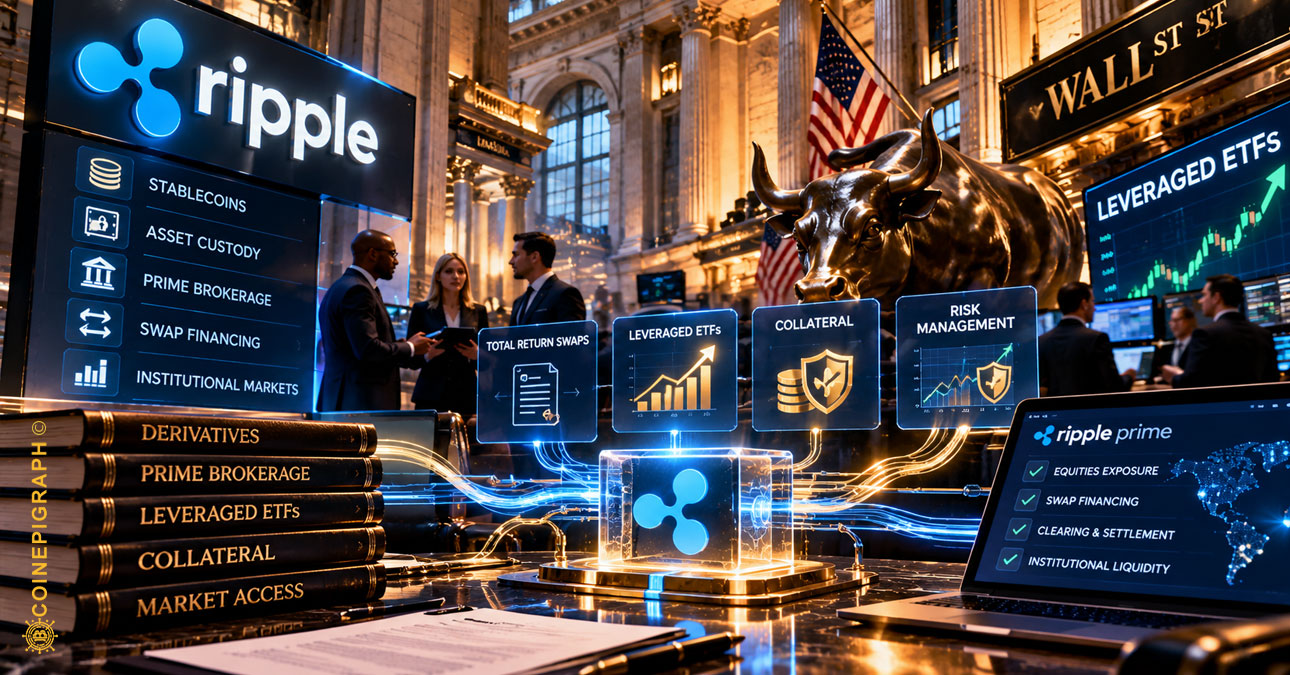
Ripple’s expansion into leveraged ETF financing marks a different stage in the convergence between digital assets and traditional finance. Crypto companies are no longer competing only to tokenize Wall Street’s assets. Some are beginning to provide the financing infrastructure behind them.
By CoinEpigraph Editorial Desk
For much of the past decade, the relationship between cryptocurrency and Wall Street was described as a competition between two financial systems.
That description is becoming harder to maintain.
Traditional financial institutions have moved steadily toward digital assets through Bitcoin ETFs, stablecoins, tokenized securities, custody platforms and blockchain settlement experiments. Crypto companies, meanwhile, have been moving in the opposite direction, acquiring licenses, building institutional custody operations and expanding into businesses that would once have belonged almost exclusively to banks, brokers and securities firms.
Ripple’s latest expansion pushes that convergence into a less visible part of the market: financing.
The company has emerged as a participant in providing swap financing to leveraged exchange-traded funds, according to recent reporting. Through Ripple Prime, the business created from its acquisition of institutional prime broker Hidden Road, Ripple is now participating in transactions that allow investment products to obtain amplified exposure to conventional stocks and indexes.
There is nothing particularly crypto-like about the underlying economic activity.
That is precisely what makes it important.
Behind the Leveraged ETF
A conventional ETF can simply own the securities represented by an index. A leveraged ETF has a more complicated objective. It may seek to produce two or three times the daily performance of a stock or benchmark.
Obtaining that exposure often requires derivatives.
One important instrument is the total return swap. Rather than purchasing enough of the underlying securities to create the desired leverage directly, the fund enters into an agreement with a counterparty that provides the economic return of those assets.
Behind the ETF visible to investors, therefore, sits another market involving financing, collateral, derivatives and counterparty risk.
Large banks have traditionally occupied much of that terrain.
Ripple’s arrival matters because it represents something different from a cryptocurrency company persuading Wall Street to buy a token. It represents a digital-asset company entering the machinery that allows conventional financial products to function.
The distinction is important.
The ETF does not need to hold XRP. The stock does not need to be tokenized. The swap does not need to settle on a public blockchain for the competitive boundary to have shifted.
Crypto is entering traditional finance through the intermediary itself.
The Hidden Road Was More Important Than the Headline
Ripple’s acquisition of Hidden Road in 2025 was initially easy to view as another example of consolidation across the digital-asset industry.
The transaction was more strategic than that interpretation suggested.
Hidden Road brought institutional capabilities spanning prime brokerage, clearing, financing and derivatives across multiple asset classes. Ripple subsequently brought the operation under the Ripple Prime identity.
That gave the company something considerably harder to build than another crypto trading venue: relationships and infrastructure connecting professional market participants to financing and execution.
Prime brokerage occupies an unusual position in financial markets because it sits behind much of what investors actually see.
Hedge funds and other sophisticated trading firms need financing. Positions require collateral. Trades require clearing and settlement. Derivatives create exposures that must be managed. Capital must move efficiently between strategies and counterparties.
The business is not primarily about creating an asset.
It is about making markets possible around assets.
That moves Ripple into territory fundamentally different from the cryptocurrency industry in which it originated.
Tokenization Is Only One Direction of Travel
Much of the institutional digital-asset story has focused on moving traditional finance onto blockchain infrastructure.
Treasuries become tokens.
Stocks become tokens.
Deposits become programmable.
Funds become transferable onchain.
Those developments remain significant, but they can create the impression that convergence requires Wall Street’s assets to migrate toward crypto infrastructure.
Ripple demonstrates another path.
The infrastructure provider can migrate toward Wall Street.
That produces two simultaneous movements:
Traditional financial institutions are adopting digital-asset infrastructure, while digital-asset institutions are acquiring traditional financial capabilities.
Eventually, the distinction between the two becomes less useful.
A company might provide stablecoin settlement in one part of its business, digital-asset custody in another and conventional derivatives financing somewhere else. Its competitive advantage would no longer depend upon being classified as a crypto company or a traditional financial institution.
It would depend upon how effectively it moves collateral, manages risk, provides liquidity and connects markets.
That is a much older financial competition.
The Balance Sheet Still Matters
There is also an important limit to the story.
Financial infrastructure cannot be reduced to software.
Providing leveraged exposure creates counterparty risk. Financing requires capital. Derivatives require collateral management. Volatile markets can produce margin calls precisely when liquidity becomes most valuable.
Banks developed enormous prime-brokerage operations partly because their balance sheets allowed them to intermediate those risks at scale.
Nonbank institutions entering the same territory eventually confront similar economics.
That means the important question is not simply whether Ripple can provide swap financing. It is whether digital-asset companies can build or access the capital, risk-management systems, collateral networks and institutional relationships required to compete consistently in markets historically dominated by major financial institutions.
The answer will determine whether this is an adjacent business or the beginning of a structural change in financial intermediation.
Blockchain May Come Later
There is another temptation that should be resisted.
Ripple’s participation in traditional financing does not mean leveraged ETF swaps have suddenly moved onto a blockchain.
The significance comes before that.
Once a financial company operates custody, stablecoins, payments, collateral infrastructure and prime brokerage under the same institutional umbrella, opportunities emerge to connect those businesses.
Collateral could eventually become more programmable. Settlement cycles could compress. Stablecoins could provide another cash-management rail. Tokenized securities could interact with financing markets. Assets that currently sit in separate operational systems could become easier to mobilize.
Whether those possibilities materialize will depend upon regulation, market structure and whether blockchain infrastructure actually improves the economics of existing systems.
But the sequence matters.
A company does not necessarily have to persuade Wall Street to rebuild its markets onchain before participating in them.
It can first become part of Wall Street’s existing machinery.

From Disruption to Intermediation
Crypto’s original narrative frequently imagined removing intermediaries.
The institutional phase is producing something more complicated.
Some intermediaries are disappearing. Others are being automated. Still others are being rebuilt around different technology.
And some crypto companies are becoming intermediaries themselves.
That evolution is not contradictory. Financial markets have always rewarded institutions capable of connecting pools of capital with the places where that capital is needed. The technology may change how the connection occurs without eliminating the economic function.
Ripple’s expansion into leveraged ETF financing therefore matters less because of the particular ETFs involved than because of what the business represents.
A company originating in digital assets is earning fees from financing exposure to conventional securities.
The direction of financial convergence has reversed.
Wall Street is still moving toward tokenization and programmable settlement. But crypto companies are simultaneously moving toward custody, clearing, collateral and financing—the less visible businesses upon which Wall Street has always depended.
The next stage of competition may therefore be decided somewhere different from the token market.
It may be decided on the balance sheet.
At CoinEpigraph, we are committed to delivering digital-asset journalism with clarity, accuracy, and uncompromising integrity. Our editorial team works daily to provide readers with reliable, insight-driven coverage across an ever-shifting crypto and macro-financial landscape. As we continue to broaden our reporting and introduce new sections and in-depth op-eds, our mission remains unchanged: to be your trusted, authoritative source for the world of crypto and emerging finance.
— Ian Mayzberg, Editor-in-Chief
The team at CoinEpigraph.com is committed to independent analysis and a clear view of the evolving digital asset order.
To help sustain our work and editorial independence, we would appreciate your support of any amount of the tokens listed below. Support independent journalism:
BTC: 3NM7AAdxxaJ7jUhZ2nyfgcheWkrquvCzRm
SOL: HxeMhsyDvdv9dqEoBPpFtR46iVfbjrAicBDDjtEvJp7n
ETH: 0x3ab8bdce82439a73ca808a160ef94623275b5c0a
XRP: rLHzPsX6oXkzU2qL12kHCH8G8cnZv1rBJh TAG – 1068637374
SUI – 0xb21b61330caaa90dedc68b866c48abbf5c61b84644c45beea6a424b54f162d0c
and through our Support Page.
🔍 Disclaimer: CoinEpigraph is for entertainment and information, not investment advice. Markets are volatile — always conduct your own research.
COINEPIGRAPH™ does not offer investment advice. Always conduct thorough research before making any market decisions regarding cryptocurrency or other asset classes. Past performance is not a reliable indicator of future outcomes. All rights reserved | 版权所有 ™ © 2024-2029.