


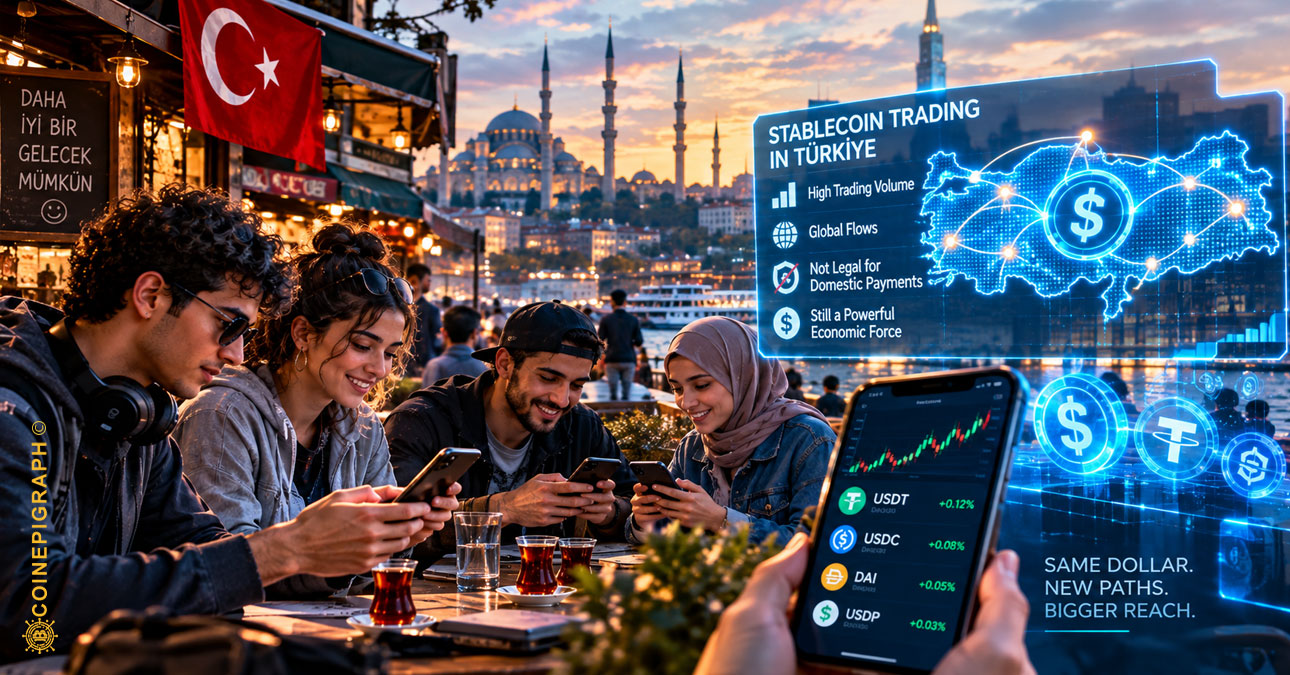
Türkiye has become one of the world’s most intensive markets for stablecoin trading even though crypto cannot legally be used for domestic payments. The contradiction reveals a larger monetary shift: a foreign currency can gain influence over an economy without becoming the money people spend.
By CoinEpigraph Editorial Desk
Türkiye has prohibited crypto assets from being used for domestic payments since 2021.
Yet Turks have become some of the world’s most intensive users of dollar-linked stablecoins.
Those two facts appear contradictory only if money is understood primarily as something people spend.
It is also something they save.
That distinction has become important enough for the Financial Stability Board to flag Türkiye’s stablecoin market as a financial-stability concern. In a peer review released this week, the FSB said Türkiye has made meaningful progress regulating crypto-asset service providers but still lacks a comprehensive regime governing stablecoin issuers.
The concern is not simply that another corner of the crypto market remains insufficiently regulated.
The FSB pointed specifically to foreign-exchange channels and the possibility of digital dollarisation.
Türkiye may be showing what happens when access to foreign money becomes easier than the financial architecture historically required to obtain it.
A Dollar Without the Dollar Account
Dollarization is not new.
Households and businesses in countries with unstable currencies have long protected wealth by holding dollars, opening foreign-currency deposits, buying dollar-denominated assets or, where those options were difficult, accumulating physical cash and gold.
Each route came with friction.
A bank account required access to a bank willing and permitted to offer foreign-currency deposits. Moving money abroad could encounter capital controls, correspondent banks, reporting requirements and settlement delays. Physical dollars had to be acquired and stored.
A dollar stablecoin changes some of those mechanics.
Someone with access to a crypto exchange can convert local currency into a token designed to track the dollar and then hold or transfer that value through digital infrastructure.
The dollar has not entered the user’s bank account.
But dollar exposure has entered the user’s balance sheet.
Türkiye offers an unusually visible example.
Chainalysis found that the country ranked first globally in stablecoin trading volume relative to GDP in its 2024 study. That measure requires care: it does not mean stablecoins represented 4% of Turkish GDP. It means centralized-exchange stablecoin trading volume was equivalent to roughly that share of GDP.
More revealing was what Turks were buying with lira.
Stablecoins consistently represented the majority of crypto assets purchased with the Turkish currency, with monthly purchases approaching $6 billion in March 2024. Chainalysis also found stablecoin purchases moving broadly with inflation, although market conditions contributed to individual spikes.
The International Monetary Fund has since reached a similar conclusion about the underlying behavior. Its 2026 assessment of Türkiye describes crypto assets, particularly stablecoins, as increasingly important stores of value and digital substitutes for foreign currency.
That moves the issue beyond crypto speculation.
It becomes monetary behavior.
Payment Is Only One Function of Money
Türkiye’s response illustrates an important limitation of looking only at payments.
The Central Bank of the Republic of Türkiye prohibits crypto assets from being used directly or indirectly to pay for goods and services.
That closes one channel through which stablecoins could compete with the lira.
It does not close all of them.
A household does not need to purchase groceries with USDT for USDT to affect how that household stores wealth.
A business does not need to price its products in stablecoins for stablecoins to provide access to dollar liquidity.
And a saver does not need a foreign bank account to move some portion of savings from lira exposure into dollar exposure.
This creates a separation between the traditional functions of money.
The lira can remain the unit in which wages are paid, taxes are collected and domestic purchases are made while another currency becomes increasingly attractive as a store of value.
Stablecoins make that separation easier to execute digitally.
That is the monetary innovation.
Not necessarily a new currency.
A new route into an old one.
The Savings Channel Matters
The IMF has begun examining the consequences of this architecture beyond Türkiye.
Foreign-currency stablecoins now overwhelmingly represent claims linked to the U.S. dollar. The IMF estimates that foreign-currency stablecoins account for 99% of the existing stablecoin market, while USDT and USDC together account for roughly 90%.
For most countries, those tokens are therefore foreign monetary instruments issued outside the domestic jurisdiction.
If households begin shifting deposits into them at meaningful scale, the effect could reach beyond personal portfolio allocation.
Domestic banks depend partly on deposits to fund lending. If a growing portion of savings migrates into foreign-currency stablecoins, some of those funds can move outside the domestic banking intermediation process.
The IMF warns that sufficiently large adoption could alter capital flows, encourage currency substitution and, under some circumstances, amount to a de facto liberalization of the capital account.
That does not mean Türkiye has already reached that point.
It means the infrastructure now exists for the movement to happen differently than it did before.
The physical friction is disappearing.
Foreign Finance Gains Another Channel
This is where stablecoins begin to matter to countries rather than merely to crypto markets.
When someone exchanges lira for a dollar stablecoin, the transaction changes the currency exposure of the holder. The saver becomes more exposed to the dollar and to the institutions supporting that token.
At sufficient scale, that can give external financial conditions another route into the domestic economy.
The relevant influence does not have to arrive through a foreign bank opening branches in Istanbul or an international fund buying Turkish securities.
It can begin one wallet at a time.
Stablecoin holders may become exposed to foreign interest rates, the reserve policies of offshore issuers, regulatory decisions in other jurisdictions and changes in global demand for dollar liquidity.
The IMF’s broader work on foreign-currency stablecoins warns that recipient economies could therefore face stronger currency substitution and capital-flow pressures as adoption grows.
That deserves a careful distinction.
Foreign monetary gravity is not the same as foreign control.
Türkiye still sets interest rates, regulates its banking system, collects taxes in lira and determines the legal framework governing domestic payments.
But monetary sovereignty is partly about the incentives facing people deciding what form of money they want to hold.
Stablecoins create another option.
Capital Controls Meet Software
The Bank for International Settlements has examined stablecoin flows across more than 130 economies and found something potentially more consequential.
Traditional deposit dollarization and stablecoin dollarization appear to respond to similar conditions, including macroeconomic instability and financial stress.
But they do not respond equally to restrictions.
Foreign-currency bank deposits remain embedded in regulated financial institutions. Stablecoins can circulate partly outside that perimeter.
BIS researchers found stablecoin flows largely unaffected by either broad or targeted capital-flow restrictions in their dataset.
That does not make stablecoins immune to regulation.
It does suggest that some of the mechanisms governments historically used to influence movement between domestic and foreign money may become less effective when foreign-currency exposure can travel through software.
The IMF describes the same possibility in more formal terms: foreign-currency stablecoins could effectively liberalize parts of a country’s capital account even without an intentional policy decision to do so.
That would be a remarkable institutional inversion.
Capital-account liberalization has historically been something governments chose.
Digital infrastructure may increasingly allow markets to perform part of it themselves.
The Crypto Market Is Becoming an FX Market
There is another reason policymakers are paying attention.
Buying a dollar stablecoin with lira is economically similar in one important respect to buying dollars with lira.
It is a foreign-exchange transaction.
Research published this year by the IMF and BIS examined four dollar stablecoins traded against 27 currencies across 64 exchanges. The researchers found that stablecoin flows can spill into conventional foreign-exchange markets.
Their results suggest that increases in stablecoin inflows can affect the price at which dollar exposure is obtained, pressure local exchange rates and alter dollar funding conditions.
Stablecoins are therefore beginning to connect two markets that were once easier to distinguish.
One is crypto.
The other is foreign exchange.
The boundary between them is becoming less useful.
That may explain why Türkiye’s regulatory gap concerns the FSB. A stablecoin market can remain outside the domestic payment system while still becoming relevant to capital flows, foreign-exchange exposure and financial stability.
Regulation Has a Jurisdiction Problem
Türkiye has already brought much of its crypto market inside a licensing and supervisory framework.
The FSB says authorities have introduced registration and licensing requirements for crypto service providers, custody protections and centralized monitoring infrastructure.
But stablecoins introduce an awkward problem.
The exchange serving the customer may be regulated in Türkiye.
The stablecoin issuer may not be.
The reserves supporting the token may sit in another jurisdiction.
The blockchain can operate globally.
And the token can move to a self-hosted wallet beyond the immediate perimeter of a domestic exchange.
That makes stablecoin regulation different from regulating a local bank deposit.
Türkiye can supervise the doorway without necessarily controlling everything on the other side.
The FSB consequently recommends not only a dedicated stablecoin regime but greater cross-border regulatory cooperation and better monitoring of activities occurring beyond Türkiye’s domestic perimeter.
The architecture of the asset has made jurisdiction part of the financial-stability problem.

Dollarization Without Dollar Banking
There are reasons not to overstate what Türkiye tells us.
Stablecoin trading volume is not the same as stablecoin savings. Crypto trading remains an important source of demand. Türkiye’s existing history of dollarization also means stablecoins did not create the desire for foreign-currency exposure.
Nor is there yet strong evidence that stablecoin adoption has materially impaired monetary-policy transmission.
The BIS finds that dollarization can be persistent once established, but the historical evidence on moderate deposit dollarization shows limited effects on monetary transmission.
The more defensible conclusion is narrower.
Stablecoins reduce the infrastructure required to obtain foreign-currency exposure.
And that can matter enormously.
The old architecture of dollarization generally required banks, physical currency, offshore accounts or other financial intermediaries.
The emerging architecture can require little more than local currency, an exchange and a wallet.
Türkiye did not invent that mechanism.
It simply makes it easier to see.
A country can prohibit stablecoins from buying coffee and still discover that they matter to its monetary system. It can preserve the domestic currency as the means of payment while households quietly choose another currency as part of their savings architecture.
That is why the stablecoin debate is becoming larger than payments.
The dollar does not have to replace the lira at the cash register to acquire greater financial gravity.
It only needs to become easier to hold.
And increasingly, it no longer needs a dollar bank account to get there.
At CoinEpigraph, we are committed to delivering digital-asset journalism with clarity, accuracy, and uncompromising integrity. Our editorial team works daily to provide readers with reliable, insight-driven coverage across an ever-shifting crypto and macro-financial landscape. As we continue to broaden our reporting and introduce new sections and in-depth op-eds, our mission remains unchanged: to be your trusted, authoritative source for the world of crypto and emerging finance.
— Ian Mayzberg, Editor-in-Chief
The team at CoinEpigraph.com is committed to independent analysis and a clear view of the evolving digital asset order.
To help sustain our work and editorial independence, we would appreciate your support of any amount of the tokens listed below. Support independent journalism:
BTC: 3NM7AAdxxaJ7jUhZ2nyfgcheWkrquvCzRm
SOL: HxeMhsyDvdv9dqEoBPpFtR46iVfbjrAicBDDjtEvJp7n
ETH: 0x3ab8bdce82439a73ca808a160ef94623275b5c0a
XRP: rLHzPsX6oXkzU2qL12kHCH8G8cnZv1rBJh TAG – 1068637374
SUI – 0xb21b61330caaa90dedc68b866c48abbf5c61b84644c45beea6a424b54f162d0c
and through our Support Page.
🔍 Disclaimer: CoinEpigraph is for entertainment and information, not investment advice. Markets are volatile — always conduct your own research.
COINEPIGRAPH™ does not offer investment advice. Always conduct thorough research before making any market decisions regarding cryptocurrency or other asset classes. Past performance is not a reliable indicator of future outcomes. All rights reserved | 版权所有 ™ © 2024-2029.