


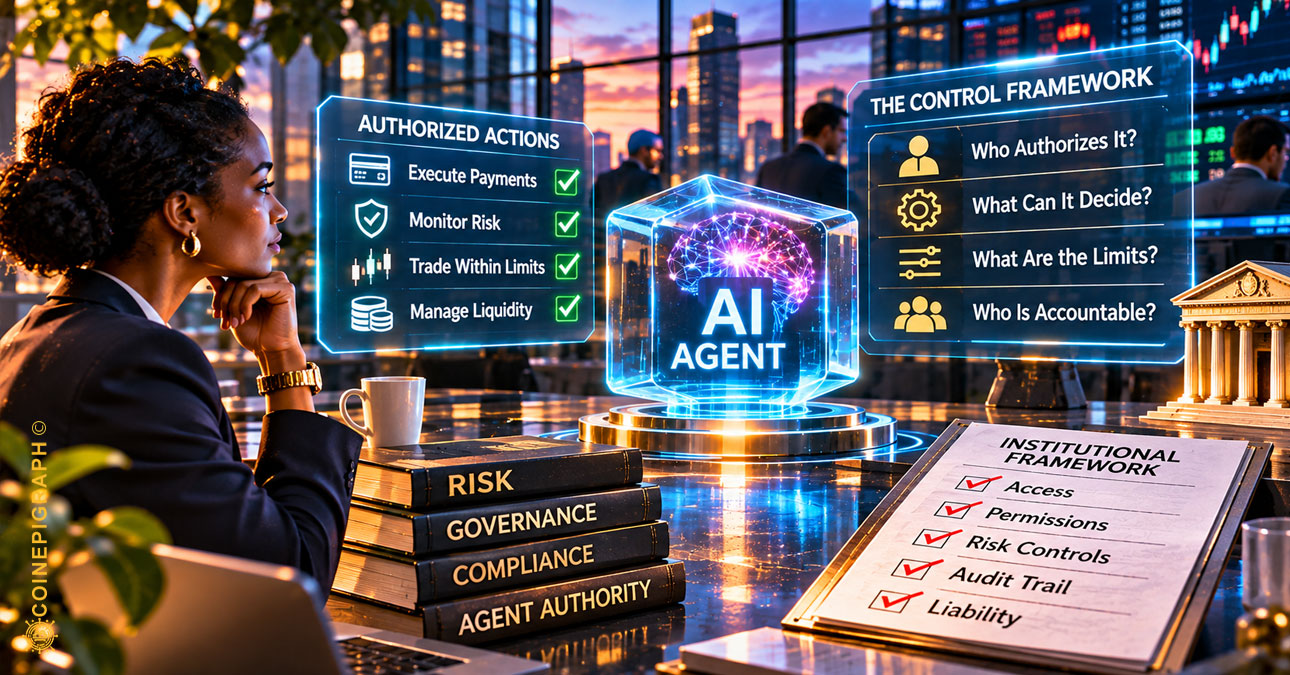
AI agents are moving from financial research and analysis into workflows that can execute payments, monitor risk and even trade. The consequential transition may not be automation itself, but the architecture institutions build to determine what a machine is allowed to decide.
By CoinEpigraph Editorial Desk
For most of the history of financial automation, the division of labor was relatively clear.
Humans decided. Software executed.
An investor selected a mandate. An algorithm rebalanced the portfolio. A bank established a rule. Software processed the payment. A trading system operated according to parameters established before the transaction arrived.
Artificial intelligence is beginning to complicate that arrangement.
Financial institutions are experimenting with systems capable of gathering information, interpreting objectives, coordinating multiple tasks and determining what action should follow. Some remain research assistants. Others can operate for hours across financial workflows. A smaller group is beginning to interact directly with the infrastructure through which money moves.
The important distinction is not whether these systems are autonomous in some absolute sense.
It is whether institutions are beginning to delegate decision authority to them.
That transition is already visible.
The Cambridge Centre for Alternative Finance reported this year that 52% of financial-industry respondents were actively adopting agentic AI. Yet only 23% had reached the scaling or transforming stages; another 29% remained in pilots. Fintech companies were further along than traditional financial institutions.
Those numbers describe an industry somewhere between experimentation and institutionalization.
The infrastructure being built around it tells us more.
From Algorithms to Mandates
Google Cloud launched Gemini Enterprise for Financial Services in August with a Financial Research agent containing more than 50 financial skills. It can work across market data, filings and proprietary institutional information, with connections to providers including FactSet, LSEG, Moody’s, MSCI, PitchBook and S&P Global. Deutsche Bank and CME Group helped develop the financial capabilities.
Anthropic has taken a similar approach. Its financial-services offering includes ten agent templates covering research, financial modeling, valuation review, KYC screening, general-ledger reconciliation and other workflows. Managed versions can operate autonomously over longer periods, but Anthropic explicitly retains human review and approval before consequential work is acted upon.
That qualification matters.
These systems are not being given unrestricted authority over institutional balance sheets. They are being placed inside increasingly sophisticated boundaries.
FINRA has nevertheless observed how far those boundaries can extend. Its 2026 description of agentic-AI use cases among member firms includes trade-execution agents capable of analyzing market conditions, generating strategies and executing transactions with varying degrees of human oversight.
That begins to look different from the robo-adviser.
A robo-adviser generally applies algorithms to a predefined investment process. An agent can potentially interpret a broader objective, gather information from several systems, decide which intermediate tasks are necessary and coordinate actions to accomplish the mandate.
The distinction is subtle until money moves.
Then it becomes institutional.
Authority Becomes Infrastructure
Visa, BILL and Billtrust have provided one of the clearest demonstrations.
Their live B2B pilot allows an authenticated AI agent to enter a supplier environment and complete an invoice payment using tokenized payment credentials. The agent can traverse a process that previously required a human to enter the supplier portal and finish the transaction.
But the agent does not decide whether the invoice should be paid.
The buyer has already approved it.
That boundary may reveal more about the future of financial agents than a demonstration of unrestricted autonomy would.
What is emerging is less a single architecture than a division of responsibility. The institution still sets the mandate and decides how much authority to surrender. The agent works within those limits, while the financial system determines whether the resulting action can actually be executed. What happens along the way must remain visible enough to reconstruct afterward.
The International Monetary Fund has reached a similar problem from the perspective of payment architecture.
Its framework separates agentic payments into three layers: intent, authorization and settlement. The reason is fundamental. AI systems are probabilistic. Financial authorization and settlement eventually have to become deterministic. A machine may reason about what should happen, but financial infrastructure must still determine whether it is permitted to happen.
That makes authorization more than a security feature.
It could become a new financial infrastructure layer.
An institution may eventually need to specify not only what an employee can access, but what an agent can spend, which assets it can trade, which counter-parties it can approach, which information it can disclose, when it must escalate a decision and which actions always require human approval.
The more capable the agent becomes, the more valuable that control architecture becomes.
Old Obligations, New Actor
Financial regulation does not disappear when the decision maker becomes software.
The SEC has long treated automated investment advice as a means of providing advisory services rather than a separate category of activity. Registered robo-advisers remain subject to the fiduciary and substantive obligations of the Investment Advisers Act.
Agentic systems make that principle harder, not less relevant.
If an AI system recommends an investment, who is responsible for the recommendation?
If it selects among counter-parties, where do conflicts of interest reside?
If it exceeds its mandate, was the failure in the model, the authorization system, the institution’s supervision or the design of the mandate itself?
And if several agents coordinate a transaction, accountability may have to survive a chain of machine decisions rather than a single algorithmic output.
The technology may be new.
The obligation attached to the financial decision may not be.
This is where the question of control begins to move beyond software engineering.
Financial institutions have spent decades constructing systems of delegated authority around people. Traders receive limits. Portfolio managers receive mandates. Corporate officers receive signing authority. Employees receive permissions. Transactions above specified thresholds require additional approval.
Agentic finance does not eliminate that institutional architecture.
It requires institutions to translate it into machine-readable form.

The Economics Are Not Settled
There is a commercial market forming around these capabilities: enterprise licenses, agent platforms, financial-data connections, APIs, orchestration systems and specialized agents.
But autonomy should not be confused with cheapness.
Agentic systems can generate repeated model calls, use multiple data sources and require monitoring, security, memory, auditability and human verification. McKinsey has noted that moving AI systems from pilots into production can dramatically increase costs as consumption, cloud infrastructure and oversight accumulate.
In financial-crime applications, McKinsey found human oversight accounting for 70% to 75% of variable running costs in one class of agentic workflow.
That changes the economic question.
The valuable agent may not be the one that eliminates the most people. It may be the one that removes enough expensive institutional work to justify the cost of verifying what the machine does.
That leaves several places where value might accumulate: proprietary financial data, specialized models, orchestration, identity, authorization, cybersecurity, compliance and transaction infrastructure.
It also gives incumbents advantages in some parts of the market. Banks, asset managers and market-data companies already possess information, customer relationships, licenses and access to regulated infrastructure.
Smaller companies may still find room where specialization matters more than scale. A narrowly designed agent capable of performing a costly institutional workflow exceptionally well may be more valuable than a general financial intelligence system attempting to replace an entire organization.
That contest is only beginning.
The Agent May Choose the Rail
Digital assets introduce another possibility.
Programmable wallets, stablecoins and smart contracts can give software direct access to financial instruments designed to be manipulated programmatically. That makes blockchain infrastructure a natural experimental environment for machine-to-machine economic activity.
But it does not make blockchain inevitable.
Visa’s pilot demonstrates that agents can operate over existing payment networks. Banks and card networks can build machine identity, delegated credentials and programmable controls into conventional infrastructure.
The eventual financial system may therefore be heterogeneous.
An agent could use a bank account for one transaction, a card network for another and stablecoin settlement when continuous availability, programmability or cross-border movement makes it advantageous.
The consequential development would not be an AI agent committed to a particular financial rail.
It would be an agent capable of choosing among them.
That possibility changes the competitive question for financial infrastructure. Payment networks, banks, stablecoin issuers and blockchains may eventually compete not only for human customers and institutional transaction flow, but for software capable of evaluating which rail best satisfies a mandate.
Price could matter. So could speed, liquidity, privacy, settlement finality, regulatory treatment and access to counter-parties.
The agent may eventually become a customer of the financial system.

Who Controls the Agent?
Financial automation has been moving toward this moment for decades.
Electronic markets automated execution. Algorithmic trading automated strategy implementation. Robo-advisers automated portfolio construction. Cloud computing moved financial software onto scalable infrastructure.
Agentic finance introduces something different.
The machine can increasingly participate in determining what happens next.
That does not mean financial institutions are preparing to surrender control. The evidence so far suggests almost the opposite. As agents acquire greater capability, institutions are constructing identity systems, permissions, audit trails and approval boundaries around them.
That pattern has a familiar historical logic.
Financial systems rarely respond to a new form of economic power by leaving it undefined. They build institutions around it. Corporations created hierarchies of authority. Electronic markets developed access controls and surveillance. Digital banking created identity, authentication and transaction limits.
Financial agents are beginning to encounter the same institutionalization.
The emerging financial agent may therefore be neither an independent machine investor nor a more elaborate chatbot.
It may become something closer to a new institutional actor: software carrying delegated authority through financial infrastructure on behalf of a human or organization.
If that happens, intelligence alone will not determine who controls the market.
The more consequential layer may sit between intelligence and money: the systems that establish identity, translate mandates into permissions, constrain actions and preserve accountability after the machine has acted.
The financial system is learning how to let machines make decisions.
Now it has to decide who gets to give them permission.
At CoinEpigraph, we are committed to delivering digital-asset journalism with clarity, accuracy, and uncompromising integrity. Our editorial team works daily to provide readers with reliable, insight-driven coverage across an ever-shifting crypto and macro-financial landscape. As we continue to broaden our reporting and introduce new sections and in-depth op-eds, our mission remains unchanged: to be your trusted, authoritative source for the world of crypto and emerging finance.
— Ian Mayzberg, Editor-in-Chief
The team at CoinEpigraph.com is committed to independent analysis and a clear view of the evolving digital asset order.
To help sustain our work and editorial independence, we would appreciate your support of any amount of the tokens listed below. Support independent journalism:
BTC: 3NM7AAdxxaJ7jUhZ2nyfgcheWkrquvCzRm
SOL: HxeMhsyDvdv9dqEoBPpFtR46iVfbjrAicBDDjtEvJp7n
ETH: 0x3ab8bdce82439a73ca808a160ef94623275b5c0a
XRP: rLHzPsX6oXkzU2qL12kHCH8G8cnZv1rBJh TAG – 1068637374
SUI – 0xb21b61330caaa90dedc68b866c48abbf5c61b84644c45beea6a424b54f162d0c
and through our Support Page.
🔍 Disclaimer: CoinEpigraph is for entertainment and information, not investment advice. Markets are volatile — always conduct your own research.
COINEPIGRAPH™ does not offer investment advice. Always conduct thorough research before making any market decisions regarding cryptocurrency or other asset classes. Past performance is not a reliable indicator of future outcomes. All rights reserved | 版权所有 ™ © 2024-2029.