


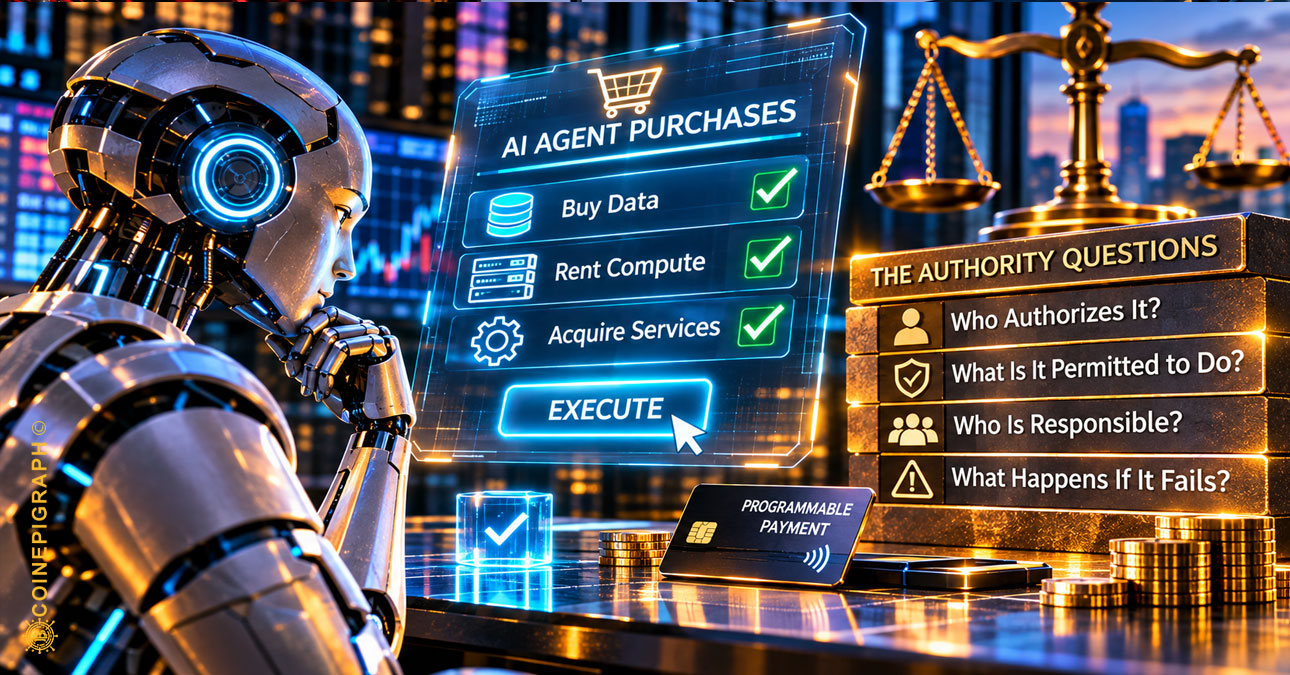
AI agents are gaining the ability to buy data, computing power and services without waiting for a person to approve every transaction. Moving the money is becoming easier. The harder problem is establishing whose authority the machine carries, what it is permitted to do and who remains responsible when something goes wrong.
By CoinEpigraph Editorial Desk
The financial system has spent decades getting comfortable with a basic assumption: somewhere behind a transaction is a person or organization that decided to make it.
A cardholder taps a terminal. A corporate officer approves a wire. An employee submits an expense. A trader enters an order.
Even when software performs much of the work, institutions have generally been able to trace the authority back to someone.
AI agents are beginning to disturb that arrangement.
Software can increasingly search for a service, negotiate with another system, encounter a price and complete a payment without returning to a human for every decision. Coinbase’s x402 protocol, for example, uses the web’s long-dormant HTTP 402 “Payment Required” status to let software respond to a payment request programmatically. An agent can encounter a paid resource, satisfy the request and continue working.
The transaction itself is becoming the easy part.
What comes next is considerably harder.
If a machine spends money, a merchant may need to know more than whether the payment will clear. It may need to know who the machine represents. A bank may need to determine whether the transaction falls within an authorized mandate. A company may want an agent to purchase computing capacity but prohibit it from entering certain contracts. Regulators will still expect sanctions and financial-crime controls to operate even when no person is sitting at the keyboard.
And when something goes wrong, someone will eventually ask a very old financial question.
Who authorized this?
A Payment Credential Does Not Establish Authority
Traditional payments already contain layers of delegated authority.
A corporation gives an employee a purchasing card. The employee is permitted to spend company money, but that permission has boundaries. A portfolio manager can trade assets belonging to a fund but cannot necessarily withdraw those assets for personal use. A lawyer may act for a client under a defined mandate. Corporate officers can bind companies in some circumstances and not others.
AI agents extend this familiar problem into unfamiliar territory.
The agent may make thousands of decisions rather than one. It may operate continuously. It may interact with counter-parties its principal has never encountered. And it can make choices based on changing conditions rather than following a fixed sequence written in advance.
Giving such an agent access to a wallet or payment credential answers only one question: can it pay?
It does not establish what the agent was permitted to buy.
That distinction is already appearing in the infrastructure being built around agentic commerce.
Google’s Agent Payments Protocol, AP2, starts from the observation that existing payment systems largely assume a human is directly initiating a purchase. Its proposed answer uses cryptographically signed “Mandates” that preserve evidence of what a user authorized. A person could instruct an agent to buy concert tickets when they become available, for example, while defining the price, timing and other conditions under which the purchase may occur.
The agent receives discretion, but not unlimited discretion.
Mastercard is approaching the same problem from another direction. Its Agent Pay for Machines architecture separates credentialing from permissioning and allows organizations to define spending limits and authorization rules before an agent begins transacting. The company’s current pilot is designed for software purchasing things such as data, APIs, AI models and computing resources without creating a conventional checkout interaction every time.
The terminology differs.
The institutional problem does not.
Financial infrastructure needs some way to determine not merely whether a machine possesses a valid payment instrument, but whether the transaction being attempted falls within authority delegated by the principal behind it.
That is a different kind of credential.
The Customer May No Longer Be the Actor
Identity presents another problem.
Blockchains are unusually good at establishing that a particular cryptographic address initiated an action. That does not necessarily tell a financial institution who stands behind the address, why the transaction occurred or who should answer for it.
The distinction becomes more important when agents themselves begin interacting.
Ethereum’s ERC-8004 addresses part of this problem through registries for agent identity, reputation and validation. An agent can have a persistent identifier and accumulate information that helps other participants decide whether to trust it.
But ERC-8004 deliberately does not attempt to become a payment system. Its specification describes payments as orthogonal to the protocol.
That separation is revealing.
The emerging machine economy may require several things that human commerce often compresses into the idea of a “customer.”
There is the principal whose money or authority ultimately stands behind the transaction. There is the agent acting for that principal. There is the credential the agent uses. There are the instructions governing what the agent may do. And there is the counterparty deciding whether to accept what the agent is attempting.
Those parties do not necessarily need the same information.
A merchant selling an inexpensive digital service may care primarily that payment is valid. A bank facilitating a much larger transaction may need substantially more assurance about the principal, the agent’s authority and the purpose of the payment.
The financial system already adjusts scrutiny according to risk. Agentic commerce will likely make that distinction more explicit.
Ordering a few dollars of data through an API should not require the same architecture as an autonomous system moving millions of dollars between financial assets.
The higher the value at risk, the more important the provenance of authority becomes.
Compliance Does Not End When the Customer Becomes Software
There is an appealing simplicity to imagining autonomous commerce as machines paying machines.
Financial regulation is unlikely to be that simple.
Banks, payment companies and other regulated institutions still operate under obligations involving sanctions, money laundering, fraud, customer identification and transaction monitoring. Turning the immediate actor into software does not make those obligations disappear.
The original Concordium discussion that helped surface this issue makes the distinction well: payments can be treated as an engineering problem, while identity introduces questions of trust, law and responsibility.
The next problem may be broader still.
An institution may know perfectly well who owns an agent and still need to determine whether the owner authorized what the agent actually did.
That creates a new requirement for auditability.
A useful financial agent may eventually need to leave behind evidence of the authority under which it acted: what task it received, what constraints applied, what conditions it observed and why the resulting transaction fell within its mandate.
Google’s AP2 architecture is explicitly designed around such an evidentiary chain. Its Mandates are intended to preserve the principal’s instructions through the purchasing process and create a record connecting intent to payment.
That sounds technical until a transaction is disputed.
Then it begins to resemble something the financial system has understood for centuries: documentation.
Privacy Cannot Mean Broadcasting the Principal
Solving accountability by attaching a complete identity file to every machine transaction would create another problem.
It would be an extraordinary expansion of financial surveillance and an attractive collection of information for attackers.
An agent may need to demonstrate that its principal satisfies a condition without revealing everything about that principal.
A counter-party might need to know that the entity behind an agent has been verified, is permitted to transact in a jurisdiction or is not subject to a particular restriction. It does not necessarily need a passport copy, home address and complete identity record attached to every interaction.
This is where privacy-preserving verification becomes more than a philosophical feature of blockchain systems.
It could become part of commercial architecture.
Concordium, for example, is developing its agent identity model around verified identities and cryptographic proofs intended to establish required attributes without automatically disclosing the underlying identity. The broader idea is not unique to Concordium. Zero-knowledge systems increasingly make it possible to prove that a condition is true without revealing all of the information used to establish it.
That distinction between anonymity and privacy becomes important once machines transact at scale.
A financial institution may need accountability.
It does not necessarily need maximum disclosure.
The architecture will have to find the boundary between the two.
Financial Authority May Become Machine-Readable
The most consequential change may therefore have little to do with which payment rail wins.
Stablecoins could become important for machine-to-machine transactions because they are programmable and can move continuously. Cards will not disappear. Bank accounts and real-time payment systems can also be incorporated into agentic commerce. Google’s AP2 is deliberately designed to accommodate several payment methods, while Mastercard’s architecture contemplates settlement across cards, accounts and stablecoins.
The competition is happening one layer above the money.
It concerns how financial authority is expressed.
Today much of that authority is embedded in institutions, contracts, account permissions and human procedures. A company knows which employee can approve an invoice. A bank knows who is authorized to operate an account. An investment manager works within a mandate defined by agreements, regulation and internal controls.
Machines will need some version of those boundaries that other machines can understand.
A company might permit an agent to purchase cloud computing up to a defined amount but prohibit it from buying securities. Another agent might be authorized to rebalance a treasury portfolio within specified limits but unable to move assets to an unapproved counter-party. A purchasing agent might negotiate freely with vendors while requiring human approval once a transaction exceeds a threshold.
Those instructions cannot remain merely prose buried in a corporate policy manual if autonomous software is expected to act on them.
Some portion of financial authority will have to become machine-readable.
That could ultimately prove more consequential than giving agents wallets.

The Architecture Is Forming Before the Standard Is Settled
There is no single architecture for this yet.
ERC-8004 is approaching agent identity, reputation and validation from the blockchain layer. x402 makes machine-native payment requests possible over the web. Google is concentrating on verifiable mandates and the connection between intent and payment. Mastercard is building credentialing and permissioning into its existing network. Other payment companies, blockchain networks and identity providers are approaching pieces of the same problem.
That fragmentation is not surprising.
The internet did not begin with a complete institutional model for digital commerce either. Authentication, payments, fraud controls, identity and consumer protections accumulated over time as online activity became economically important.
Agentic commerce may be compressing that development cycle.
The technology capable of initiating transactions is arriving while the rules governing those transactions are still being designed.
That leaves financial institutions with a problem they cannot solve simply by deciding whether they like AI agents.
The agents are becoming capable of acting.
The architecture now has to determine what their actions mean.
A payment system can establish that money moved. An identity system can establish which agent appeared to initiate the transaction. Neither necessarily establishes whether that machine possessed legitimate authority to do what it did.
For autonomous finance to move beyond experimentation, those questions will have to meet somewhere.
The financial system spent centuries developing ways to determine who can sign, who can spend, who can bind an institution and who bears responsibility afterward.
AI does not eliminate those questions.
It requires the financial system to teach machines how to answer them.
At CoinEpigraph, we are committed to delivering digital-asset journalism with clarity, accuracy, and uncompromising integrity. Our editorial team works daily to provide readers with reliable, insight-driven coverage across an ever-shifting crypto and macro-financial landscape. As we continue to broaden our reporting and introduce new sections and in-depth op-eds, our mission remains unchanged: to be your trusted, authoritative source for the world of crypto and emerging finance.
— Ian Mayzberg, Editor-in-Chief
The team at CoinEpigraph.com is committed to independent analysis and a clear view of the evolving digital asset order.
To help sustain our work and editorial independence, we would appreciate your support of any amount of the tokens listed below. Support independent journalism:
BTC: 3NM7AAdxxaJ7jUhZ2nyfgcheWkrquvCzRm
SOL: HxeMhsyDvdv9dqEoBPpFtR46iVfbjrAicBDDjtEvJp7n
ETH: 0x3ab8bdce82439a73ca808a160ef94623275b5c0a
XRP: rLHzPsX6oXkzU2qL12kHCH8G8cnZv1rBJh TAG – 1068637374
SUI – 0xb21b61330caaa90dedc68b866c48abbf5c61b84644c45beea6a424b54f162d0c
and through our Support Page.
🔍 Disclaimer: CoinEpigraph is for entertainment and information, not investment advice. Markets are volatile — always conduct your own research.
COINEPIGRAPH™ does not offer investment advice. Always conduct thorough research before making any market decisions regarding cryptocurrency or other asset classes. Past performance is not a reliable indicator of future outcomes. All rights reserved | 版权所有 ™ © 2024-2029.