


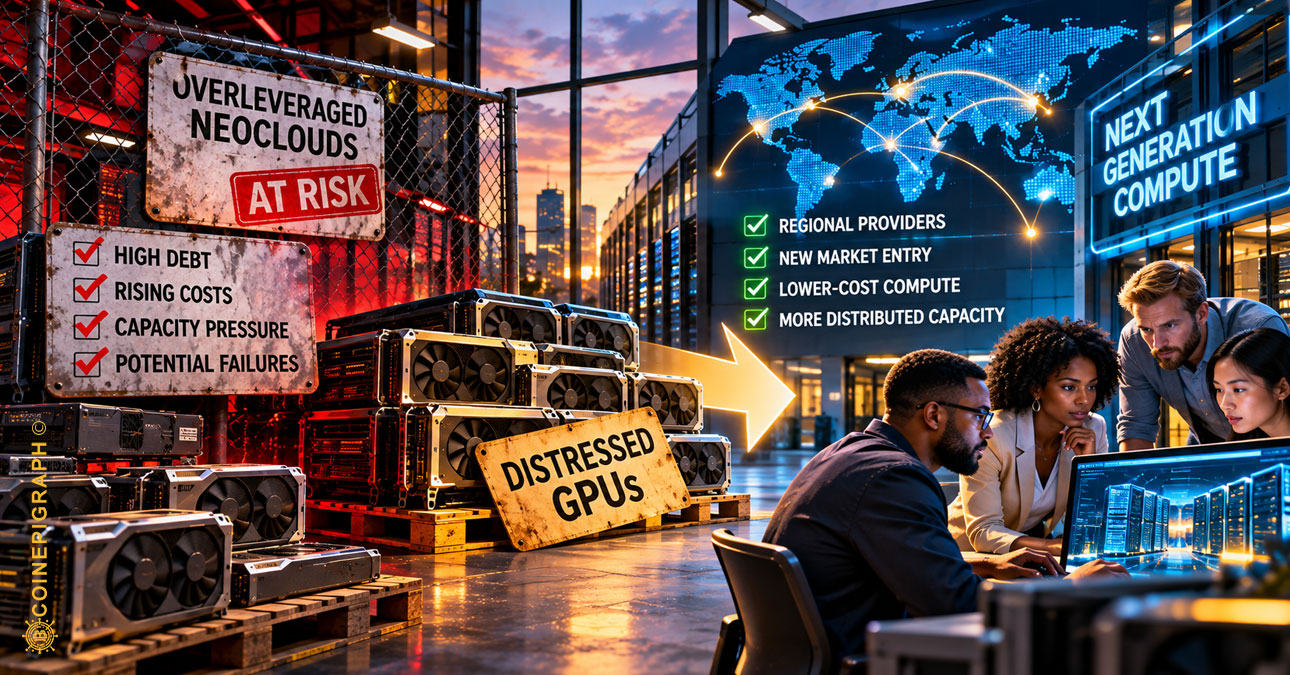
Smaller neocloud providers borrowed heavily to build the infrastructure behind the AI boom. If weaker operators begin to fail, their GPUs may not simply become distressed collateral. They could become the inexpensive entry point for a new generation of regional compute providers.
By CoinEpigraph Editorial Desk
For much of the artificial intelligence boom, access to computing power was treated as a scarcity problem.
There were not enough advanced GPUs. Companies that could secure them gained an advantage. Capital followed the shortage, financing data centers and a new class of specialized cloud providers that bought high-performance chips and rented their capacity to AI developers.
Now the financial question is beginning to change.
It is no longer only who can obtain the GPUs. It is whether all the companies that borrowed money to acquire them can earn enough from those machines, for long enough, to support the capital structures built around them.
That concern has become particularly visible among neoclouds, specialized providers built around AI and high-performance computing rather than the diversified businesses of traditional hyperscalers. Elon Musk recently predicted severe consolidation among more than 200 such operators, describing what he expects among the weaker providers as “guppy-level death.”
His language was characteristically dramatic. The underlying concern is not his alone.
Gartner predicts that cost pressures and insufficient differentiation will cause more than 80% of neocloud providers to cease operating independently by 2030. The research firm estimates that more than $3.5 trillion of AI infrastructure spending could be exposed to impairment by the end of the decade if spending continues on its current trajectory.
That does not mean the demand for artificial intelligence is disappearing. It raises a different question.
What happens to the computing infrastructure when the company that financed it cannot survive?
The Debt Can Outlive the Advantage
The basic neocloud model can appear straightforward.
A provider raises capital, acquires GPUs and supporting infrastructure, and rents computing capacity to customers. Revenue from those customers helps service the financing used to build the operation.
For lenders, the transaction can be supported by valuable equipment and, in stronger arrangements, contracted revenue from recognizable technology companies.
The difficulty is that the clocks do not necessarily run together.
A loan can extend for years. A customer contract can have another duration. The competitive position of the GPU can change much faster.
Each new generation of hardware can improve performance and economics sufficiently to reduce what customers are willing to pay for earlier equipment. A machine does not have to stop working to become less valuable.
That distinction matters because the debt does not depreciate alongside the chip.
A provider can therefore find itself servicing financing based on yesterday’s acquisition cost while competing in a market increasingly priced around tomorrow’s computing performance.
Power adds another complication.
A company can secure GPUs, financing and even customer commitments without having every piece of the physical infrastructure ready to generate revenue. Grid connections, cooling, networking and data-center construction operate on their own schedules. Financing costs can accumulate while equipment waits for the infrastructure required to put it to work.
Nvidia itself acknowledged the constraint in an August regulatory filing, describing land, power and data-center capacity as a critical phase of the AI buildout. The company also noted that some AI clouds and model developers are expanding faster than their balance sheets and long-term credit profiles can support.
This is not simply a technology cycle anymore. It is becoming a credit cycle built around technology that ages unusually quickly.
The Smaller Operators Matter
CoreWeave has naturally attracted much of the attention.
Its scale, debt, public-market visibility and relationships with companies including Meta make it an obvious case study. Its bonds have also provided investors with a visible measure of changing attitudes toward AI infrastructure credit.
But concentrating exclusively on CoreWeave can obscure the larger market.
The smaller operators matter precisely because many lack the advantages available to the largest providers.
They may have fewer customers, thinner balance sheets, less negotiating power with lenders and less ability to absorb a period of weak utilization. Some may have excellent technical operations but limited access to capital. Others may own useful computing equipment without possessing the financial resilience necessary to survive a prolonged tightening of credit.
That is where consolidation becomes more than a question of which corporate names remain on the market.
If a smaller neocloud fails, its GPUs do not disappear.
Neither does the productive capacity embedded in them.
The machines may change owners. They may be sold individually, as clusters or as part of a broader data-center transaction. Lenders may have to determine what recoveries are available from equipment originally acquired under very different market conditions.
At that point, the price of the asset changes.
And potentially, so does its purpose.
Depreciated Is Not the Same as Obsolete
The AI infrastructure market may eventually have to become much better at distinguishing technological depreciation from technological uselessness.
The newest GPUs command premium economics because certain workloads demand extraordinary performance. Frontier-model training can require massive clusters of the most advanced hardware, connected by specialized networking and supported by enormous amounts of electricity.
Not every AI workload has those requirements.
Inference, fine-tuning, smaller-model development, university research, enterprise applications and regional AI services can present different performance economics.
A GPU that no longer deserves its original premium may still have years of productive work ahead of it.
The difference could become especially important when the acquisition price falls.
Suppose equipment originally financed near the top of a scarcity cycle eventually reaches a distressed sale. A buyer acquiring those GPUs at a substantially lower basis does not inherit the original owner’s economics.
The machine is the same.
The capital structure is not.
That can extend the economic usefulness of hardware that looked increasingly unattractive under its previous financing arrangement.
It also introduces another variable that has received comparatively little attention in the discussion about AI depreciation.
Geography.

Computing Power Can Move
AI infrastructure discussions increasingly revolve around enormous campuses, gigawatt power requirements and clusters containing tens or hundreds of thousands of GPUs.
That is one part of the market.
It does not have to describe every viable computing operation.
A regional provider can operate at a far smaller scale. Hundreds of GPUs can support meaningful commercial workloads without attempting to compete with the infrastructure required to train the world’s largest frontier models.
That creates a possible destination for some equipment displaced by consolidation.
A cluster that has lost part of its premium earning power in a mature AI market could have different economics in a region where high-performance computing remains scarce, provided the location can supply reliable electricity, adequate cooling, international connectivity and the technical capability required to operate it.
This is not yet an established migration pattern. Moving computing infrastructure across borders introduces its own problems, including equipment transportation, export controls, chip restrictions, network latency, taxation, maintenance, security and the reliability of local power systems.
But the possibility matters.
It means the secondary market for AI hardware may eventually become international rather than simply a liquidation mechanism inside the countries where the equipment was first deployed.
Emerging markets with improving power systems and connectivity could become candidates for that second life. The relevant question would not be which country can immediately reproduce a hyperscale American AI campus. It would be which locations can economically absorb smaller amounts of computing capacity and then expand if regional demand develops.
That is a considerably lower threshold.
The Hardware Can Depreciate While the Position Appreciates
There is another consequence.
A small regional deployment does not have to remain small.
An operator beginning with a few hundred GPUs is also establishing relationships around electricity, fiber, land, cooling, customers, regulators and technical personnel.
Those relationships can matter more over time than the original machines.
If utilization grows, older GPUs can remain in appropriate workloads while newer hardware is added. Capacity can expand without recreating the operating structure from the beginning.
The first machines then serve two purposes. They sell computing power, but they also establish the position from which additional computing infrastructure can be built.
This produces an unusual investment characteristic.
The GPUs depreciate.
The infrastructure position around them may appreciate.
Power access can become more valuable. Fiber connectivity can become more important. Local operating knowledge can deepen. Customer relationships can strengthen. Technical teams can mature. A facility initially designed around hundreds of GPUs can become the foundation for something substantially larger if demand warrants the additional capital.
In that scenario, distressed hardware is not merely cheap equipment.
It is a lower-cost way of entering a developing compute market.

Consolidation Does Not Necessarily Mean Destruction
There are good reasons not to assume that a neocloud shakeout will produce a flood of inexpensive GPUs.
Some operators will be acquired intact. Stronger competitors may absorb weaker ones. Lenders may restructure financing rather than liquidate equipment. Large customers may take capacity directly. Nvidia and other participants in the AI infrastructure market also have considerable incentives to prevent valuable computing assets from sitting idle.
Demand itself remains substantial. Gartner separately expects neocloud providers to capture a meaningful portion of a growing AI cloud market even while predicting consolidation among the companies providing that capacity.
Those two forecasts are not contradictory.
A market can grow while the number of companies serving it declines.
That may be precisely what is beginning to happen.
The first stage of the AI infrastructure boom rewarded access. GPUs were scarce, computing demand was accelerating and capital raced to finance the companies capable of putting machines into service.
The next stage may place greater emphasis on balance sheets, utilization, power availability and the price paid for the equipment in the first place.
Some companies will probably discover that they financed useful assets with capital structures those assets cannot support.
But that does not make the assets useless.
A credit cycle can transfer productive infrastructure from one owner to another. It can change the acquisition price, the required return and ultimately the location where an asset makes economic sense.
If the neocloud market enters the consolidation that lenders and researchers are beginning to anticipate, the important story will not end with the companies that disappear.
It may continue with the machines they leave behind.
The first phase of the AI infrastructure boom was about who could obtain the GPUs. The next could be about who can acquire them at a different price, put them where computing power remains scarce, and build something around them that the original financing never anticipated.
At CoinEpigraph, we are committed to delivering digital-asset journalism with clarity, accuracy, and uncompromising integrity. Our editorial team works daily to provide readers with reliable, insight-driven coverage across an ever-shifting crypto and macro-financial landscape. As we continue to broaden our reporting and introduce new sections and in-depth op-eds, our mission remains unchanged: to be your trusted, authoritative source for the world of crypto and emerging finance.
— Ian Mayzberg, Editor-in-Chief
The team at CoinEpigraph.com is committed to independent analysis and a clear view of the evolving digital asset order.
To help sustain our work and editorial independence, we would appreciate your support of any amount of the tokens listed below. Support independent journalism:
BTC: 3NM7AAdxxaJ7jUhZ2nyfgcheWkrquvCzRm
SOL: HxeMhsyDvdv9dqEoBPpFtR46iVfbjrAicBDDjtEvJp7n
ETH: 0x3ab8bdce82439a73ca808a160ef94623275b5c0a
XRP: rLHzPsX6oXkzU2qL12kHCH8G8cnZv1rBJh TAG – 1068637374
SUI – 0xb21b61330caaa90dedc68b866c48abbf5c61b84644c45beea6a424b54f162d0c
and through our Support Page.
🔍 Disclaimer: CoinEpigraph is for entertainment and information, not investment advice. Markets are volatile — always conduct your own research.
COINEPIGRAPH™ does not offer investment advice. Always conduct thorough research before making any market decisions regarding cryptocurrency or other asset classes. Past performance is not a reliable indicator of future outcomes. All rights reserved | 版权所有 ™ © 2024-2029.