


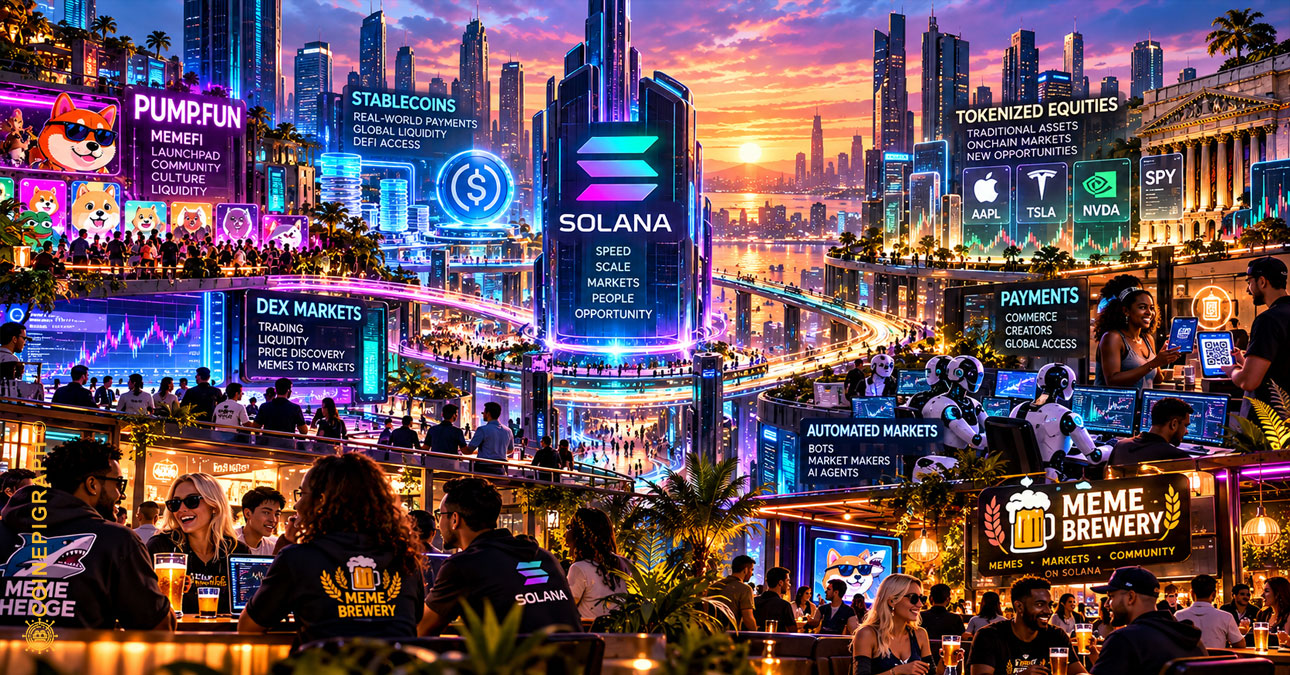
Three consecutive transaction records would normally be a blockchain story. But Solana’s recent activity is spreading across stablecoins, tokenized equities, decentralized exchanges, automated trading and a still-powerful MemeFi economy. The more consequential development may be the number of different markets beginning to operate on the same execution layer.
By CoinEpigraph Editorial Desk
September ended with another record on Solana.
The network completed 3.18 billion non-vote transactions during the month, its third consecutive monthly high in Solana Compass data. That was 8.3% above August and brought the third-quarter total to 8.78 billion completed transactions, 23.3% above the previous quarter. An independent Blockworks calculation cited by Solana Compass arrived at a similar result.
The obvious interpretation is that Solana is getting busier.
That may also be the least interesting one.
Beneath the transaction count, different kinds of economic activity are beginning to accumulate on the same network. Stablecoins are reaching record supply. Tokenized equities are attracting more holders. Decentralized exchanges continue to process enormous trading flows. Payment activity is expanding. Automated systems increasingly participate alongside human traders. And Pump.fun, despite repeated challenges to its dominance, has reasserted itself as one of the strongest application businesses in the ecosystem.
Solana is not simply processing more activity.
It is beginning to host more kinds of markets.
That distinction could matter far more than another blockchain throughput record.
The Speculators Never Left
There is an appealing institutional narrative about Solana that goes something like this: the network became famous for memecoins, survived that speculative phase, and is now graduating toward more serious financial activity.
The evidence suggests something more complicated.
Pump.fun has not been displaced by the arrival of tokenized securities, stablecoins or payment infrastructure. After temporarily losing ground to newer launchpads including Stonk and Pons, Pump.fun returned to more than 73% of daily launchpad revenue share in late September, according to Blockworks data cited by Solana Floor. It also regained leadership in launchpad revenue, token volume and deployments. Pump’s own application recently recorded an all-time high in Solana-based volume.
This matters because Pump should not be treated merely as evidence of speculation that Solana must eventually outgrow.
It is an economic machine operating on the network.
It attracts users, launches assets, generates transactions, produces fees, creates demand for liquidity and feeds activity into the surrounding trading infrastructure. Whether the majority of those assets possess enduring economic value is a different question from whether the application itself has become economically significant.
Solana’s evolution therefore looks less like a transition from speculative finance to conventional finance than an accumulation of financial layers.
The memecoin economy remains. Other economies are being built alongside it.
The Dollars Are Arriving Too
Stablecoins provide a different signal.
Solana’s official account reported stablecoin supply reaching a record $17.3 billion on September 25. Solana Floor measured $17.39 billion around the same period, while DeFiLlama’s methodology produced a lower figure of roughly $16.6 billion. The difference is a useful reminder that blockchain metrics depend heavily on what each provider counts, but all point toward a substantial pool of dollar-denominated liquidity now sitting on the network.
USDC alone accounted for roughly $8.4 billion in Solana Compass data at the time, while the number of wallets holding USDC had increased from about 8.1 million in August to more than 9.3 million by late September.
Those dollars can do more than sit in wallets.
They can provide trading pairs, enter lending markets, settle payments, supply liquidity and move between applications without leaving the network. Stablecoin depth therefore functions differently from speculative token creation. It supplies monetary infrastructure underneath the markets forming above it.
That distinction becomes more important as Solana’s activity broadens.
Birdeye’s third-quarter data put stablecoin holders at 13.07 million wallets, up 16% during the quarter, while card payment volume reached a record $262.7 million before the quarter had even ended.
None of these figures by itself establishes Solana as a payment network or institutional financial system. Together, however, they indicate that the network is carrying economic functions that no longer fit neatly inside the category of crypto trading.
Wall Street Assets Are Entering the Same Environment
Tokenized equities make the convergence harder to ignore.
More than 1.2 million Solana wallets held tokenized stocks by the beginning of October, according to Token Terminal data cited by Solana Compass. Separate Blockworks figures cited by SolanaFloor placed Solana at more than 32% of daily tokenized-equity trading volume across chains.
The significance is not simply that stocks can now appear on a blockchain.
Tokenization makes traditional assets available to software.
Once represented onchain, an equity-linked instrument can potentially interact with wallets, decentralized exchanges, liquidity pools, automated strategies and other programmable financial applications. The asset no longer has to remain inside the market structure from which it originated.
We have already seen the beginnings of this in the launchpad market, where StonkFun experimented with tokenized equities as reserve assets for newly created speculative tokens.
That is an unusual financial combination: a representation of a traditional security becoming a building block inside a crypto-native speculative market.
It also illustrates why Solana’s emerging structure cannot easily be divided into a respectable institutional side and a serious speculative side.
The more interesting development occurs when the layers begin touching.
A tokenized traditional asset enters an environment originally optimized for crypto-native trading. A launchpad incorporates it into a new market structure. Stablecoins provide another unit of account and source of liquidity. Automated market makers and trading systems connect the pieces.
TradFi and MemeFi do not have to become the same market for their infrastructure to become increasingly composable.
Not Every Transaction Means What It Appears to Mean
There is an important complication.
Solana’s enormous activity figures should not be treated as equivalent to human adoption.
Solana Compass counted $184.1 billion of September spot DEX volume across 95 programs and more than 1.6 million markets. DeFiLlama, using the DEX integrations it tracks, recorded closer to $78 billion. Bitquery separately classified $117.7 billion of activity during an overlapping August 24–September 22 period as circular or bot-like under its methodology. Solana Compass
That discrepancy is too large to ignore.
But automation itself is not necessarily evidence that nothing economically meaningful is happening.
Modern markets are already heavily machine-mediated. Market makers quote automatically. Arbitrage systems identify price discrepancies. Routers search for execution. Algorithms rebalance positions. Smart contracts enforce conditions without waiting for human intervention.
The relevant distinction is increasingly between useful automation and activity manufactured primarily to resemble demand.
That makes raw transaction count a weaker analytical instrument.
Interestingly, Solana’s September record improved on precisely this dimension. Total non-vote transaction attempts actually declined from 5.12 billion in August to 4.70 billion in September. Reverted transactions fell about 30%, while completed transactions increased by 243 million. The share of non-vote transactions ending in a completed result rose from 57.3% to 67.6%.
The network did not set its latest completed-transaction record simply by processing more attempts.
A larger proportion of those attempts finished with a settled result.
From Throughput to Economic Coordination
This points toward a different way of thinking about blockchain scale.
For much of crypto’s history, networks competed through relatively simple numbers: transactions per second, fees, users, total value locked and occasionally developer counts.
Those metrics remain useful.
But a financial network ultimately becomes more consequential when the activities taking place on it begin to depend on one another. Stablecoins can provide liquidity for trading, tokenized assets can move into markets that did not exist when those assets were issued, and automated systems can route capital between them. Payments, credit and speculation no longer have to occupy entirely separate environments. As more of those functions become programmable, the network’s value may increasingly lie not in any one activity, but in its ability to let different forms of economic activity meet.
The question is no longer only how many transactions the infrastructure can process. It is how many economically useful relationships the infrastructure can coordinate.
Solana’s speculative markets are relevant to that question. So are its stablecoins. So are tokenized equities. So are payments and the automated systems responsible for an increasing share of market activity.
This does not mean every category will succeed. Galaxy Research noted earlier this year that Solana remained unusually exposed to speculative trading cycles even as stablecoins, real-world assets, lending, payments and institutional infrastructure broadened. It also found areas—including perpetual futures and prediction markets—where competitors remained stronger.
That tension is precisely what makes the present moment interesting.
Solana does not need to cease being a speculative environment in order to become broader financial infrastructure.
It needs the infrastructure underneath speculation to become useful for more than speculation.

The Machine for Markets
The next competition among blockchains may therefore be harder to measure than the last one.
It may not be decided by which network can advertise the highest theoretical throughput, nor by which one temporarily records the greatest number of transactions.
The more durable advantage may belong to networks capable of supporting different economic systems simultaneously—and allowing those systems to interact without requiring each one to reconstruct the financial machinery beneath it.
That is what makes Solana’s recent records worth watching.
The 3.18 billion completed transactions are evidence of scale. The stablecoins provide monetary depth. Pump.fun demonstrates that crypto-native speculative businesses can develop durable economic machinery. Tokenized equities introduce traditional financial assets. Payments extend the network toward commerce. Automated systems increasingly connect the pieces.
None of that proves Solana has become the dominant financial network of the blockchain economy.
It suggests something subtler.
Solana is increasingly becoming an environment in which markets can be created, connected, automated and recombined.
The blockchain industry’s first great competition was about building faster networks. Its next one may be about what those networks become capable of coordinating once speed is no longer the entire story.
Solana’s September records do not settle that contest.
They may be showing us what the contest is becoming.
At CoinEpigraph, we are committed to delivering digital-asset journalism with clarity, accuracy, and uncompromising integrity. Our editorial team works daily to provide readers with reliable, insight-driven coverage across an ever-shifting crypto and macro-financial landscape. As we continue to broaden our reporting and introduce new sections and in-depth op-eds, our mission remains unchanged: to be your trusted, authoritative source for the world of crypto and emerging finance.
— Ian Mayzberg, Editor-in-Chief
The team at CoinEpigraph.com is committed to independent analysis and a clear view of the evolving digital asset order.
To help sustain our work and editorial independence, we would appreciate your support of any amount of the tokens listed below. Support independent journalism:
BTC: 3NM7AAdxxaJ7jUhZ2nyfgcheWkrquvCzRm
SOL: HxeMhsyDvdv9dqEoBPpFtR46iVfbjrAicBDDjtEvJp7n
ETH: 0x3ab8bdce82439a73ca808a160ef94623275b5c0a
XRP: rLHzPsX6oXkzU2qL12kHCH8G8cnZv1rBJh TAG – 1068637374
SUI – 0xb21b61330caaa90dedc68b866c48abbf5c61b84644c45beea6a424b54f162d0c
and through our Support Page.
🔍 Disclaimer: CoinEpigraph is for entertainment and information, not investment advice. Markets are volatile — always conduct your own research.
COINEPIGRAPH™ does not offer investment advice. Always conduct thorough research before making any market decisions regarding cryptocurrency or other asset classes. Past performance is not a reliable indicator of future outcomes. All rights reserved | 版权所有 ™ © 2024-2029.