


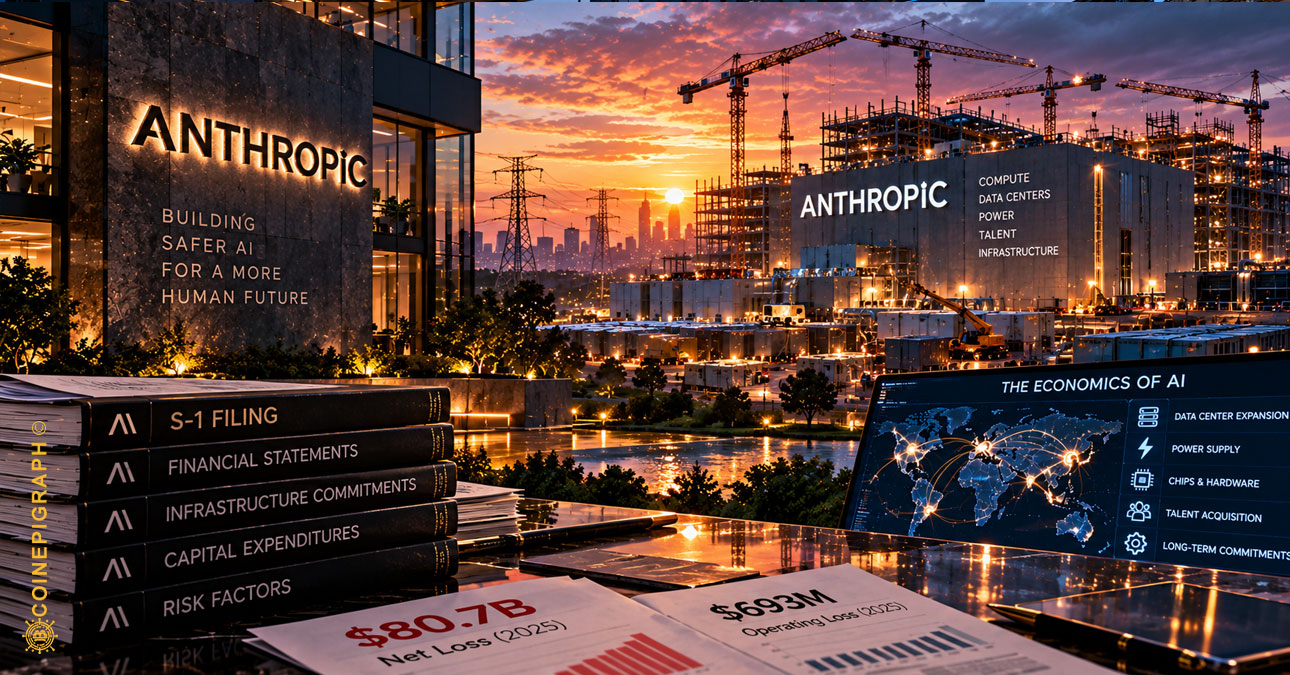
Anthropic reported an extraordinary $80.7 billion net loss while its underlying operating loss narrowed to $693 million. The difference exposes an accounting distortion, but the company’s enormous infrastructure commitments reveal something more consequential about the economics of artificial intelligence.
By CoinEpigraph Editorial Desk
Anthropic generated $16.3 billion in revenue during the first six months of 2026.
It also lost $80.7 billion.
Those numbers appear to describe one of the most extraordinary corporate contradictions to arrive at the public markets in years. A company approaching an initial public offering after one of the fastest revenue expansions in technology history simultaneously reported a net loss almost five times larger than its revenue.
But the headline number does not describe Anthropic’s operating business particularly well.
Of the $80.7 billion net loss reported for the six months ended June 30, approximately $72.4 billion came from changes in the fair value of convertible notes, derivative liabilities and simple agreements for future equity, or SAFEs. Anthropic says those changes were primarily driven by an increase in the fair value of outstanding convertible promissory notes as the company’s enterprise valuation increased.
The paradox is remarkable.
Anthropic became substantially more valuable, and that increase in value helped produce an enormous accounting loss.
Strip away that effect and another company begins to appear.
Anthropic reported an operating loss of just $693 million during the first half of 2026, down from $2.14 billion during the same period a year earlier. Revenue, meanwhile, increased from $1.16 billion to $16.29 billion.
The company reporting an $80.7 billion GAAP loss was simultaneously moving much closer to operating breakeven.
That distinction will matter as investors attempt to value Anthropic’s IPO.
But it may not be the most important number in the filing.
The deeper question is what it costs to keep the machine growing.
When Becoming More Valuable Creates a Loss
Private technology companies frequently finance expansion using instruments that can eventually convert into equity.
Anthropic has done so at extraordinary scale.
Convertible notes and SAFEs can provide companies with capital before a public offering without immediately establishing all of the economics that would accompany conventional public equity. But as the value of the underlying company changes, the accounting value of those obligations can change with it.
That is what happened at Anthropic.
The company recorded $34.3 billion in fair-value changes associated with convertible notes, derivatives and SAFEs during 2025. During the first half of 2026, the figure increased to $72.4 billion.
Those charges pushed Anthropic’s reported net loss from $42 billion in 2025 to $80.7 billion in only the first six months of this year.
This should not be dismissed as imaginary money.
The instruments represent genuine financial claims, and their eventual conversion can affect ownership and dilution. Anthropic’s S-1 says its convertible notes will convert immediately before completion of the offering, subject to the terms governing particular instruments.
But a fair-value charge is not the same thing as spending $72 billion running Claude.
That distinction is essential.
The spectacular net-loss figure primarily tells investors something about the financial architecture used to capitalize Anthropic while it was private.
The operating statement tells a different story.
The Business Beneath the Accounting
Anthropic’s revenue trajectory is difficult to overstate.
The company generated $41 million in revenue in 2023.
That increased to $386 million in 2024 and $4.59 billion in 2025.
During the first six months of 2026 alone, revenue reached $16.29 billion.
Operating expenses grew aggressively alongside it, rising from $3.30 billion in the first half of 2025 to $16.98 billion in the first half of this year. But revenue grew even faster.
As a result, the operating loss contracted from $2.14 billion to $693 million even as the company expanded at extraordinary speed.
That is the number investors should place beside the $80.7 billion loss.
Anthropic is not yet demonstrating that its economics are permanently profitable. Its own registration statement warns that it has incurred losses since inception and may not achieve or sustain profitability.
But the filing shows something important.
The underlying operation is scaling very differently from the GAAP net-loss headline.
That should make the IPO discussion more sophisticated, not necessarily more bullish.
Because once the accounting distortion is separated from the operating business, another cost becomes impossible to ignore.
The Real Cost Is Compute
Anthropic spent $8.95 billion on compute and infrastructure during the first half of 2026.
A year earlier, it spent $2.33 billion.
In 2024, it spent $2.52 billion for the entire year.
Compute has therefore become the largest operating expense in a company whose principal products are software.
That inversion captures one of the most important structural changes underway in artificial intelligence.
The leading AI laboratories may sell intelligence through software interfaces, but producing that intelligence increasingly requires physical infrastructure at enormous scale.
Semiconductors must be manufactured.
Accelerators must be acquired or leased.
Data centers must be constructed and powered.
Networking capacity must connect them.
Cloud providers must reserve enormous amounts of computing capacity.
And increasingly, those resources must be contracted years before the revenue they are expected to support has been earned.
Anthropic’s commitments show how far that transformation has progressed.
The company has disclosed at least $518 billion of long-term infrastructure commitments involving major technology and semiconductor partners. Reuters reported that roughly 80% of those commitments are non-cancelable or payable regardless of actual utilization.
The arrangements include more than $111 billion committed to Google and approximately $110 billion to Amazon, alongside extensive equipment and computing arrangements involving Broadcom and other suppliers.
Anthropic’s S-1 also describes an arrangement under which it can issue as much as $42 billion of convertible promissory notes to Broadcom or a designated financing partner to help finance specialized AI accelerators and associated components.
This is no longer merely the economics of software development.
It is infrastructure finance.
Software Is Becoming Capital Intensive
For decades, software produced one of the most attractive economic models in corporate America.
Once a product had been developed, distributing another copy often cost very little. Successful software companies could therefore expand revenue far faster than their physical capital requirements.
Frontier AI complicates that model.
Serving another customer does not require building another factory in the traditional sense. But inference consumes compute. Training more capable models requires enormous clusters of specialized hardware. Maintaining competitive capacity requires continuing investment in equipment whose technological life may be considerably shorter than the buildings housing it.
That changes the relationship between growth and capital.
Anthropic’s $16.3 billion of first-half revenue demonstrates enormous demand.
Its $8.95 billion compute bill demonstrates what supplying that demand requires.
Its hundreds of billions of dollars of infrastructure commitments demonstrate what management believes maintaining that position may require in the future.
Those three figures belong in the same analysis.
A rapidly growing AI company can approach operating profitability while simultaneously committing itself to one of the largest infrastructure buildouts in corporate history.
The traditional distinction between a technology company and an infrastructure company begins to blur.
The Balance Sheet Becomes Part of the Model
This also changes what competition among frontier AI companies means.
Model quality remains important. So do developers, enterprise customers, distribution and safety.
But access to capital is increasingly becoming part of the product architecture.
An AI laboratory unable to secure enough accelerators, cloud capacity or electricity may find itself technologically constrained regardless of the quality of its research.
Conversely, reserving too much capacity creates another risk.
Long-duration infrastructure commitments assume that demand, model economics and technological requirements will evolve favorably enough to justify them. Yet AI hardware improves rapidly. Model architectures change. Inference becomes more efficient. Customers can migrate. Competitors can lower prices.
Anthropic is therefore making two bets simultaneously.
One is that demand for Claude and related AI services will continue expanding.
The other is that the company can accurately anticipate how much physical computing capacity it will need to satisfy that demand years into the future.
The second bet receives considerably less attention.
It may ultimately prove just as important as the first.
The IPO Changes the Financial Architecture
Anthropic’s transition into the public markets should also begin changing the way investors evaluate the company.
The convertible instruments that helped finance its private-market expansion are expected to convert as part of the offering process. That will not make dilution or financing risk disappear, but it should reduce the usefulness of enormous fair-value movements as a measure of the underlying operation.
Public investors will increasingly focus on more conventional questions.
How quickly is revenue growing?
How much does it cost to produce that revenue?
How much cash must be committed to infrastructure?
What returns will those commitments generate?
How much additional capital will the company require?
And how durable are its margins if the price of AI inference continues falling?
Those questions cannot be answered by pointing to the $80.7 billion loss.
Nor can they be answered by simply removing it.
The accounting anomaly and the operating improvement are both pieces of a much larger capital structure.

The AI Boom Moves Into the Physical World
Anthropic’s S-1 arrives at an important moment for the artificial intelligence industry.
For several years, the AI boom was largely described through models, benchmarks, applications and increasingly capable software.
The financial architecture now coming into view tells a different story.
The industry’s frontier is becoming dependent upon enormous pools of capital financing chips, data centers, cloud infrastructure, electricity and long-term computing contracts.
That does not make Anthropic an infrastructure company in the conventional sense.
But it means infrastructure has become inseparable from its economics.
The $80.7 billion net loss will attract attention because of its scale. It should.
But investors who stop there will misunderstand what Anthropic has disclosed.
The more consequential numbers may be the $16.3 billion of first-half revenue, the $693 million operating loss, the nearly $9 billion already being spent on compute and infrastructure, and the hundreds of billions of dollars committed to securing future capacity.
Together they describe something larger than an accounting curiosity.
Artificial intelligence is entering a stage in which access to intelligence increasingly depends upon access to capital, and access to capital increasingly determines who can afford to build the infrastructure required to remain at the frontier.
Anthropic’s S-1 does not merely reveal the finances of an AI company preparing to go public.
It reveals how much of the AI boom is becoming a capital project.
At CoinEpigraph, we are committed to delivering digital-asset journalism with clarity, accuracy, and uncompromising integrity. Our editorial team works daily to provide readers with reliable, insight-driven coverage across an ever-shifting crypto and macro-financial landscape. As we continue to broaden our reporting and introduce new sections and in-depth op-eds, our mission remains unchanged: to be your trusted, authoritative source for the world of crypto and emerging finance.
— Ian Mayzberg, Editor-in-Chief
The team at CoinEpigraph.com is committed to independent analysis and a clear view of the evolving digital asset order.
To help sustain our work and editorial independence, we would appreciate your support of any amount of the tokens listed below. Support independent journalism:
BTC: 3NM7AAdxxaJ7jUhZ2nyfgcheWkrquvCzRm
SOL: HxeMhsyDvdv9dqEoBPpFtR46iVfbjrAicBDDjtEvJp7n
ETH: 0x3ab8bdce82439a73ca808a160ef94623275b5c0a
XRP: rLHzPsX6oXkzU2qL12kHCH8G8cnZv1rBJh TAG – 1068637374
SUI – 0xb21b61330caaa90dedc68b866c48abbf5c61b84644c45beea6a424b54f162d0c
and through our Support Page.
🔍 Disclaimer: CoinEpigraph is for entertainment and information, not investment advice. Markets are volatile — always conduct your own research.
COINEPIGRAPH™ does not offer investment advice. Always conduct thorough research before making any market decisions regarding cryptocurrency or other asset classes. Past performance is not a reliable indicator of future outcomes. All rights reserved | 版权所有 ™ © 2024-2029.