


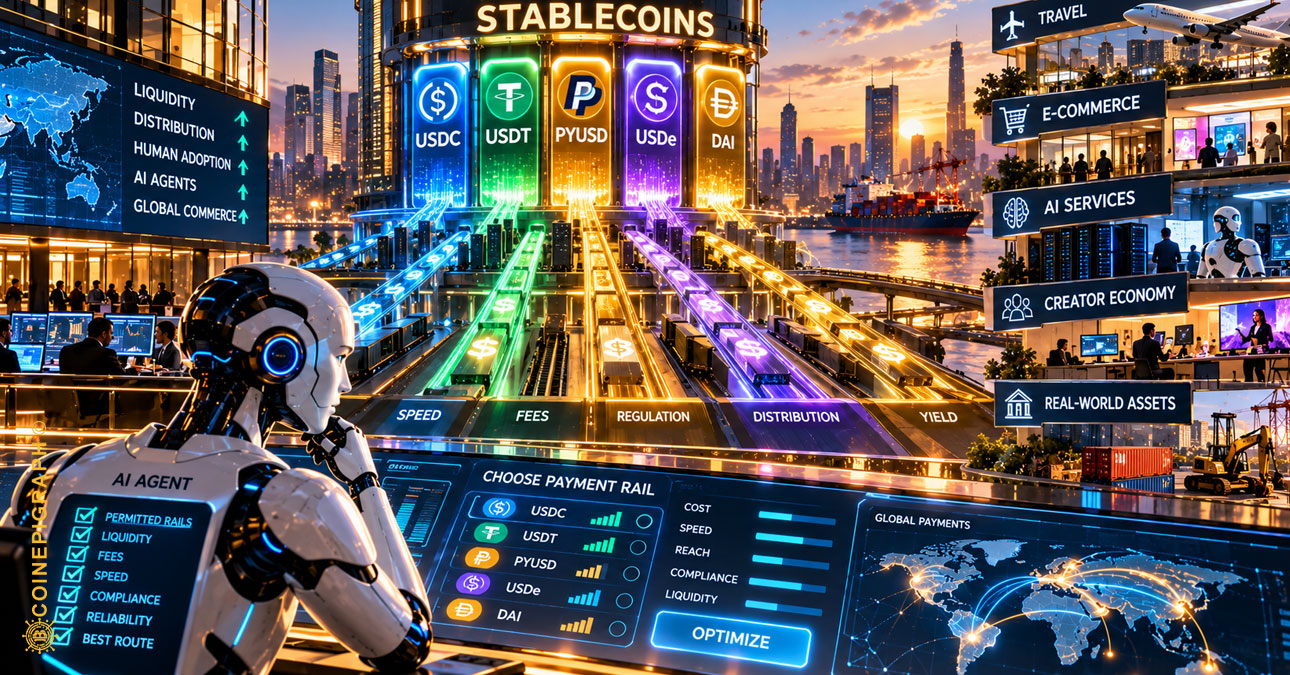
Stablecoin competition began with liquidity, distribution and human adoption. AI agents introduce a different customer—software capable of choosing among permitted payment rails, moving value and purchasing services without waiting for a person to select the infrastructure underneath the transaction.
By CoinEpigraph Editorial Desk
Stablecoin competition has largely been measured through familiar numbers.
Supply matters. Transaction volume matters. Exchange liquidity matters. So do the number of wallets, payment integrations and blockchains on which a digital dollar can circulate.
Those measurements assume something about the customer: somewhere in the transaction, a person or institution has already decided which financial infrastructure to use.
Artificial intelligence may begin changing that assumption.
Circle, Ripple and a growing collection of payment-protocol developers are building infrastructure through which software agents can hold spending authority, purchase digital services and initiate transactions programmatically. The development does not mean autonomous software is about to receive unrestricted access to the financial system. It suggests something more practical: within boundaries established by their operators, machines may increasingly participate in selecting how money moves.
That would introduce a different competitive dynamic into digital payments.
The question would no longer be only which stablecoin people prefer.
It would also become which forms of money software is permitted—and economically incentivized—to choose.
From Digital Dollars to Machine Spending
A stablecoin is already unusually well suited to software.
It can exist inside a programmable wallet, move around the clock and interact with applications without requiring the conventional sequence of bank operating hours, card authorization systems and manual checkout processes.
AI agents add decision-making to that infrastructure.
Circle has been developing an Agent Stack intended to give software agents access to wallets, spending controls and payment capabilities using USDC. The architecture points toward agents capable of discovering services and paying for them while remaining subject to policies established by the humans or organizations delegating authority.
Ripple is approaching the same emerging market from another direction. Its XRP Ledger AI Starter Kit supports agent-oriented applications using XRP and the RLUSD stablecoin, including implementations involving the x402 payment protocol.
Neither development means that an AI has become financially sovereign.
The agent remains dependent upon permissions. A company might allow software to purchase computing capacity up to a defined amount, for example, while prohibiting transfers to unknown counter-parties or transactions outside approved jurisdictions.
But once those boundaries are established, the individual payment decision may no longer require human attention.
That is where the economics begin to change.
Machines Do Not Have Bank-Account Loyalty
Human financial behavior contains enormous amounts of inertia.
Consumers leave deposits in accounts paying less than competing alternatives. Businesses maintain payment relationships that are not necessarily the cheapest available. Changing banks, payment processors or financial software can require research, paperwork, integration costs and management approval.
Convenience frequently defeats optimization.
Software behaves differently.
An agent instructed to acquire a particular digital service could theoretically evaluate several approved payment options before executing the transaction. Cost could matter. So could settlement speed, available liquidity, network reliability, counterparty acceptance and the policies attached to a particular wallet.
An agent managing treasury operations might make a different calculation. It could be authorized to allocate balances among approved instruments according to liquidity requirements or yield, while remaining inside limits established by the institution.
This does not create frictionless financial arbitrage. Regulatory requirements, taxes, liquidity, security controls and contractual obligations remain.
It does reduce one particular source of friction: human attention.
That difference becomes economically significant when transactions occur repeatedly.
A person making one payment may not care about a small difference in cost. Software executing thousands or millions of permitted transactions can incorporate that difference into every decision.
Financial infrastructure may therefore begin competing for machine flow in ways that resemble the competition for algorithmic order flow in modern markets.
The Stablecoin May Be Only One Layer
This also complicates the assumption that stablecoin issuers will capture all of the value created by machine payments.
Consider what must happen when an autonomous agent purchases a digital service.
The agent first needs authority to spend. It needs some mechanism for discovering what the service costs. The service must communicate which payment methods it accepts. The agent must produce the required payment, the transaction must settle, and the provider must determine that payment has occurred before releasing the resource.
Several businesses can occupy those layers.
The stablecoin issuer provides the monetary instrument.
A blockchain provides settlement.
A wallet manages credentials and permissions.
A payment protocol communicates the terms of exchange.
Security infrastructure determines what the agent is allowed to do.
Identity or compliance systems may determine where it can do it.
That makes developments such as x402 particularly interesting.
Originally developed by Coinbase, x402 adapts a long-existing feature of internet architecture—the HTTP 402 “Payment Required” status—into a mechanism through which software can encounter a payment request and respond programmatically.
The concept is straightforward but potentially consequential. Instead of every machine transaction requiring a conventional subscription, account relationship or human checkout process, a digital service can communicate that payment is required and provide instructions for satisfying it.
Cloudflare has also been developing machine-payment capabilities around agent infrastructure, further suggesting that this market will not belong exclusively to cryptocurrency companies.
The emerging architecture therefore resembles a stack rather than a single product:
authority → discovery → payment instruction → monetary instrument → settlement → service
Who controls the most valuable part of that stack remains unsettled.
Stablecoin Competition Could Become Routing Competition
This introduces a possibility that looks less like conventional banking competition and more like internet routing.
A future agent may not begin with the instruction, “Pay with this particular stablecoin.”
It might instead receive an instruction such as: acquire a certain amount of computing capacity from an approved provider while remaining within specified cost, security and settlement requirements.
The payment rail becomes one variable inside the decision.
If several stablecoins satisfy those requirements, software could select among them.
That possibility should not be overstated. Stablecoins are not interchangeable simply because they track the same currency.
They have different issuers, reserve structures, regulatory frameworks, liquidity profiles and redemption arrangements. They circulate across different networks and are accepted by different counter-parties.
Institutions will impose their own restrictions as well. A regulated financial company may permit an agent to transact only in specific assets, through approved counter-parties and across designated infrastructure.
Machine choice will therefore be bounded choice.
Yet even bounded choice can transform competition.
The important development is not that an AI will roam freely through global finance looking for the highest yield. It is that software can repeatedly optimize among whatever choices an institution has already determined are acceptable.
That turns financial policy into executable infrastructure.
Circle and Ripple Are Approaching the Same Frontier Differently
The distinction matters when evaluating Circle and Ripple.
Circle’s USDC already benefits from broad distribution across public blockchains and digital-asset markets. Its Arc network and agent-oriented tooling indicate an effort to extend that position into an environment where programmable financial applications and automated commerce become more important.
Ripple brings a different institutional footprint. Its expansion through payments, custody, RLUSD and prime brokerage increasingly places the company at the intersection of digital assets and traditional financial infrastructure. Its work around XRP Ledger agent tooling shows that machine payments are not separate from that strategy.
It would therefore be premature to declare one architecture the winner.
The more important observation is that both are preparing for a market in which the end user may increasingly be software.
That market could reward different characteristics from consumer payments.
Brand recognition may matter less.
Machine-readable liquidity could matter more.
Marketing may matter less than integration.
The ability to enforce spending policies, verify counter-parties and move reliably across infrastructure could become part of the product itself.
Stablecoin issuers would then be competing not merely for balances, but for inclusion inside the rules governing automated financial activity.
Money Is Becoming an Input to Software
Financial history contains earlier examples of technology changing how payment systems compete.
Credit cards separated purchasing from physical cash. Electronic trading allowed algorithms to choose execution venues. Payment processors abstracted much of the banking infrastructure underneath internet commerce.
Agentic finance could extend that abstraction further.
A machine does not necessarily need to know the institutional history of the monetary instrument it uses. It needs to know whether the instrument satisfies the requirements encoded into its task.
That shifts part of financial competition from persuasion toward specification.
For issuers and payment networks, the challenge may become ensuring that their infrastructure is sufficiently liquid, reliable, programmable and compliant to remain inside the universe of options an agent is permitted to consider.
For financial institutions, the challenge runs in the opposite direction.
Giving software the ability to choose among payment rails also requires deciding which choices software should never be allowed to make.
Spending limits, counter-party restrictions, transaction monitoring, revocation mechanisms and independent verification become increasingly important as financial discretion moves from interface clicks into machine-executable policy.
The machine-native economy therefore needs more than machine-native money. It needs mechanisms for governing machine-native authority.

When the Customer Becomes Software
Stablecoins have already begun separating the dollar from some of the infrastructure through which dollars historically traveled.
Agentic commerce introduces another separation.
The person or institution can establish the objective and the boundaries while software increasingly determines how an individual transaction is executed inside them.
That does not remove human control from finance. Properly designed, it changes where that control is exercised—from approving every transaction toward defining the policies under which transactions can occur.
For stablecoin issuers, blockchain networks and payment-protocol developers, that creates a new competitive arena.
The winning monetary instrument may not simply be the one with the largest supply or the most recognizable name. Nor will machines necessarily select a single universal digital dollar.
Different forms of digital money may instead compete for inclusion within the policies, wallets and protocols governing automated economic activity.
Stablecoin competition began by asking where people would keep and move digital dollars.
The arrival of autonomous financial software introduces a different question.
What happens when the customer choosing the financial rail is no longer human?
At CoinEpigraph, we are committed to delivering digital-asset journalism with clarity, accuracy, and uncompromising integrity. Our editorial team works daily to provide readers with reliable, insight-driven coverage across an ever-shifting crypto and macro-financial landscape. As we continue to broaden our reporting and introduce new sections and in-depth op-eds, our mission remains unchanged: to be your trusted, authoritative source for the world of crypto and emerging finance.
— Ian Mayzberg, Editor-in-Chief
The team at CoinEpigraph.com is committed to independent analysis and a clear view of the evolving digital asset order.
To help sustain our work and editorial independence, we would appreciate your support of any amount of the tokens listed below. Support independent journalism:
BTC: 3NM7AAdxxaJ7jUhZ2nyfgcheWkrquvCzRm
SOL: HxeMhsyDvdv9dqEoBPpFtR46iVfbjrAicBDDjtEvJp7n
ETH: 0x3ab8bdce82439a73ca808a160ef94623275b5c0a
XRP: rLHzPsX6oXkzU2qL12kHCH8G8cnZv1rBJh TAG – 1068637374
SUI – 0xb21b61330caaa90dedc68b866c48abbf5c61b84644c45beea6a424b54f162d0c
and through our Support Page.
🔍 Disclaimer: CoinEpigraph is for entertainment and information, not investment advice. Markets are volatile — always conduct your own research.
COINEPIGRAPH™ does not offer investment advice. Always conduct thorough research before making any market decisions regarding cryptocurrency or other asset classes. Past performance is not a reliable indicator of future outcomes. All rights reserved | 版权所有 ™ © 2024-2029.