


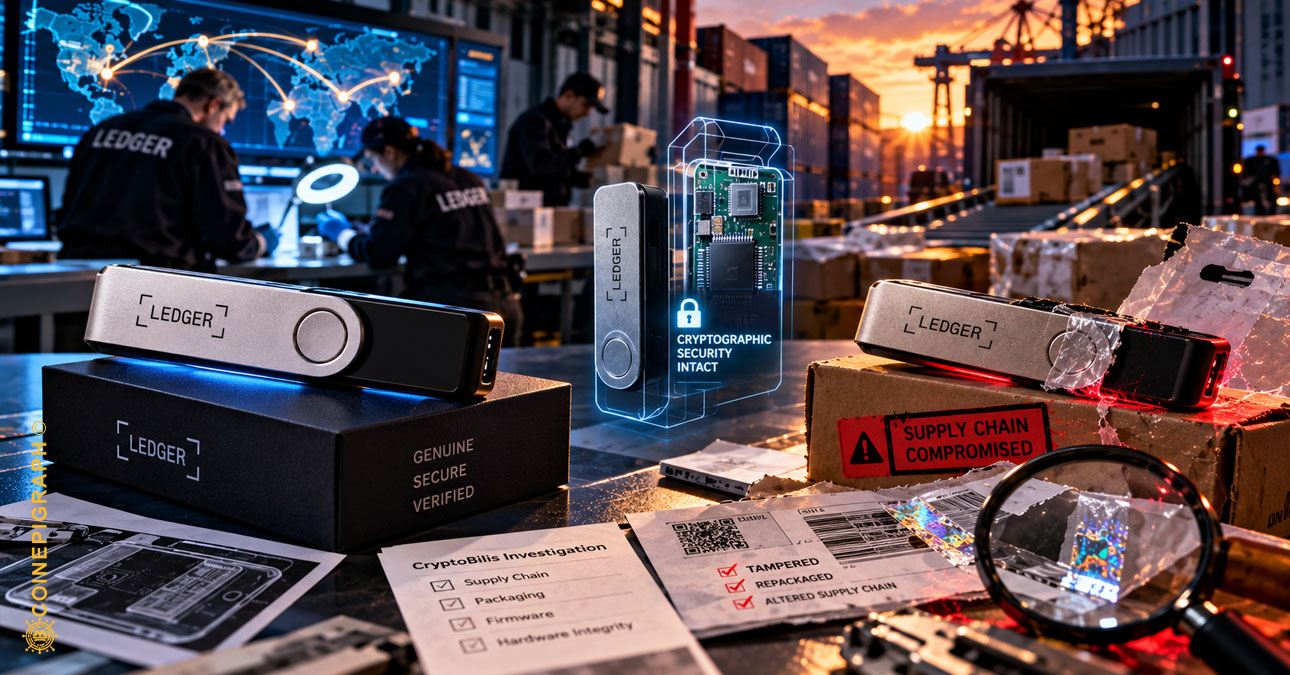
Ledger has confirmed an unauthorized hardware implant in a wallet associated with suspected cryptocurrency thefts exceeding $90 million by one investigator’s estimate. The incident exposes a weakness that cryptographic security cannot resolve alone: the integrity of the device before it reaches its owner.
By CoinEpigraph Editorial Desk
The promise of a hardware wallet is that private keys can remain protected even when the computer connected to the device cannot be trusted.
That protection has become fundamental to cryptocurrency self-custody. By isolating sensitive cryptographic operations within specialized hardware, wallet manufacturers have sought to reduce the risks associated with compromised computers, malicious applications and internet-connected systems.
But the security model depends upon an assumption that is receiving renewed scrutiny: the device itself must be trustworthy when it reaches the customer.
On October 9, Ledger began investigating reports of cryptocurrency losses involving customers who purchased hardware wallets through CryptoBilis, an authorized reseller serving Southeast Asian markets.
The investigation subsequently established that at least one affected device contained an unauthorized hardware implant. Ledger says every confirmed case associated with the reported incident involves devices sold through CryptoBilis, while its own infrastructure, services and direct sales channels remain unaffected.
The financial exposure could be substantial. Blockchain analytics firm Bitquery estimates that approximately $93.2 million was removed from 315 wallets across six networks, although Ledger has not independently confirmed that figure or established that every identified loss resulted from the same compromise.
The distinction matters because the incident is not simply another example of cryptocurrency theft. It raises questions about where responsibility for protecting cryptographic ownership begins.
When Security Fails Before the First Transaction
Hardware wallets are designed to protect private keys from exposure during normal use. Their security architecture typically separates sensitive signing operations from the software environments through which users prepare transactions.
An attacker who compromises the user’s computer should not automatically gain access to the private keys stored inside a properly functioning hardware wallet.
Physical tampering introduces a different threat.
If unauthorized components are introduced before the device reaches its owner, an attacker may be able to interfere with initialization, observe sensitive information or compromise the protections upon which the owner relies.
Researchers examining modified hardware wallets have described implants capable of intercepting recovery information. However, Ledger has not publicly established the precise operation of the implant discovered in the CryptoBilis investigation or confirmed that it caused every reported theft.
That uncertainty should not obscure the structural issue.
A hardware wallet may contain authentic security components while other parts of the device have been altered. Authentication of one component does not necessarily establish the integrity of the entire assembled product.
The resulting vulnerability exists outside the blockchain itself.
A network can correctly verify a transaction signed with a compromised credential. It cannot determine whether that credential was exposed through hardware manipulation before the owner began using the device.
Cryptographic verification remains intact even when the surrounding chain of trust has failed.

The Authorized Reseller Problem
CryptoBilis was not an obscure, unauthorized marketplace seller. It was listed as an authorized Ledger reseller in Indonesia, Malaysia and the Philippines.
That relationship makes the incident particularly relevant to the economics of hardware distribution.
Manufacturers depend upon resellers and logistics networks to reach customers across international markets. Authorized distribution provides commercial legitimacy and a degree of accountability, but it does not eliminate every opportunity for physical interference.
Ledger has advised customers who recently purchased devices through CryptoBilis not to initialize unused wallets. Customers who have already configured affected devices have been advised to consider transferring their assets to a new device using a newly generated recovery phrase.
CryptoBilis has suspended hardware wallet sales while the investigation continues.
The broader question is what assurances should accompany the movement of security-sensitive financial hardware from manufacturer to customer.
For institutional custodians, comparable concerns extend into procurement controls, device authentication, secure transportation, inventory management and independent inspection.
These are familiar disciplines in industries where equipment integrity is essential. Their relevance to digital asset custody is becoming harder to overlook.
The Silicon Beneath Self-Custody
The incident arrives shortly after Ethereum co-founder Vitalik Buterin drew attention to the computing infrastructure beneath cryptographic ownership.
His formulation, “Not your silicon, not your keys,” extends the familiar self-custody principle beyond possession of private credentials.
The underlying concern is that financial authority ultimately depends upon hardware and software capable of exercising it.
The CryptoBilis investigation does not establish that all hardware wallets share the same vulnerability. Nor does it demonstrate that physical ownership of a device is insufficient in every circumstance.
It illustrates a narrower but important dependency: users cannot rely exclusively upon cryptographic assurances if the equipment generating or protecting their credentials has been compromised.
That distinction becomes increasingly consequential as digital assets move into institutional portfolios and automated financial systems.
The question of custody is expanding beyond where private keys are stored to include how the devices protecting them are manufactured, distributed, authenticated and maintained.

A Larger Market for Verifiable Trust
The immediate investigation concerns a particular reseller and a limited number of confirmed compromised devices. Its broader implications concern the infrastructure supporting digital ownership.
As tokenized securities, institutional custody services and autonomous financial applications expand, the reliability of computing equipment will become part of the financial system’s operational risk.
This could increase demand for stronger supply-chain verification, tamper-resistant designs, independently auditable hardware and more rigorous device-provenance controls.
None of those measures eliminates risk. Hardware integrity is a continuing process rather than a permanent guarantee.
The emerging challenge is to make the trust placed in physical computing systems more independently verifiable.
Ledger’s investigation remains open, and the ultimate losses, number of affected devices and method of compromise have not been conclusively established.
Nevertheless, the confirmed discovery of an unauthorized implant provides a useful reminder of the boundary between cryptographic security and operational security.
Blockchain technology can verify that the correct credentials authorized a transaction. Protecting the legitimacy of those credentials requires safeguards extending well beyond the ledger.
The integrity of digital ownership increasingly depends upon the integrity of the machinery entrusted to exercise it.
At CoinEpigraph, we are committed to delivering digital-asset journalism with clarity, accuracy, and uncompromising integrity. Our editorial team works daily to provide readers with reliable, insight-driven coverage across an ever-shifting crypto and macro-financial landscape. As we continue to broaden our reporting and introduce new sections and in-depth op-eds, our mission remains unchanged: to be your trusted, authoritative source for the world of crypto and emerging finance.
— Ian Mayzberg, Editor-in-Chief
The team at CoinEpigraph.com is committed to independent analysis and a clear view of the evolving digital asset order.
To help sustain our work and editorial independence, we would appreciate your support of any amount of the tokens listed below. Support independent journalism:
BTC: 3NM7AAdxxaJ7jUhZ2nyfgcheWkrquvCzRm
SOL: HxeMhsyDvdv9dqEoBPpFtR46iVfbjrAicBDDjtEvJp7n
ETH: 0x3ab8bdce82439a73ca808a160ef94623275b5c0a
XRP: rLHzPsX6oXkzU2qL12kHCH8G8cnZv1rBJh TAG – 1068637374
SUI – 0xb21b61330caaa90dedc68b866c48abbf5c61b84644c45beea6a424b54f162d0c
and through our Support Page.
🔍 Disclaimer: CoinEpigraph is for entertainment and information, not investment advice. Markets are volatile — always conduct your own research.
COINEPIGRAPH™ does not offer investment advice. Always conduct thorough research before making any market decisions regarding cryptocurrency or other asset classes. Past performance is not a reliable indicator of future outcomes. All rights reserved | 版权所有 ™ © 2024-2029.