


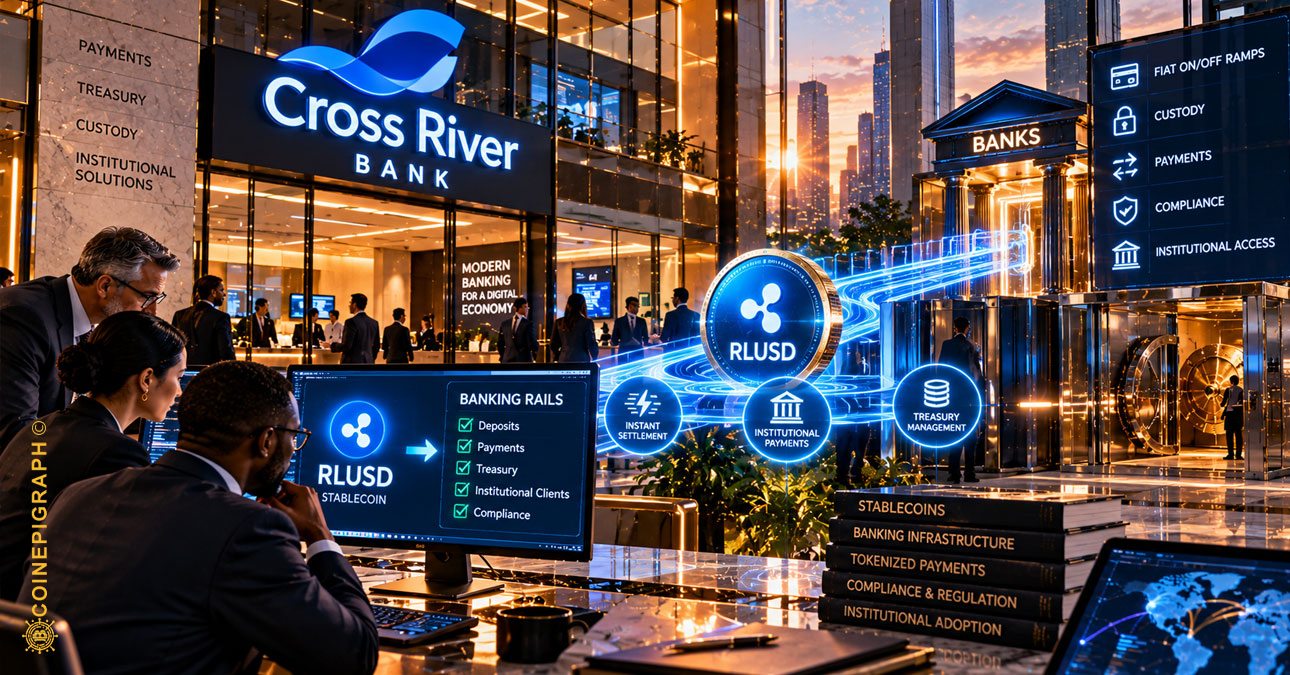
Cross River has integrated Ripple’s RLUSD and XRP Ledger settlement into the same core infrastructure its fintech clients use to access conventional payment rails. The development points toward a different path for stablecoin adoption—not replacing the banking system, but becoming another rail inside it.
By CoinEpigraph Editorial Desk
For much of crypto’s history, the relationship between stablecoins and banks was framed as competition.
Stablecoins could move around the clock. Bank payments remained tied to established networks, intermediaries and, depending on the rail, operating windows. One system was presented as an alternative to the other.
Cross River Bank is beginning to make that distinction less useful.
The regulated U.S. bank has integrated Ripple USD, or RLUSD, into its proprietary Core Operating System, with transactions supported on the XRP Ledger. Fintech customers can access the stablecoin through the same API environment Cross River uses to provide ACH, wires and real-time payments. They do not have to construct their own blockchain infrastructure to reach it.
That sounds like another stablecoin integration.
The more important development is where the stablecoin has been placed.
RLUSD is not being positioned outside the banking system as an alternative monetary network. It is being inserted into infrastructure that already determines how businesses move dollars.
The stablecoin is becoming another rail.
The Bank Account Does Not Have to Become Crypto
That distinction matters.
Cross River’s stablecoin-enabled accounts remain U.S. dollar deposit accounts. Incoming stablecoin payments can be reflected as dollars in the corresponding account, while outgoing stablecoin transfers debit the customer’s dollar balance. Cross River says customers do not hold digital assets at the bank through these accounts, and the bank does not provide cryptocurrency custody as part of the product. FDIC insurance applies to eligible dollar deposits, not to stablecoins themselves.
In other words, the deposit does not have to become a stablecoin for the payment infrastructure underneath it to become blockchain-based.
That begins to separate two concepts that crypto has often treated as the same thing: what money a customer holds and which infrastructure moves it.
A fintech may continue to think in dollars. Its accounting can remain dollar-denominated. Its relationship can remain with a regulated bank.
But somewhere between payment instruction and final settlement, value can travel over a public blockchain.
Cross River’s architecture increasingly looks something like this:
Dollar account → banking API → payment instruction → selected rail → blockchain settlement when appropriate → recipient
The blockchain begins disappearing beneath the financial product.
That may be one of the more consequential paths toward stablecoin adoption.
This Did Not Begin With RLUSD
Cross River did not suddenly become a stablecoin bank because of Ripple.
The bank launched its broader stablecoin payments infrastructure in November 2025, integrating fiat and stablecoin flows directly into its Core Operating System. Its existing stablecoin-enabled account infrastructure has supported USDC over Ethereum and Solana, alongside conventional rails including ACH, wires, RTP and FedNow.
That history changes how the RLUSD announcement should be interpreted.
This is not principally a story about one stablecoin gaining access to one bank.
It is evidence of a banking architecture becoming capable of supporting multiple forms of settlement behind a common interface.
Cross River describes its stablecoin system as providing interoperability among conventional payment networks and approved stablecoins. Its current product architecture can handle on- and off-ramps, treasury movement, payouts and network settlement while keeping reporting and controls within the bank’s environment.
RLUSD expands that architecture by adding another monetary instrument and another blockchain settlement option.
The competitive question therefore begins to change.
It is no longer simply whether stablecoins can compete with banks.
It is which stablecoins and blockchains banks will make available inside their own infrastructure.

XRP Ledger Becomes Infrastructure, Not the Product
The distinction is equally important for XRP.
Cross River is integrating RLUSD transactions on the XRP Ledger. That does not mean the bank has adopted XRP as its customers’ payment currency.
RLUSD is an issued token on XRP Ledger backed by real-world reserve assets. Ripple also issues RLUSD on Ethereum and several other blockchain environments, making the stablecoin itself multichain.
In Cross River’s implementation, the XRP Ledger provides the blockchain settlement environment while RLUSD provides the dollar-denominated instrument.
That may appear less dramatic than claims of banks adopting cryptocurrencies directly.
Structurally, it may be more important.
Financial infrastructure tends to become consequential when users no longer need to think about it.
Consumers rarely consider which correspondent banks participate in an international payment or which clearing architecture sits underneath a card transaction. Businesses generally care about cost, availability, settlement certainty, reconciliation and whether money arrives where it is supposed to arrive.
Blockchain may ultimately face the same test.
Its success inside banking may depend less on convincing every business to become a blockchain user than on making blockchain settlement available without requiring businesses to behave like blockchain companies.
Cross River is moving in that direction.
The Stablecoin Becomes a Routing Option
Once several rails exist behind the same banking interface, another possibility emerges.
Payments can increasingly be routed according to what a transaction requires.
A domestic payment might use ACH. A time-sensitive transfer might use a real-time network. Another transaction could eventually use a stablecoin because continuous settlement, cross-border reach or treasury efficiency makes blockchain infrastructure more appropriate.
Cross River’s documentation already describes network optionality in operational terms, with supported blockchain networks selected according to the needs of the transaction while the bank manages network interaction, execution and confirmation.
This is where the development intersects with another transition occurring in finance: automation.
As treasury systems, payment orchestration software and eventually AI agents gain greater authority to initiate transactions, the question may increasingly become not whether an organization has chosen “crypto” or “banking,” but which permitted rail best satisfies a particular instruction.
That creates a very different competitive environment for stablecoins.
Liquidity matters. So does settlement speed. But compliance compatibility, redemption infrastructure, network reliability, bank integrations and the ability to fit into existing financial controls become equally important.
The stablecoin that wins a consumer branding contest may not necessarily be the stablecoin that becomes deeply embedded inside financial infrastructure.
Banks May Become the Abstraction Layer
Crypto’s early architecture often attempted to remove financial intermediaries.
The emerging stablecoin architecture may instead give some intermediaries a new function.
Banks and financial infrastructure providers can become the abstraction layer between customers and multiple settlement networks.
The customer sees an account.
The fintech sees an API.
Underneath both, the bank can connect ACH, wires, real-time payment systems and approved blockchain networks while maintaining compliance, reconciliation and risk controls around the movement of funds.
Cross River’s model does not eliminate the bank.
It potentially makes the bank the institution that determines which pieces of blockchain infrastructure become usable within regulated finance.
That also means integration is not the same as unrestricted access. Stablecoin payments remain subject to compliance requirements, supported assets, approved networks, product permissions and geographic availability. Cross River says its stablecoin services remain available only in limited states.
The architecture may be open to new rails without being open to every rail.
That distinction will matter as stablecoin issuers compete for institutional distribution.

The Parallel System Is Beginning to Converge
There was a period when stablecoins appeared to be constructing a financial system beside banking.
That system still exists. Wallets, exchanges and decentralized protocols continue to operate outside conventional bank interfaces.
But another model is now developing alongside it.
Stablecoins are moving into payment processors, card settlement, treasury infrastructure and banking APIs. Public blockchains can increasingly operate underneath regulated financial products without becoming the product presented to the customer.
Cross River’s RLUSD integration is one example of that transition rather than its beginning.
And that is precisely why it matters.
The most significant stage of stablecoin adoption may not arrive when businesses abandon bank accounts for blockchain wallets. It may arrive when businesses continue using familiar financial products while the infrastructure underneath those products quietly gains the ability to move value across both conventional and blockchain networks.
The stablecoin does not have to replace the bank.
It only has to become one of the rails the bank knows how to use.
At CoinEpigraph, we are committed to delivering digital-asset journalism with clarity, accuracy, and uncompromising integrity. Our editorial team works daily to provide readers with reliable, insight-driven coverage across an ever-shifting crypto and macro-financial landscape. As we continue to broaden our reporting and introduce new sections and in-depth op-eds, our mission remains unchanged: to be your trusted, authoritative source for the world of crypto and emerging finance.
— Ian Mayzberg, Editor-in-Chief
The team at CoinEpigraph.com is committed to independent analysis and a clear view of the evolving digital asset order.
To help sustain our work and editorial independence, we would appreciate your support of any amount of the tokens listed below. Support independent journalism:
BTC: 3NM7AAdxxaJ7jUhZ2nyfgcheWkrquvCzRm
SOL: HxeMhsyDvdv9dqEoBPpFtR46iVfbjrAicBDDjtEvJp7n
ETH: 0x3ab8bdce82439a73ca808a160ef94623275b5c0a
XRP: rLHzPsX6oXkzU2qL12kHCH8G8cnZv1rBJh TAG – 1068637374
SUI – 0xb21b61330caaa90dedc68b866c48abbf5c61b84644c45beea6a424b54f162d0c
and through our Support Page.
🔍 Disclaimer: CoinEpigraph is for entertainment and information, not investment advice. Markets are volatile — always conduct your own research.
COINEPIGRAPH™ does not offer investment advice. Always conduct thorough research before making any market decisions regarding cryptocurrency or other asset classes. Past performance is not a reliable indicator of future outcomes. All rights reserved | 版权所有 ™ © 2024-2029.