


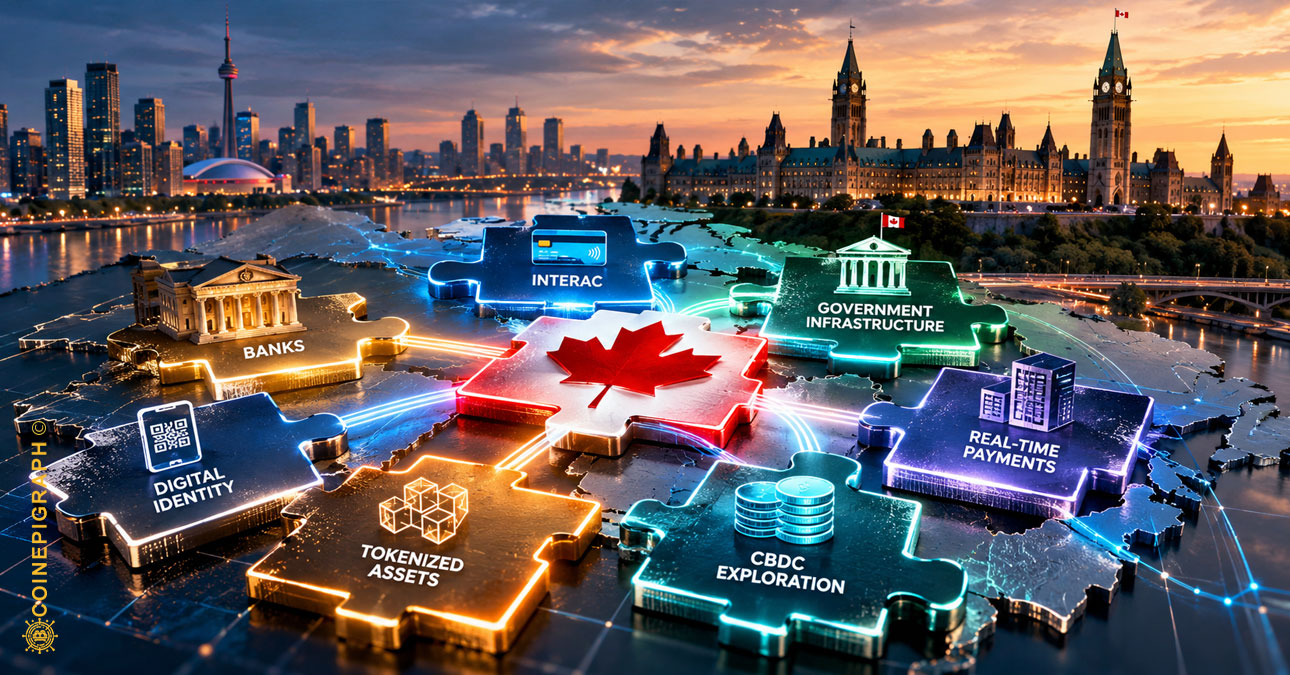
Visa and Mastercard remain deeply embedded in Canadian commerce. But Interac, new payment-service providers and the coming Real-Time Rail raise a more consequential question: how much of Canada’s financial infrastructure must continue to depend on the traditional card networks?
By CoinEpigraph Editorial Desk
A Canadian walks into a store, taps a credit card and leaves.
Almost everything about the transaction appears domestic. The shopper is Canadian. The merchant is Canadian. The purchase is priced in Canadian dollars, and the customer’s credit may have been extended by a Canadian bank.
Yet between the tap and the merchant receiving money sits an infrastructure that is considerably more complicated than the plastic card—or increasingly the phone—suggests.
That hidden machinery is becoming important as Canada prepares to introduce another piece of its domestic payments architecture.
Writing in The Walrus earlier this year, Vass Bednar raised a deceptively simple question: should Canada build alternatives to Visa and Mastercard? Bednar reported that the two networks accounted for approximately 96% of Canada’s credit-card market in 2025 and framed that concentration partly as a question of economic sovereignty.
It is a useful question. But it becomes more interesting once the credit card itself is separated from the infrastructure underneath it.
Canada may not need to build another Visa.
It may need to decide how many other ways Canadian money should be able to move.
The Network Behind the Tap
Consumers tend to experience a card payment as a single event. Financially, it is a sequence.
A bank can extend credit to the customer. An interface initiates the payment. Credentials must be authenticated. A network routes the transaction between institutions. Fraud and authorization systems determine whether it should proceed. The transaction is cleared, and ultimately money must settle between financial institutions.
Visa and Mastercard sit inside this architecture, but they do much more than carry an electronic message from one bank to another.
Their networks coordinate issuers, acquirers and merchants across enormous acceptance footprints. They provide standards, authorization infrastructure, fraud-management systems, dispute mechanisms and chargeback processes that have been developed over decades. Their position reflects not merely technology, but network effects: consumers want payment instruments merchants accept, while merchants want payment instruments consumers carry.
That makes payment infrastructure unusually difficult to challenge. Canada’s Competition Bureau has previously described retail payments as a collection of interconnected layers spanning payment initiation, networks, processing, clearing and settlement, while recognizing the economies of scale and network effects enjoyed by established systems.
The mistake would therefore be to reduce the question to whether Canada can invent something capable of moving money faster.
Canada already knows how to build payment infrastructure.
Canada Already Built One Rail
Interac is the obvious example.
Its importance goes beyond debit cards. Interac demonstrates that Canadian-controlled payment infrastructure can become embedded in ordinary economic life without requiring consumers to think about the architecture underneath it.
Canada also has Payments Canada operating the country’s core payment systems, financial institutions capable of extending credit independently of the card networks, and an expanding regulatory framework for payment-service providers.
Now another component is approaching.
Payments Canada’s Real-Time Rail is scheduled to begin a sequenced launch in the fourth quarter of 2026. Initial direct-to-Exchange participants are expected first, followed in 2027 by phases involving the migration of Interac e-Transfer clearing and settlement, with participants in the initial phases targeted to reach full transaction volumes by the third quarter. Canada-oct-2
That sequence matters.
The Real-Time Rail should not be imagined as a giant switch that Canada flips one morning, instantly creating a new consumer payment network. It is underlying infrastructure being introduced progressively.
Its significance lies partly in what others may eventually build above it.
Changes to Canada’s payments framework have also made registered payment-service providers eligible to apply for Payments Canada membership. That potentially expands the set of institutions able to operate closer to the country’s core payment infrastructure.
This is where the question begins to change.
Credit Is Not the Rail
Credit cards have conditioned consumers to think of credit and payment infrastructure as one product because the experience arrives bundled together.
Economically, they are different functions.
A Canadian bank can decide whether to lend a customer $5,000. That decision does not inherently determine which network must initiate, route, clear or settle every transaction made against that credit.
Credit is a financial product. A payment network is infrastructure.
Separating those functions opens a different way of thinking about Canadian payments.
Instead of asking whether Canada should construct a domestic replica of Visa or Mastercard, the more consequential question is whether Interac, the Real-Time Rail, Canadian financial institutions, regulated payment-service providers and domestic clearing and settlement infrastructure could eventually support payment arrangements that perform some of the functions currently bundled inside card networks.
That would be a very different project.
Rather than rebuilding the architecture of the previous payments era, Canada could create more room for financial companies to innovate above common infrastructure.
The distinction resembles what has happened elsewhere in technology. Infrastructure becomes more consequential when companies no longer have to reconstruct the entire underlying system before they can compete at the service layer.
Payments could gradually become more modular in the same way.

The Card Networks Still Have a Formidable Moat
None of this means the Real-Time Rail replaces Visa or Mastercard.
It doesn’t.
Real-time clearing and settlement does not automatically create revolving credit, rewards programs, chargebacks, international acceptance, merchant acquiring, mature fraud allocation or the consumer protections associated with established card products. Nor does it reproduce decades of coordination among banks, merchants, processors and consumers.
That is why the most important asset of the incumbent card networks may not be their ability to move money.
It is the machinery surrounding the movement of money.
Trust has infrastructure. So does fraud prevention. So does dispute resolution. Global acceptance is itself an enormous coordination achievement.
Any Canadian alternative that ignores those functions would not really be an alternative.
But Canada does not necessarily need to reproduce all of them inside a single competing network.
Some capabilities could remain with existing card systems. Others might eventually be supplied by banks, payment-service providers or specialized technology companies operating above domestic infrastructure. Different payment methods could coexist depending on whether the transaction requires credit, immediate settlement, international acceptance, stronger consumer protections or simply an inexpensive way to move Canadian dollars between Canadian parties.
Competition need not require replacement.
It can begin with optionality.
Sovereignty Can Mean Having Another Route
That distinction also makes the sovereignty argument less political and more practical.
Foreign infrastructure is not inherently a weakness. Visa and Mastercard became deeply embedded in Canadian commerce because their networks solve difficult problems at enormous scale.
The more useful question is how much optionality a sophisticated economy should possess over infrastructure essential to domestic commerce.
Canada can continue using global card networks while creating more domestic pathways through which money can move. Those outcomes are not contradictory.
Redundancy can improve resilience. Infrastructure access can lower barriers to new services. More routing possibilities can create competitive pressure even when incumbent networks remain dominant.
And once common infrastructure exists, innovation does not necessarily have to originate with the institution operating the rail itself.
A Canadian bank might build one kind of service above it. A regulated payment provider might build another. Interac could use it differently again. Consumers might eventually encounter new payment products without knowing—or particularly caring—which underlying rail completed the transaction.
That may be the deeper significance of the Real-Time Rail.
It does not tell Canada what the next payment product should look like.
It gives more participants infrastructure upon which that answer can be discovered.

What Changes Underneath the Tap
Return to the Canadian shopper standing at the checkout counter.
Years from now, the experience might look remarkably familiar. A phone is presented. A credential is authenticated. A payment is approved. The shopper leaves.
What happens beneath that gesture could be considerably different.
The transaction might travel across a traditional card network. Another might move through infrastructure connected more directly to Canadian clearing and settlement. Credit could still come from a bank even when the payment architecture changes underneath it. New providers could compete over interfaces, fraud controls, routing and services without having to recreate every component of a global card network.
Canada spent decades building a sophisticated banking system while Visa and Mastercard became part of the connective tissue of its commerce. The Real-Time Rail does not undo that history, nor does it make those networks obsolete.
It adds another piece of infrastructure upon which alternatives can be built.
The question facing Canada may therefore be changing. It is no longer simply whether Canadians need another payment network.
It is whether the next generation of Canadian payments still needs to be organized like the last one.
At CoinEpigraph, we are committed to delivering digital-asset journalism with clarity, accuracy, and uncompromising integrity. Our editorial team works daily to provide readers with reliable, insight-driven coverage across an ever-shifting crypto and macro-financial landscape. As we continue to broaden our reporting and introduce new sections and in-depth op-eds, our mission remains unchanged: to be your trusted, authoritative source for the world of crypto and emerging finance.
— Ian Mayzberg, Editor-in-Chief
The team at CoinEpigraph.com is committed to independent analysis and a clear view of the evolving digital asset order.
To help sustain our work and editorial independence, we would appreciate your support of any amount of the tokens listed below. Support independent journalism:
BTC: 3NM7AAdxxaJ7jUhZ2nyfgcheWkrquvCzRm
SOL: HxeMhsyDvdv9dqEoBPpFtR46iVfbjrAicBDDjtEvJp7n
ETH: 0x3ab8bdce82439a73ca808a160ef94623275b5c0a
XRP: rLHzPsX6oXkzU2qL12kHCH8G8cnZv1rBJh TAG – 1068637374
SUI – 0xb21b61330caaa90dedc68b866c48abbf5c61b84644c45beea6a424b54f162d0c
and through our Support Page.
🔍 Disclaimer: CoinEpigraph is for entertainment and information, not investment advice. Markets are volatile — always conduct your own research.
COINEPIGRAPH™ does not offer investment advice. Always conduct thorough research before making any market decisions regarding cryptocurrency or other asset classes. Past performance is not a reliable indicator of future outcomes. All rights reserved | 版权所有 ™ © 2024-2029.