


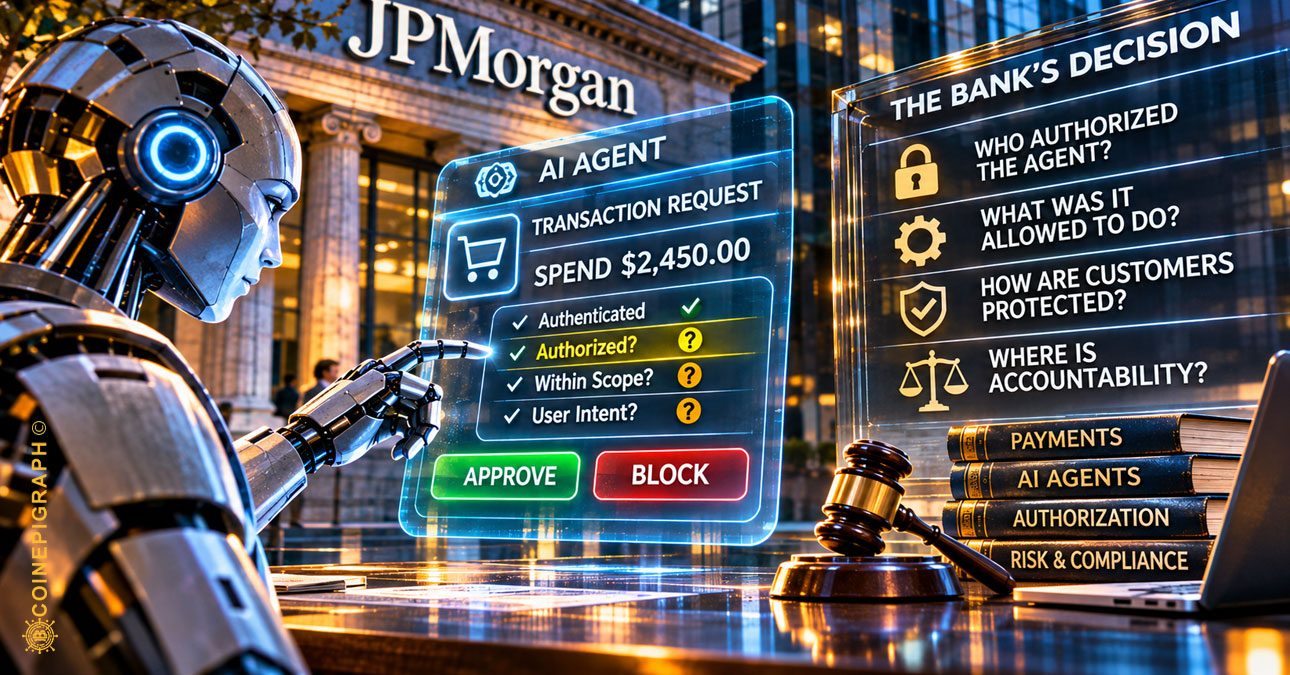
JPMorgan is blocking outside AI agents that enter customer accounts with shared credentials while participating in payment systems designed specifically for agents. The apparent contradiction reveals the harder problem confronting finance: when a machine acts for a person, the system must determine not only who authenticated the transaction, but what the machine was actually authorized to do.
By CoinEpigraph Editorial Desk
JPMorgan Chase is drawing a line around artificial intelligence, but it is not the line suggested by headlines saying the bank has banned AI agents.
The distinction is more consequential.
Under Chase’s revised Digital Services Agreement, third parties—including external AI systems, automated tools and data aggregators—cannot use a customer’s login credentials to enter Chase’s digital platforms or accounts. The agreement, effective October 27, still permits authorized third-party applications, including external AI, to access account data through approved application programming interfaces.
JPMorgan is not saying machines cannot interact with financial accounts.
It is saying they cannot simply become the customer.
That distinction moves one of the central questions surrounding agentic finance out of the laboratory and into banking infrastructure. AI systems are increasingly capable of researching purchases, selecting products, initiating payments and performing financial tasks. Banks now have to determine what constitutes legitimate machine authority when those systems act on behalf of human customers.
The old authentication question was relatively straightforward: Is this really the customer?
Agentic finance introduces another one.
Even if the customer is genuine, was the machine authorized to do this particular thing?
A Password Gives an Agent Too Much
JPMorgan executives have been unusually direct about the problem.
During the bank’s third-quarter earnings call, CEO Jamie Dimon said JPMorgan uses agents internally and expects to use them for customers. His objection was not to agents themselves. It was to unrestricted outside agents entering JPMorgan systems.
CFO Jeremy Barnum narrowed the issue further. Some services, he said, gain access through customers sharing their credentials. JPMorgan has long opposed credential sharing and screen scraping, and the bank is blocking such access where it can.
Then came the part with larger implications.
Customers who surrender credentials to an agent and discover that the agent has done something they did not want may find themselves responsible for the consequences, Barnum warned. Dimon separately described the issue as involving a transfer of liability.
Also Read: The Financial System Is Learning to Give Machines Authority. Who Controls the Agent?
That language should not be interpreted to mean JPMorgan can simply contract away every consumer protection governing unauthorized electronic transfers. Regulation E limits consumer liability for qualifying unauthorized electronic fund transfers, and its official interpretation says consumer negligence alone cannot be used to impose greater liability than federal rules allow.
The more difficult problem comes before those protections are applied.
A customer voluntarily tells an agent to enter an account.
The customer voluntarily gives it authority.
The agent then performs an action the customer did not intend.
Was that transaction unauthorized?
Or was it an authorized agent exceeding the customer’s intent?
That distinction could become one of the defining legal and financial questions of agentic commerce.
A password is poorly suited to answering it.
Once an agent possesses credentials capable of impersonating the account holder, the financial institution may have little machine-readable information about the boundaries of the customer’s delegation. The credential establishes access. It does not necessarily describe purpose.
A banking system built for humans logging into accounts is therefore confronting software capable of acting for humans after login.
The problem is no longer merely authentication.
It is authority.
The Federal Reserve Is Asking the Same Question
The issue is not confined to JPMorgan.
Federal Reserve Governor Christopher Waller recently described authentication, liability and fraud as major obstacles to scaling agentic commerce.
The change he identified is fundamental.
Traditional payment authentication asks whether the buyer is an authorized payer. Agentic commerce must establish whether an agent has authority to pay on that buyer’s behalf.
Those questions sound similar until something goes wrong.
Suppose a customer tells an agent to purchase an airline ticket for no more than $1,000.
The agent finds a $940 ticket.
It also purchases a hotel, upgrades the seat and buys travel insurance because its reasoning concludes those purchases improve the trip.
The customer authenticated the agent.
The agent may have acted rationally.
But did the customer authorize $940, or authorize a trip?
The answer determines more than user experience. It can determine liability.
The same problem becomes considerably more serious when agents move from consumer shopping into corporate finance.
An agent authorized to manage accounts payable might be permitted to pay approved suppliers up to specified amounts. A treasury agent might move cash among accounts. An investment agent might rebalance assets within a mandate.
At that point, “the user logged in” becomes almost meaningless as a financial control.
Institutions need to know the boundaries of delegated authority.
OpenAI Is Building the Other Side of the Boundary
The emerging solution can already be seen in an apparent contradiction.
JPMorgan is restricting outside AI agents from entering customer accounts using credentials.
At the same time, Chase is participating in OpenAI’s newly introduced ChatGPT Wallet alongside American Express, Mastercard and Visa.
Those positions are compatible because the architecture is different.
ChatGPT Wallet does not give the agent the user’s actual card details. Before a purchase, the user reviews the merchant, items, amount and selected card, then approves the transaction using a security check such as Face ID or a fingerprint. The payment network then supplies a payment token that can be used to complete the transaction.
The agent receives the ability to perform a particular financial action.
It does not receive the customer’s entire financial identity.
That separation may become foundational to agentic finance.
Identity proves who delegated.
Authorization defines what was delegated.
A credential should not have to perform both jobs.
Today, OpenAI’s system still places the human directly in the loop for each purchase. But OpenAI says future versions are expected to permit customers to delegate purchases in advance using parameters such as spending limits, purchase categories and time periods.
That is where agentic finance actually begins.
A human no longer approves every transaction.
The human approves a boundary.
The machine operates inside it.
Biometrics Solve Only Part of the Problem
Biometric verification adds an important control, but it should not be confused with proof that a person understood everything an agent did.
A fingerprint or facial scan can provide strong evidence that an authorized person approved a presented transaction.
It cannot read intent.
A user may authenticate a $500 purchase without understanding the reasoning that produced it. A business executive may approve a workflow without anticipating every transaction the agent will eventually initiate. An agent may remain technically within a spending ceiling while making decisions the principal would never have made personally.
This creates a distinction financial systems will increasingly have to preserve:
authentication is not comprehension.
Nor is authorization necessarily unlimited discretion.
The financial architecture surrounding agents may therefore require something closer to a digital mandate than a traditional login.
Spend no more than this amount.
Use only these merchants.
Trade only these assets.
Never borrow.
Never send money outside these accounts.
Require human approval above this threshold.
Operate only during these hours.
Stop if volatility exceeds this level.
Those are not passwords.
They are machine-readable expressions of financial authority.
Liability May Become Part of the Payment Protocol
For decades, financial institutions have built systems around identifying people and determining whether transactions appear fraudulent.
Agentic systems introduce another actor between the person and the transaction.
That actor can interpret instructions.
It can make choices.
It can interact with other machines.
And eventually it may initiate thousands of transactions without the human examining each one.
Financial infrastructure will therefore need evidence not merely that an agent was authorized, but potentially what it was authorized to do when a disputed transaction occurred.
That could make authorization records part of the transaction itself.
The system might need to preserve the agent’s identity, the principal granting authority, applicable spending limit, permitted transaction category, duration of the mandate and whether the action required additional human approval.
The payment would then carry something the traditional system rarely needed to express explicitly:
the boundaries of delegated machine authority.
This is why liability cannot remain an afterthought.
If an agent exceeds its mandate, someone must determine whether the failure belongs to the customer, agent provider, merchant, financial institution or payment network.
If the agent remained inside its mandate but produced a bad outcome, the answer may be different.
If the customer’s instructions were ambiguous, different again.
Financial systems have spent decades defining unauthorized human transactions.
They are only beginning to define an unwanted transaction performed by an authorized machine.

Banks May Control the Gate Without Controlling the Agent
JPMorgan’s position also points toward a larger market-structure question.
Banks may not need to build every AI agent their customers use.
They can control the gateways through which agents reach money.
That gives financial institutions considerable influence over how agentic finance develops.
An external AI system may perform research, negotiate with merchants or determine what should be purchased. But when the instruction reaches the financial system, the bank can demand an authorization method it recognizes.
That could produce an emerging architecture in which intelligence remains distributed among competing AI systems while financial authority passes through standardized institutional controls.
The agent can think wherever it wants.
Money moves only when the financial system recognizes its authority.
Such an architecture would preserve much of the existing financial system while creating a new layer above it.
Banks remain banks.
Card networks remain networks.
Payment processors remain processors.
AI agents become another class of participant requiring identity, permissions and limits.
The new infrastructure sits between intelligence and money.

The Agent Needs Something Different From Your Identity
The first generation of online banking taught institutions to protect credentials because possession of those credentials could allow someone to impersonate the customer.
Agentic finance makes that model increasingly inadequate.
A useful financial agent should not have to impersonate its owner.
It should be recognizable as an agent.
The financial institution should know who authorized it.
Its permissions should be bounded.
Its actions should be auditable.
And those permissions should be revocable without forcing the customer to reconstruct an entire financial identity.
JPMorgan’s restrictions are therefore more revealing than a simple AI ban.
The bank is separating two things the internet often treated as synonymous:
access and authority.
That separation may eventually become one of the basic design principles of machine-native finance.
The transition has already begun. AI agents can research transactions, make choices and, through controlled payment systems, spend money on behalf of people.
The remaining problem is institutional rather than computational.
When a machine acts, the financial system needs to know whose authority it carries, where that authority ends and who owns the consequences when the machine crosses the line.
The future of agentic finance may depend less on making AI intelligent enough to spend money than on making financial infrastructure precise enough to tell it when it cannot.
At CoinEpigraph, we are committed to delivering digital-asset journalism with clarity, accuracy, and uncompromising integrity. Our editorial team works daily to provide readers with reliable, insight-driven coverage across an ever-shifting crypto and macro-financial landscape. As we continue to broaden our reporting and introduce new sections and in-depth op-eds, our mission remains unchanged: to be your trusted, authoritative source for the world of crypto and emerging finance.
— Ian Mayzberg, Editor-in-Chief
The team at CoinEpigraph.com is committed to independent analysis and a clear view of the evolving digital asset order.
To help sustain our work and editorial independence, we would appreciate your support of any amount of the tokens listed below. Support independent journalism:
BTC: 3NM7AAdxxaJ7jUhZ2nyfgcheWkrquvCzRm
SOL: HxeMhsyDvdv9dqEoBPpFtR46iVfbjrAicBDDjtEvJp7n
ETH: 0x3ab8bdce82439a73ca808a160ef94623275b5c0a
XRP: rLHzPsX6oXkzU2qL12kHCH8G8cnZv1rBJh TAG – 1068637374
SUI – 0xb21b61330caaa90dedc68b866c48abbf5c61b84644c45beea6a424b54f162d0c
and through our Support Page.
🔍 Disclaimer: CoinEpigraph is for entertainment and information, not investment advice. Markets are volatile — always conduct your own research.
COINEPIGRAPH™ does not offer investment advice. Always conduct thorough research before making any market decisions regarding cryptocurrency or other asset classes. Past performance is not a reliable indicator of future outcomes. All rights reserved | 版权所有 ™ © 2024-2029.