


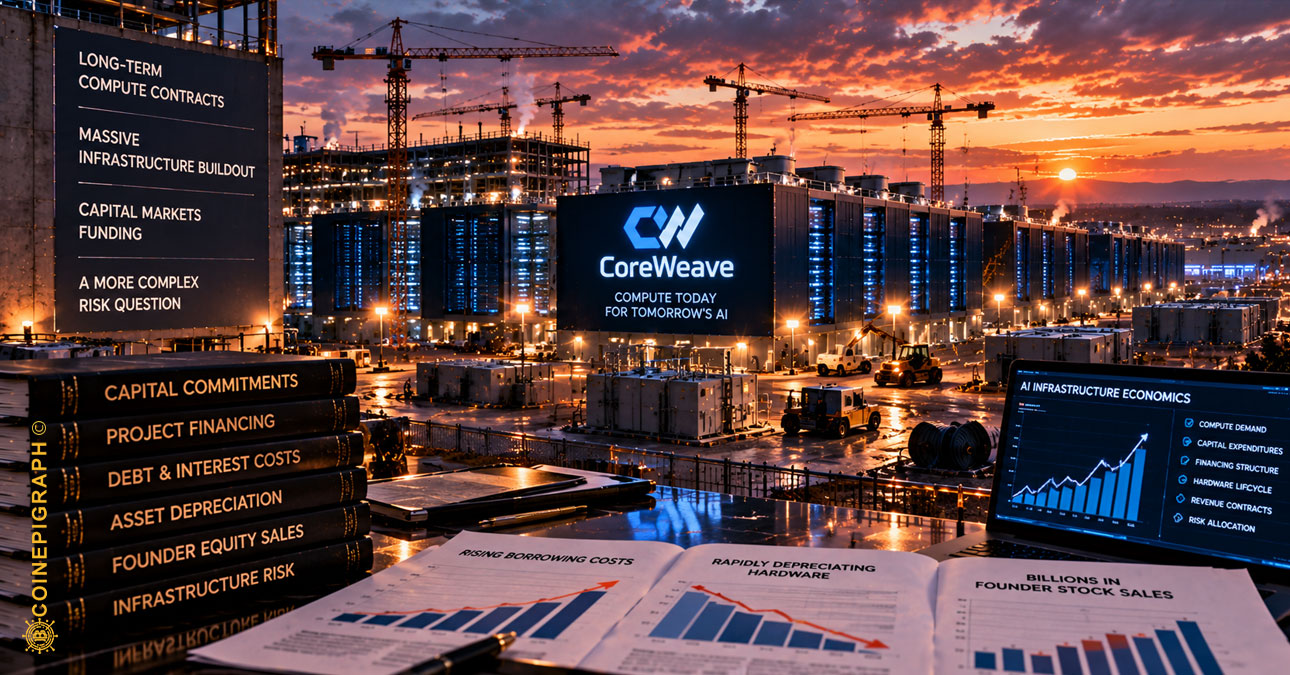
CoreWeave has turned enormous commitments for future computing power into the foundation for an equally enormous infrastructure buildout. Its rising borrowing costs, rapidly depreciating hardware and billions in founder stock sales are exposing a larger question for artificial intelligence: who carries the financial risk while tomorrow’s compute is being built today?
By CoinEpigraph Editorial Desk
Artificial intelligence has spent the past several years producing extraordinary promises about the future. The financial system is now being asked to fund them.
CoreWeave sits unusually close to the point where those two worlds meet.
The company buys enormous quantities of Nvidia processors, installs them inside increasingly expensive computing infrastructure and rents that capacity to some of the largest participants in artificial intelligence. Microsoft became an important early customer. OpenAI subsequently committed tens of billions of dollars to CoreWeave capacity. Meta followed with another large, long-duration agreement.
That has given CoreWeave something lenders generally like: customers with substantial financial resources making commitments extending years into the future.
It has also given CoreWeave something it needs even more.
Collateral for the future.
The company must build much of the infrastructure before it can collect the revenue expected from it. That means GPUs have to be purchased, data-center capacity secured, power contracted and networks constructed while much of the corresponding cash flow still lies years ahead.
Credit fills the interval.
And increasingly, that interval may be where some of the most consequential financial risk in the artificial-intelligence boom resides.
From Crypto Mining to AI Infrastructure
CoreWeave’s origins make the transformation particularly striking.
The business began in 2017 as Atlantic Crypto, an Ethereum mining operation. When cryptocurrency markets deteriorated the following year, the company acquired additional GPUs being sold by struggling miners. It subsequently moved away from cryptocurrency mining, renamed itself CoreWeave and began renting its computing capacity to other industries.
Artificial intelligence changed the scale of the opportunity.
The same class of graphics processors that had been useful for cryptocurrency mining became indispensable to training and running increasingly sophisticated AI models. As demand for Nvidia’s most advanced chips accelerated, CoreWeave developed into a specialized cloud provider capable of supplying large GPU clusters more quickly than many conventional cloud operators.
The company eventually became one of the purest public-market expressions of the AI infrastructure trade.
But the transformation required enormous amounts of capital.
In 2023, CoreWeave raised $2.3 billion through a financing facility secured partly by Nvidia H100 GPUs. The structure illustrated something that would become increasingly important across the AI infrastructure market: computing hardware itself could become part of the collateral base supporting additional expansion.
Customer commitments added another layer.
Long-term agreements for computing capacity give infrastructure providers greater visibility into future revenue. Some arrangements contain take-or-pay characteristics, requiring customers to pay for contracted capacity whether or not they ultimately consume all of it.
For lenders, that can make tomorrow’s AI demand financially relevant today.
CoreWeave has continued layering conventional debt, convertible securities, equipment financing and long-term infrastructure commitments around that demand. Its capital structure now includes billions of dollars of senior notes and convertible debt, alongside substantial lease and contractual obligations.
Those obligations should not be treated as though they are all conventional funded debt. A multiyear data-center lease is economically different from a bond.
But together they reveal the scale of the wager.
CoreWeave is building infrastructure today against demand expected to persist for years.
Backlog Is Not Cash
There is a powerful counterargument to concerns about CoreWeave’s leverage.
The company has customers.
A lot of them.
Its contracted revenue backlog has grown dramatically as major technology and AI companies reserve future computing capacity. That backlog provides evidence that CoreWeave isn’t simply building speculative data centers and hoping someone eventually arrives to use them.
But backlog and cash are not interchangeable.
A contract representing future computing demand becomes revenue as the company delivers the contracted service. The infrastructure required to provide that service frequently has to be financed beforehand.
That distinction is central to understanding the economics of the AI buildout.
A large backlog can make additional borrowing more defensible because it provides visibility into future demand. Additional borrowing allows more infrastructure to be constructed. More infrastructure allows additional contracts to be fulfilled.
The system can be extraordinarily powerful while demand, capital availability and execution remain aligned.
It also creates dependency between them.
If construction costs rise, deployment is delayed, borrowing becomes more expensive or technological change reduces the economic value of existing hardware faster than expected, the distance between contracted demand and realized returns can widen.
That is why the credit market deserves as much attention as the AI market.
The Credit Market Is Beginning to Ask for More
CoreWeave’s equity has already experienced a dramatic repricing from its post-IPO highs.
More consequentially, its debt has begun attracting greater scrutiny.
Yields on some CoreWeave bonds have risen as investors demand greater compensation for holding the company’s credit risk. The cost of protecting against default has also increased, while financing conditions across parts of the specialized AI-cloud industry have become more closely watched.
That doesn’t mean CoreWeave is approaching default.
It means the price of carrying its risk is changing.
The distinction matters.
Equity investors can become pessimistic because they believe a company’s valuation has run too far ahead of its earnings. Credit investors are asking a different question: whether the cash ultimately generated by the business will adequately support the obligations used to finance it.
For CoreWeave, that question reaches directly into the architecture of the AI boom.
The company borrows money to construct infrastructure for customers promising to consume enormous quantities of compute in the future. Those customers themselves are spending aggressively because they expect artificial intelligence to create enormous future economic value.
The entire structure therefore depends less on whether AI is useful than on whether its economics mature quickly enough to support the capital already being deployed around it.
The Asset Can Age Faster Than the Debt
There is another complication.
CoreWeave isn’t financing railroads.
A railroad can issue long-duration debt against infrastructure capable of remaining economically productive for decades. Utilities can finance generating assets with similarly long expected operating lives.
AI infrastructure behaves differently.
A state-of-the-art GPU is extraordinarily valuable precisely because computing performance is advancing so rapidly. The same technological acceleration that makes the newest processors valuable can reduce the relative economic value of older processors.
CoreWeave has debt extending years into the future.
The hardware financed by some of that capital may lose its technological advantage much sooner.
That doesn’t mean an older GPU suddenly becomes worthless. Existing processors can continue performing economically useful workloads for years, particularly as different computing tasks require different performance levels.
But the financing question is unavoidable.
The liability can outlive the technological advantage of the asset it financed.
That places pressure on utilization, pricing, refinancing and replacement cycles. It also means lenders must evaluate something more complicated than whether demand for AI continues growing.
They must evaluate whether the infrastructure supporting that demand remains productive enough, for long enough, to generate an adequate return after financing costs.

Nvidia Sits on More Than One Side of the Table
The relationships surrounding CoreWeave make the structure even more unusual.
Nvidia supplies the processors at the center of CoreWeave’s infrastructure. It has also invested in CoreWeave and entered strategic arrangements involving future computing capacity.
That creates substantial economic interdependence.
It would be tempting to describe the arrangement as circular financing. That characterization goes too far without evidence that the relationships themselves are economically artificial.
The more important observation is that the AI capital system increasingly contains participants occupying several positions simultaneously.
A chip manufacturer can be a supplier and investor.
A technology company can be a customer while financing AI development elsewhere.
An AI laboratory can make enormous long-term compute commitments while relying on external investors to fund its own expansion.
An infrastructure provider can borrow against equipment and expected contractual cash flows in order to build capacity for those customers.
The relationships do not have to be improper to become interconnected.
And interconnected systems distribute risk in ways that can remain difficult to see while capital is plentiful.
Then the Founders Took Billions Off the Table
There is another piece of the CoreWeave story that deserves attention, although not the conclusion sometimes attached to it.
Three CoreWeave co-founders have sold approximately $3.3 billion of stock since the company went public, with a substantial portion of those sales occurring during 2026.
CEO Michael Intrator alone has sold close to $1 billion through transactions involving himself and affiliated entities.
Most of the relevant transactions occurred through predetermined Rule 10b5-1 trading plans. That distinction is essential. Executives commonly use such plans to diversify concentrated holdings while reducing the possibility that individual trades are being made using material nonpublic information.
The sales therefore do not establish that CoreWeave’s founders expect the company to fail.
But they remain relevant to an examination of capital allocation.
CoreWeave itself is becoming increasingly concentrated in the enormous financial requirements of the AI infrastructure buildout.
Its founders are moving in the opposite direction with their personal balance sheets.
They are diversifying.
There is nothing inherently contradictory about those decisions. A founder can remain deeply invested in a company while sensibly converting part of a concentrated equity position into personal liquidity.
Yet the contrast is difficult to ignore because of the scale involved.
The corporation is committing increasingly large amounts of capital to the proposition that future AI demand will justify today’s infrastructure investment. At the same time, the people who created the company have already converted billions of dollars of exposure to that proposition into cash.
That is not evidence of impending failure.
It is evidence that different participants in the same enterprise can rationally choose very different concentrations of risk.
Anthropic Shows the Other Side
CoreWeave becomes even more revealing when placed beside another company moving toward the public markets.
Anthropic’s S-1 exposed the enormous capital requirements behind frontier artificial intelligence.
Its headline $80.7 billion net loss was heavily distorted by fair-value accounting related to convertible instruments and other financial liabilities. Beneath that figure, operating performance had improved substantially.
But another number was harder to dismiss: the enormous infrastructure and computing commitments required to support future growth.
Anthropic represents one side of the transaction.
It needs extraordinary amounts of future compute.
CoreWeave represents another.
Someone has to construct that capacity before the AI laboratory can consume it.
Nvidia occupies another position by supplying the processors.
And the credit market occupies another by financing part of the time between construction and future revenue.
Viewed together, these companies reveal something larger about the AI economy.
Artificial intelligence is becoming a capital project.

The AI Trade Is Becoming a Credit Trade
The first stage of the AI investment cycle was dominated by venture capital.
The next was dominated by semiconductor scarcity and enormous public-equity valuations.
The current stage is increasingly reaching into bonds, convertible securities, equipment financing, leases, structured credit and special-purpose vehicles.
That changes the character of the boom.
Equity can absorb extraordinary volatility because shareholders own the residual upside if everything works.
Credit introduces schedules.
Interest must be paid.
Leases mature.
Infrastructure must be delivered.
Hardware must remain productive.
Contracts must become revenue.
Revenue must eventually become cash flow.
This doesn’t mean the AI boom is approaching an inevitable financial reckoning. It means the economics are becoming more measurable.
For years, investors could debate how intelligent the models would become, how many jobs they might transform or which laboratory would eventually dominate.
Credit markets ask less philosophical questions.
Who owes the money?
What secures it?
When does it mature?
And what happens if the asset financed today becomes less valuable before the obligation used to purchase it disappears?
CoreWeave is becoming one of the clearest places to watch those questions collide.
Its customers provide substantial evidence that demand for AI compute is real. Its backlog suggests that demand extends well into the future. Its access to capital demonstrates that sophisticated lenders continue to see value in financing the infrastructure required to meet it.
At the same time, rising borrowing costs, enormous capital requirements and rapid technological depreciation show why demand alone cannot settle the argument.
The AI boom does not merely need more compute.
It needs the economics of that compute to support the financial architecture being constructed around it.
CoreWeave may prove that the model works.
It may also reveal where its limits begin.
Either way, the most important signal may no longer come from another breakthrough model or another record-setting Nvidia chip.
It may come from the price investors demand to finance the machines.
At CoinEpigraph, we are committed to delivering digital-asset journalism with clarity, accuracy, and uncompromising integrity. Our editorial team works daily to provide readers with reliable, insight-driven coverage across an ever-shifting crypto and macro-financial landscape. As we continue to broaden our reporting and introduce new sections and in-depth op-eds, our mission remains unchanged: to be your trusted, authoritative source for the world of crypto and emerging finance.
— Ian Mayzberg, Editor-in-Chief
The team at CoinEpigraph.com is committed to independent analysis and a clear view of the evolving digital asset order.
To help sustain our work and editorial independence, we would appreciate your support of any amount of the tokens listed below. Support independent journalism:
BTC: 3NM7AAdxxaJ7jUhZ2nyfgcheWkrquvCzRm
SOL: HxeMhsyDvdv9dqEoBPpFtR46iVfbjrAicBDDjtEvJp7n
ETH: 0x3ab8bdce82439a73ca808a160ef94623275b5c0a
XRP: rLHzPsX6oXkzU2qL12kHCH8G8cnZv1rBJh TAG – 1068637374
SUI – 0xb21b61330caaa90dedc68b866c48abbf5c61b84644c45beea6a424b54f162d0c
and through our Support Page.
🔍 Disclaimer: CoinEpigraph is for entertainment and information, not investment advice. Markets are volatile — always conduct your own research.
COINEPIGRAPH™ does not offer investment advice. Always conduct thorough research before making any market decisions regarding cryptocurrency or other asset classes. Past performance is not a reliable indicator of future outcomes. All rights reserved | 版权所有 ™ © 2024-2029.