


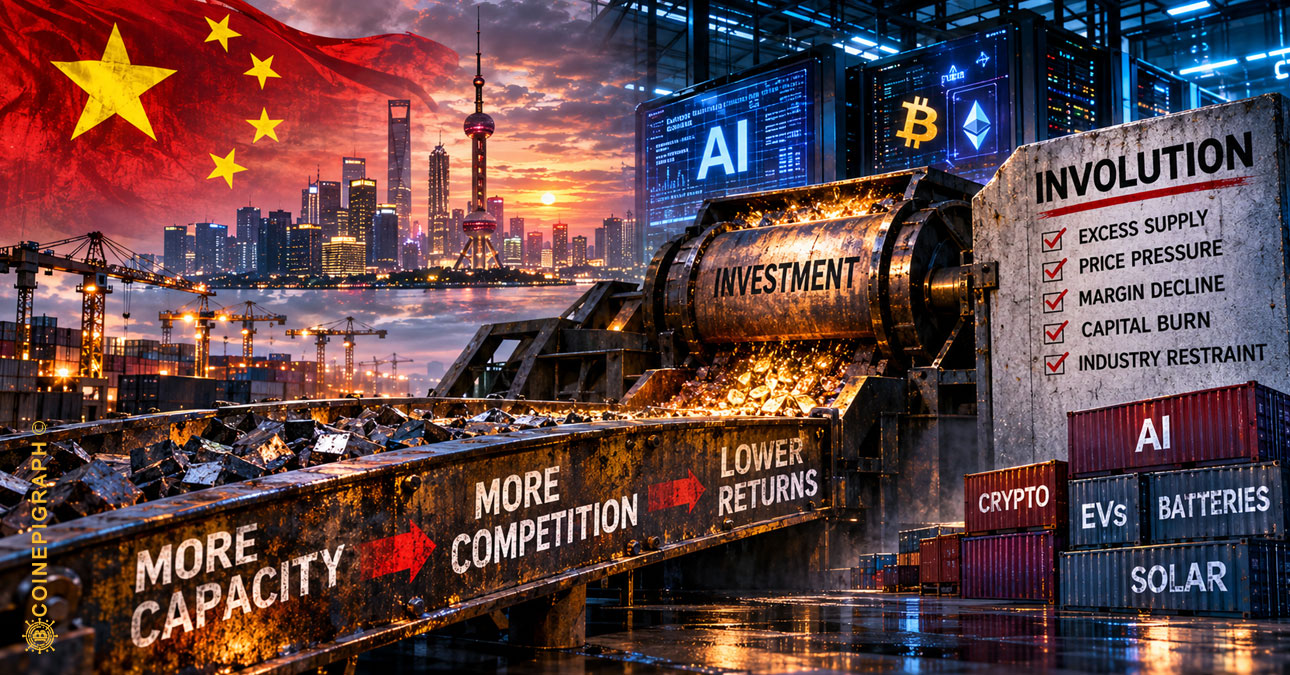
China is trying to contain industries where more production and fiercer competition have produced weaker returns. Artificial intelligence and crypto are confronting different versions of the same question: when does investment stop being primarily a path to growth and become the price of remaining competitive?
By CoinEpigraph Editorial Desk
A company invests because standing still is dangerous.
Its competitor responds.
Another factory is built. Another data center receives financing. Another blockchain launches. Capacity increases. Technology improves. Prices fall. Customers may receive a better product.
Then the competitors invest again.
There is nothing irrational about any individual decision. Each participant may be doing exactly what competitive markets require.
The problem emerges when the industry is considered as a whole.
If progressively larger amounts of capital are required merely to preserve market position while margins deteriorate and incremental returns decline, economic activity can continue expanding without producing a proportional increase in economic value.
China has a word increasingly associated with this problem: neijuan, commonly translated as involution.
The term has become attached to price wars and industrial overcapacity across parts of the Chinese economy. But its usefulness may extend beyond China if it is treated not as a political label or synonym for excessive competition, but as a test of capital efficiency.
The important question is not whether an industry is spending heavily.
It is whether the next round of spending creates enough additional economic value to justify the capital required — or whether that spending has increasingly become the admission price for remaining competitive.
That distinction matters far beyond manufacturing.
Artificial intelligence is beginning one of the largest infrastructure investment cycles in modern corporate history. Digital assets continue adding blockchains, scaling networks, exchanges and specialized financial infrastructure even as liquidity and revenue migrate among them.
Neither industry can yet be classified broadly as involutionary.
But both make the question increasingly difficult to ignore.
Involution Is Not the Same as Competition
The concept predates China’s current economic debate.
Anthropologist Clifford Geertz used “agricultural involution” in his 1963 study of Indonesia to describe a system in which additional labor and increasing complexity failed to produce corresponding improvements in productivity.
Modern Chinese usage is different, but the underlying intuition is recognizable: participants exert increasing effort while the additional reward from that effort diminishes.
Applied to markets, the idea requires considerable care.
A company cutting prices is not evidence of involution.
Neither is rapid capital expenditure, temporary losses, excess capacity during a normal business cycle or aggressive competition.
Those can all be features of healthy economic development.
Investment can initially depress free cash flow while creating enormously valuable productive capacity. Falling prices can result from genuine technological progress. Temporary overcapacity can disappear as demand catches up. Competitors can force inefficient companies to become more productive.
Involution begins to become financially meaningful under a narrower condition: additional competitive effort persistently produces weaker incremental economic returns while becoming increasingly necessary to preserve competitive position.
That creates an unusual market.
Everyone may be moving forward.
Few participants are actually getting farther ahead.
China Shows What the Mature Version Looks Like
China provides the clearest contemporary test.
Its industrial expansion has produced genuine achievements. Chinese companies have dramatically lowered manufacturing costs, improved product quality and developed formidable capabilities in electric vehicles, batteries, solar equipment and other advanced industries.
Those gains should not be confused with economic waste simply because Western competitors have struggled to match them.
But parts of China’s industrial system have moved beyond productivity improvements into something more difficult.
The International Monetary Fund has warned that extensive industrial-policy support has contributed to excessive production and firm entry. Competition among local governments helped drive innovation and growth, but also encouraged overinvestment, duplication and resource misallocation.
Beijing itself now describes part of the problem as involution and has launched an “anti-involution” campaign intended to curb destructive competition.
Solar manufacturing offers perhaps the clearest example.
China’s manufacturing capacity is now sufficient to satisfy roughly twice global demand for solar products, according to industry estimates reported by Reuters. Yet companies continued producing through years of falling prices and losses.
The five largest Chinese solar manufacturers cut more than 40,000 workers during 2025 after already making substantial reductions the previous year. Their average module selling price had fallen to roughly $130 per kilowatt from $350 in 2019.
Their average operating margin fell to negative 13%.
This is where the distinction between productivity and involution becomes important.
Cheaper solar modules are economically useful. Manufacturing efficiencies that reduce the cost of generating electricity create real value for consumers and accelerate energy deployment.
But an industry in which capacity substantially exceeds demand, products are repeatedly sold below sustainable cost and additional production continues despite persistent losses presents a different capital-allocation problem.
More output is being created.
More economic value for the producers is not necessarily following.
When Capital Becomes Defensive
The underlying mechanism can emerge without a conspiracy, cartel or centrally coordinated decision.
Imagine a manufacturer with substantial fixed costs.
Demand growth slows.
The company can reduce production and risk losing market share, or lower prices and keep its factories operating.
It chooses the second option.
Its competitor faces the same choice and responds.
Suppliers have already expanded capacity. Local governments may want factories operating because they provide employment and tax revenue. Banks may prefer refinancing an existing borrower to recognizing a loss. Investors may continue providing capital because each participant believes it can survive until weaker competitors exit.
Every decision can make sense individually.
Collectively, the industry remains overbuilt.
This is a version of the fallacy of composition: what is rational for one participant does not necessarily produce the optimal outcome when everyone behaves the same way.
Credit can extend the process.
If weak companies lose access to capital, capacity eventually leaves the market. If financing remains available, competitive pressure can continue much longer.
China illustrates this clearly. The IMF has argued that insolvency mechanisms and the exit of unviable firms should accompany Beijing’s anti-involution policies precisely because reducing subsidies without allowing uneconomic capacity to disappear may not solve the underlying allocation problem.
Competition normally reallocates capital toward more productive firms.
Involution can delay that process by making survival itself financeable.
AI Is Approaching the Same Question From Another Direction
Artificial intelligence is not China’s solar industry.
There is no basis yet for declaring the AI infrastructure boom broadly involutionary.
Demand for computing capacity is substantial. AI revenues are growing. New applications are emerging. Productivity benefits may eventually justify infrastructure spending that currently looks extraordinary.
But the capital cycle is reaching a stage where the involution framework becomes useful as a diagnostic.
The largest technology companies are committing enormous amounts of capital to processors, data centers, power and networking infrastructure because falling behind in artificial intelligence could threaten businesses worth hundreds of billions of dollars.
That changes the investment calculation.
A company no longer needs certainty that the next dollar of AI infrastructure will generate an attractive standalone return.
It may invest because the potential cost of not investing is greater.
That is the boundary worth watching.
Meta now expects 2026 capital expenditures of approximately $135 billion to $145 billion. S&P Global Ratings recently revised the company’s credit outlook to negative, citing uncertainty surrounding rising AI spending and future free operating cash flow. S&P projects substantial free operating cash-flow deficits through 2027 and potentially beyond.
Meta strongly disputes the concern and argues that AI presents significant product and business opportunities.
Both positions can be reasonable.
AI may generate enormous future economic value while the competitive race to capture that value simultaneously pushes companies toward investments whose individual returns become increasingly difficult to measure.
CoreWeave exposes another part of the structure.
The specialized cloud provider has financed massive quantities of computing infrastructure against expectations of continuing AI demand. Rising borrowing costs recently pushed some of its bonds into distressed territory, prompting investors to reassess the relationship between AI demand, asset depreciation and financing costs.
Again, this does not establish involution.
It establishes the test.
If additional AI infrastructure produces correspondingly large new revenue, productivity and cash flow, today’s investment cycle may prove highly productive.
If companies continue expanding capacity primarily because no major participant can afford to surrender technological position — while incremental returns on that capacity decline — the economics begin looking different.
The dividing line is not the size of the investment.
It is the return on the next investment.
The Asset Can Become Obsolete Before the Competition Ends
AI introduces another complication that manufacturing does not always share.
Technological assets depreciate economically as well as financially.
A factory can remain productive for decades. A leading-edge GPU cluster may continue performing useful work for years, but its competitive position can deteriorate much faster as newer processors deliver greater performance and efficiency.
That creates a potentially self-reinforcing investment cycle.
New hardware improves performance. Competitors acquire it. The performance benchmark rises. Existing infrastructure becomes relatively less competitive. More capital is required to maintain position.
The industry can therefore become more technologically sophisticated at the same time that maintaining competitiveness becomes more expensive.
That is not inherently wasteful. Rapid technological improvement is one of capitalism’s most powerful engines of productivity.
But it produces a useful warning signal.
When technological progress forces replacement investment faster than the previous investment can earn its expected economic return, innovation and capital destruction can begin occurring simultaneously.
Crypto Has a Different Involution Problem
Digital assets present another version of the question.
The blockchain industry has spent years solving genuine technical problems: transaction throughput, settlement speed, execution cost, privacy, interoperability and application-specific performance.
Those improvements created real economic capabilities.
But they also created more infrastructure.
Ethereum is surrounded by Layer 2 networks. Solana, Tron, BNB Chain, Hyperliquid and other Layer 1 systems compete for users and applications. Specialized chains continue emerging for payments, trading, stablecoins and institutional settlement.
The Bank for International Settlements has identified fragmentation of infrastructure, assets and liquidity across Layer 1 and Layer 2 networks as a structural feature of the blockchain ecosystem.
That does not make fragmentation synonymous with failure.
Different networks optimize different economic functions. Competition has dramatically reduced transaction costs. Specialized architectures can serve markets that one universal blockchain might handle poorly.
More importantly, crypto is generating new economic activity.
A 2026 industry study from 1kx estimates that blockchain-related revenues will reach approximately $100 billion this year. Revenue associated with broader-economy adoption — including tokenized assets, payments and prediction markets — has been growing, while institutional participation represents an increasing share of industry economics.
That is evidence against a simplistic involution thesis.
The ecosystem isn’t merely building infrastructure for nothing.
But the distribution of value is changing.
Research cited by The Block found that roughly two-thirds of sector fees in 2025 accrued to DeFi and financial applications, while only 19% went to blockchain networks themselves. In 2021, blockchains had captured 56%.
That raises an intriguing capital-allocation question.
If applications increasingly capture the economic value, how many underlying networks can sustainably finance themselves by competing for the same users, developers and liquidity?
Crypto’s potential involution may therefore be less about total activity than about duplicated competition for the economic activity that already exists.

More Infrastructure Does Not Necessarily Mean More Demand
That distinction matters because blockchain metrics can easily create an illusion of economic expansion.
A user moving assets from one chain to another creates activity.
A liquidity incentive can attract deposits.
A token subsidy can attract developers.
A new exchange can generate volume previously occurring somewhere else.
A bridge can record transactions caused by fragmentation between networks.
All of those actions are economically observable.
Not all represent new underlying demand.
The proper question is whether competitive investment creates new users, new financial functions and sustainable revenue — or increasingly redistributes existing participants among different pieces of infrastructure.
There is evidence for both.
Stablecoin payments, tokenized securities and prediction markets are extending blockchain infrastructure into economic activities that were previously conducted elsewhere. At the same time, liquidity fragmentation and repeated incentive cycles suggest that portions of the ecosystem continue competing intensely over the same pools of capital.
Crypto therefore does not yet provide a clean case of involution.
It provides something potentially more useful: an industry in which we can watch the boundary forming in real time.
Involution Can Eventually Destroy Itself
There is another reason investors should care about this framework.
Involution does not necessarily continue indefinitely.
Eventually someone runs out of money.
Weak producers close. Capacity disappears. Credit becomes unavailable. Investors stop subsidizing expansion. Larger firms acquire competitors. Industries consolidate.
That can produce an ironic result.
A period of excessive competition can eventually create greater market concentration.
The companies capable of surviving the period of diminishing returns emerge into a market containing fewer competitors. Pricing power can recover. Utilization can rise. Returns on capital can improve.
China’s anti-involution campaign is partly an attempt to accelerate some version of this adjustment without producing uncontrolled industrial failures.
AI may eventually experience consolidation among infrastructure providers if financing costs eliminate weaker operators.
Crypto has already demonstrated a tendency for activity to concentrate around a smaller number of networks and applications even while new infrastructure continues entering the market.
The end state of involution therefore need not be permanent fragmentation.
It can be oligopoly.

Growth Can Hide What Competition Is Costing
The difficulty with involution is that it can look like growth for a surprisingly long time.
Factories continue producing. Data centers come online. Blockchain networks report more transactions. Revenue may rise and customers may benefit from lower prices or better technology. None of those developments is insignificant, but none tells us by itself whether the additional investment behind them is becoming more or less productive.
China’s experience makes the distinction easier to see. Its manufacturing strength is real, as are the cost reductions and technological advances that came with it. The problem emerges where additional capacity continues entering markets already struggling to absorb existing production. At that point, greater output can coexist with falling margins, weak utilization and deteriorating returns.
Artificial intelligence is much earlier in that process. Demand for compute continues to grow rapidly, and there is not yet enough evidence to conclude that the infrastructure being built will fail to earn adequate returns. What has changed is the competitive calculation. For the largest technology companies, spending on AI is no longer determined solely by what can be earned from the next data center or cluster of processors. Management also has to consider what could happen to the existing business if a rival develops capabilities it cannot match.
Crypto presents another variation. New networks can create useful technical capabilities while also dividing liquidity and developer attention among more places. Some of that investment is clearly opening new markets. Some appears to be competing for activity that already exists. The financial consequences will become clearer as subsidies diminish and networks have to support themselves increasingly through organic demand.
This is where involution becomes useful to investors—not as a diagnosis applied whenever an industry spends heavily, but as a way of noticing when the reason for spending begins to change.
Companies normally invest because they see an opportunity worth pursuing. In a sufficiently intense competitive environment, they can eventually find themselves investing because the alternative is surrendering ground to someone else. The distinction can be difficult to detect while revenues are rising and capital remains available.
It becomes much easier to see when companies need progressively more capital simply to hold the position they already have.
That is the boundary worth watching.
At CoinEpigraph, we are committed to delivering digital-asset journalism with clarity, accuracy, and uncompromising integrity. Our editorial team works daily to provide readers with reliable, insight-driven coverage across an ever-shifting crypto and macro-financial landscape. As we continue to broaden our reporting and introduce new sections and in-depth op-eds, our mission remains unchanged: to be your trusted, authoritative source for the world of crypto and emerging finance.
— Ian Mayzberg, Editor-in-Chief
The team at CoinEpigraph.com is committed to independent analysis and a clear view of the evolving digital asset order.
To help sustain our work and editorial independence, we would appreciate your support of any amount of the tokens listed below. Support independent journalism:
BTC: 3NM7AAdxxaJ7jUhZ2nyfgcheWkrquvCzRm
SOL: HxeMhsyDvdv9dqEoBPpFtR46iVfbjrAicBDDjtEvJp7n
ETH: 0x3ab8bdce82439a73ca808a160ef94623275b5c0a
XRP: rLHzPsX6oXkzU2qL12kHCH8G8cnZv1rBJh TAG – 1068637374
SUI – 0xb21b61330caaa90dedc68b866c48abbf5c61b84644c45beea6a424b54f162d0c
and through our Support Page.
🔍 Disclaimer: CoinEpigraph is for entertainment and information, not investment advice. Markets are volatile — always conduct your own research.
COINEPIGRAPH™ does not offer investment advice. Always conduct thorough research before making any market decisions regarding cryptocurrency or other asset classes. Past performance is not a reliable indicator of future outcomes. All rights reserved | 版权所有 ™ © 2024-2029.