


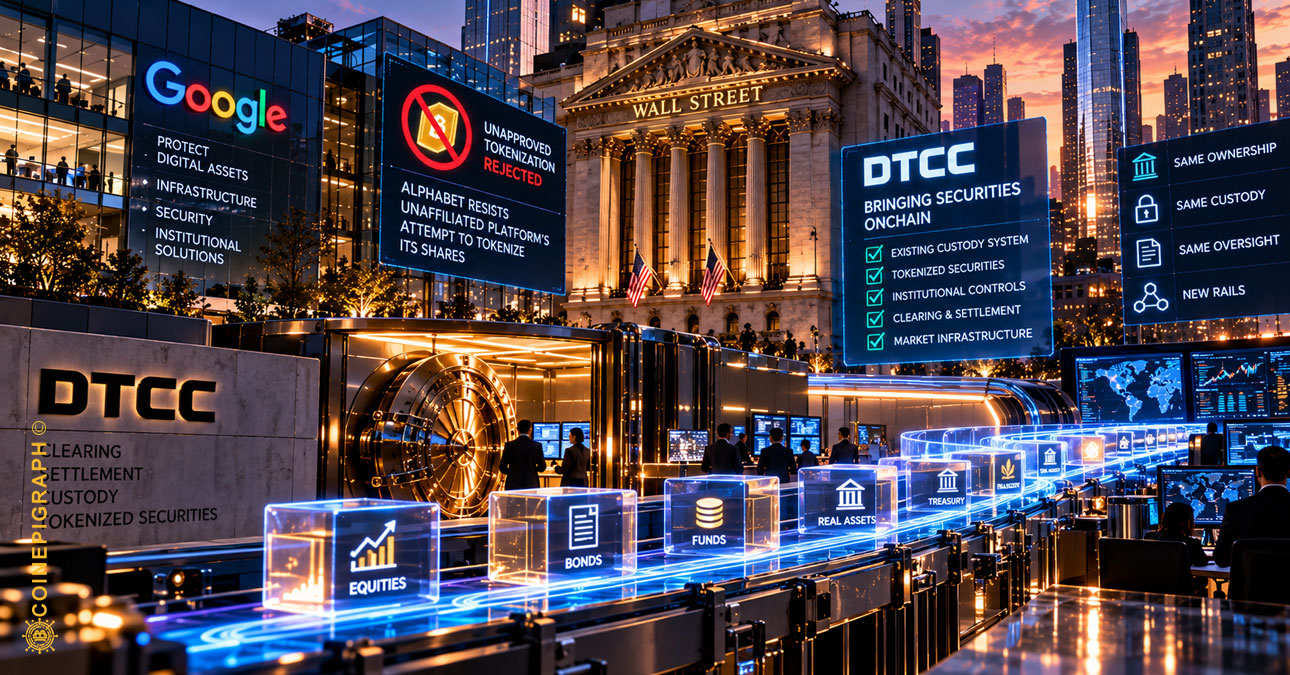
Alphabet is resisting an unaffiliated platform’s attempt to tokenize its shares. Google is building infrastructure to secure digital assets. DTCC has begun putting securities already inside Wall Street’s custody system onchain. Together, the developments suggest tokenization may change the market’s rails without displacing the institutions that control them.
By CoinEpigraph Editorial Desk
Alphabet does not want an unaffiliated trading platform creating tokenized versions of its publicly traded shares.
Google, meanwhile, is preparing technology that will help financial institutions secure and move digital assets.
And the Depository Trust Company, sitting near the center of the American securities infrastructure, has just launched a service capable of creating tokenized representations of securities already held within its custody system.
At first glance, those developments appear to be pulling in different directions.
They are not.
They may instead be revealing how tokenization is likely to enter institutional finance.
The argument surrounding tokenized stocks has often been framed as a contest between traditional markets and blockchain markets. Securities either remain inside conventional brokerage, custody and settlement systems or migrate toward decentralized infrastructure capable of operating continuously.
What is emerging is considerably less binary.
Wall Street is beginning to move securities onto blockchain infrastructure while attempting to preserve the legal rights, governance, custody and institutional controls surrounding them.
That creates a different question from whether stocks will eventually be tokenized.
Who gets to control the digital representation when they are?
Alphabet Is Not Google
The distinction matters here.
Alphabet Inc. is the publicly traded parent company. Investors buying GOOG or GOOGL are purchasing shares of Alphabet, not shares of Google LLC.
Google is an operating subsidiary beneath Alphabet.
That corporate structure explains what otherwise looks like a contradiction.
Alphabet is among the public companies that have objected to having their shares included on OKXICE, a proposed tokenized-securities venue backed by OKX and Intercontinental Exchange.
Google, by contrast, is developing Multi-Party Compute, or MPC, technology intended to help financial institutions secure digital assets and authorize blockchain transactions.
Google’s system distributes pieces of a cryptographic signing key across separate environments. Transactions can be authorized without reconstructing the complete private key in one location, reducing the risk that compromising one machine or credential gives an attacker control over the assets.
The product is currently in private preview with financial institutions and is expected to become commercially available in early 2027.
There is another wrinkle.
Alphabet itself has begun using Google’s MPC technology to secure digital assets on Ethereum and Solana, although Google has not disclosed what those assets are.
That does not establish that Alphabet intends to tokenize its stock. Nor does its objection to OKXICE establish that Alphabet opposes tokenization generally.
The available evidence supports a narrower conclusion.
Alphabet does not presently want this unaffiliated venue creating tokenized representations of its shares. Google simultaneously sees institutional digital-asset security as a business worth entering.
Those positions can coexist.
One concerns an issuer’s securities.
The other concerns infrastructure.
And the space between them is becoming one of the most important areas in digital finance.
The Objections Are Getting Harder to Ignore
Alphabet is not an isolated case.
Microsoft, Wells Fargo, Arm, Intuit and other companies have also objected to having their shares tokenized through the proposed OKXICE platform. By October 28, the number of objecting issuers had reportedly reached 33.
That resistance deserves careful interpretation.
It would be easy to describe these companies as opposing tokenization. The evidence does not support such a broad conclusion.
Under the Securities and Exchange Commission’s Innovation Exemption, a tokenized-securities venue must notify issuers before offering tokenized versions of their securities. An issuer can object, preventing the venue from proceeding with that security under the exemption.
The regulatory structure therefore gives corporations a direct voice in whether an outside platform creates an onchain version of their stock.
That matters because tokenization is not merely a technical exercise.
A public share carries voting rights, dividend rights, corporate actions, disclosure obligations and investor protections. A digital representation that trades beyond the traditional market must somehow preserve or reproduce those relationships.
Nasdaq has already warned that poorly structured tokenization could fragment liquidity and impair price discovery. Its position is not that blockchain has no place in securities markets. It has argued that tokenized securities should remain subject to appropriate investor protections and market rules.
That distinction is becoming central.
The debate may be moving away from whether tokenization should exist toward what kind of tokenization financial institutions and issuers will accept.
DTCC Has Chosen a Different Route
The Depository Trust & Clearing Corporation provides perhaps the clearest example of what institutional tokenization could look like.
On October 28, its Depository Trust Company subsidiary launched the DTCC Tokenization Service.
DTC already sits underneath an enormous portion of the American securities market. It holds more than $114 trillion in assets under custody.
Its new service does not begin by creating an independent blockchain version of a stock and asking markets to treat it as equivalent to the original.
It begins with the security already inside DTC.
Eligible securities held there can be converted into tokenized representations and delivered to registered digital wallets. DTCC says those digital twins retain the ownership rights, investor protections and economic entitlements of their traditional counterparts.
The traditional security is immobilized on DTC’s existing books while its tokenized representation moves onchain.
That is an important architectural choice.
The blockchain is not replacing the underlying securities infrastructure.
It is being connected to it.
Twenty DTC participants have already signed agreements to access the service, including Bank of America, Barclays, Citi, Fidelity Investments, J.P. Morgan, Morgan Stanley, State Street and UBS.
The service initially operates across Canton Network and DTCC’s private Besu network, with additional blockchain networks expected to be added.
Tokenized assets can move between registered wallets around the clock.
But even here, the transition is not complete. DTCC says transactions will not initially be settled in digitized form, and some corporate actions will continue to be processed through existing offchain systems.
This is not Wall Street abandoning its machinery.
It is Wall Street extending that machinery onto new rails.
The Token Does Not Eliminate the Institution
That distinction challenges one of the oldest assumptions surrounding blockchain finance.
Early crypto architecture often treated intermediaries as inefficiencies to be removed. If ownership could be represented on a distributed ledger and transferred directly between participants, clearing houses, custodians and other institutions appeared vulnerable to technological displacement.
Institutional tokenization is beginning to suggest another outcome.
The institutions may survive.
Their infrastructure changes.
A security can become programmable without abandoning securities law. It can move through blockchain networks while remaining connected to regulated custody. Transfers can become available outside conventional market hours while access remains controlled through registered wallets.
Even the private key—the mechanism that once symbolized individual control over crypto assets—is being redesigned for institutions.
Google’s MPC system demonstrates why.
A bank cannot reasonably operate a large digital-asset business around the proposition that one employee, one device or one private key should control billions of dollars of assets.
Institutional finance requires permissions, recovery procedures, governance policies, auditability and operational resilience.
Google is effectively attempting to make cryptographic ownership compatible with those requirements.
The blockchain remains.
The institution remains too.

Control Moves Into the Architecture
This is where the issuer objections become more interesting.
If tokenized securities develop into a meaningful market, corporations may increasingly care about how digital representations of their shares are created, where they trade, what rights accompany them and how those markets interact with the primary security.
Those concerns are not trivial.
A tokenized representation could theoretically expand trading hours and make securities easier to transfer across digital environments. It could improve collateral mobility and eventually connect assets to programmable financial applications.
But multiple representations of the same security could also divide liquidity among venues.
Different token structures could produce different investor protections.
Corporate actions would have to reach token holders reliably.
Voting rights would have to remain enforceable.
And markets would need to know whether the token represents the security itself, a legally recognized entitlement to it, or merely economic exposure created by an intermediary.
Those distinctions determine whether tokenization changes the plumbing of the securities market or creates a parallel market beside it.
That is why the Alphabet-Google distinction is useful.
Alphabet’s objection concerns the representation of its securities.
Google’s MPC product concerns the security infrastructure required to control digital assets.
DTCC’s service concerns the conversion and movement of regulated securities between traditional and tokenized forms.
These are not competing versions of the same activity.
They are different layers of a financial architecture beginning to connect.
Twenty-Four-Hour Markets Change More Than Trading Hours
Much of the appeal surrounding tokenized equities has focused on continuous trading.
Traditional American stock markets operate within defined sessions. Blockchain networks do not sleep.
Putting securities onto infrastructure capable of moving around the clock could eventually change collateral management, treasury operations and the movement of capital between markets.
A security held overnight might no longer have to remain economically dormant until an exchange opens the following morning. Institutions could potentially mobilize eligible assets as collateral across different time zones or move them between financial applications outside traditional settlement windows.
That helps explain why DTCC emphasizes collateral mobility and capital efficiency rather than merely longer trading hours.
The institutional prize may not be allowing someone to buy a technology stock at three o’clock in the morning.
It may be allowing financial assets to remain operational for more of the day.
But that utility becomes considerably more valuable when institutions trust the representation of the asset.
Which brings the discussion back to control.

The Rails Can Change Without the Market Disappearing
Tokenization was once frequently presented as a way of building an alternative financial system.
What is now emerging looks more like a negotiation with the existing one.
The SEC is establishing conditions under which tokenized securities venues can operate.
Issuers are exercising their ability to object.
Google is building institutional security infrastructure.
DTCC is putting securities already inside regulated custody onto blockchain networks.
Banks and brokers are connecting to those systems.
None of this guarantees that today’s tokenization architecture will become the dominant one. Questions remain about liquidity, interoperability, settlement, investor protections and whether investors actually need continuous markets for every security they own.
But the institutional direction is becoming clearer.
Blockchain does not necessarily have to defeat the existing securities system to change it.
It can move underneath it.
That may ultimately be the more consequential form of adoption.
The stock can remain a regulated security. The corporation can remain responsible to its shareholders. The custodian can remain responsible for safeguarding assets. Market infrastructure can continue administering ownership rights and corporate actions.
What changes is the machinery through which those rights can move.
And that is why the growing issuer resistance to one form of tokenization should not automatically be interpreted as resistance to tokenization itself.
The emerging contest is increasingly about architecture.
Who creates the digital representation.
Who verifies that it corresponds to the underlying security.
Who protects the keys.
Who controls access.
Who preserves shareholder rights.
And who connects the token back to the legal and financial system from which its value originates.
Wall Street may indeed be moving securities onchain.
It is showing little indication that it intends to leave control behind.
At CoinEpigraph, we are committed to delivering digital-asset journalism with clarity, accuracy, and uncompromising integrity. Our editorial team works daily to provide readers with reliable, insight-driven coverage across an ever-shifting crypto and macro-financial landscape. As we continue to broaden our reporting and introduce new sections and in-depth op-eds, our mission remains unchanged: to be your trusted, authoritative source for the world of crypto and emerging finance.
— Ian Mayzberg, Editor-in-Chief
The team at CoinEpigraph.com is committed to independent analysis and a clear view of the evolving digital asset order.
To help sustain our work and editorial independence, we would appreciate your support of any amount of the tokens listed below. Support independent journalism:
BTC: 3NM7AAdxxaJ7jUhZ2nyfgcheWkrquvCzRm
SOL: HxeMhsyDvdv9dqEoBPpFtR46iVfbjrAicBDDjtEvJp7n
ETH: 0x3ab8bdce82439a73ca808a160ef94623275b5c0a
XRP: rLHzPsX6oXkzU2qL12kHCH8G8cnZv1rBJh TAG – 1068637374
SUI – 0xb21b61330caaa90dedc68b866c48abbf5c61b84644c45beea6a424b54f162d0c
and through our Support Page.
🔍 Disclaimer: CoinEpigraph is for entertainment and information, not investment advice. Markets are volatile — always conduct your own research.
COINEPIGRAPH™ does not offer investment advice. Always conduct thorough research before making any market decisions regarding cryptocurrency or other asset classes. Past performance is not a reliable indicator of future outcomes. All rights reserved | 版权所有 ™ © 2024-2029.