


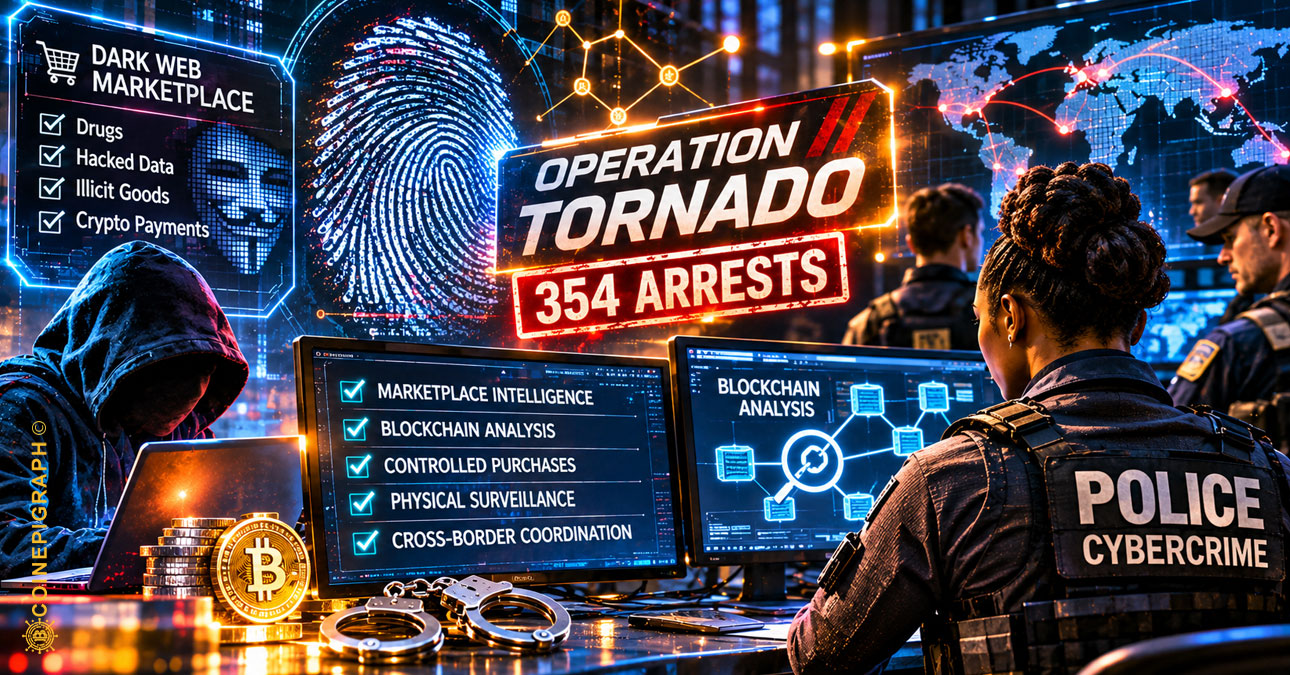
Operation TorNado produced 354 arrests after investigators combined seized marketplace intelligence, blockchain analysis, controlled purchases, physical surveillance and cross-border coordination. The larger lesson is not that cryptocurrency destroyed financial anonymity. It is that digital markets create multiple records—and anonymity can fail when those records are connected.
By CoinEpigraph Editorial Desk
The numbers are large enough to command attention.
Three hundred fifty-four arrests. More than $234 million in cash and virtual currencies seized. Roughly 5.7 metric tons of drugs. Two hundred nine firearms. Investigations spanning the United States, Europe, Australia and New Zealand.
But the more consequential part of Operation TorNado may be what happened before those arrests.
The international operation, conducted between May 2025 and October 2026, did not begin with a single breach of a darknet marketplace or a newly discovered technique for breaking online anonymity. Authorities describe it instead as the continuation of investigations built partly from intelligence gathered after previous darknet markets and vendors were taken down.
The marketplaces disappeared.
Some of the evidence did not.
That distinction helps explain how financial investigation is changing in digital markets. An illicit transaction does not necessarily reveal the person behind it when it occurs. A marketplace pseudonym may remain unidentified. A cryptocurrency address may reveal little about its owner. An anonymizing network may conceal where someone is connecting from.
But those protections do not exist in isolation.
Commerce requires systems to interact.
Money moves. Messages are exchanged. Orders are recorded. Packages are shipped. Devices connect. Assets sometimes pass through financial intermediaries. Marketplaces maintain infrastructure.
Each interaction can leave a different kind of record.
Operation TorNado shows what can happen when investigators begin connecting them.
The Investigation Continued After the Market Closed
TorNado is the latest in a series of internationally coordinated operations aimed at darknet commerce.
The Justice Department says the operation targeted vendors and buyers associated with markets including Archetyp, Bohemia, Nemesis, Kingdom and Tor2Door. Europol places it in a longer sequence of operations that includes DisrupTor, Dark HunTor, SpecTor and RapTor.
The sequence matters.
Operation RapTor, announced in May 2025, resulted in 270 arrests and more than $200 million in currency and digital assets seized. Authorities said that investigation benefited from information obtained through earlier actions against darknet marketplaces.
Then came TorNado.
The pattern suggests that shutting down a marketplace can do more than interrupt transactions. It can change the informational position of investigators.
A functioning darknet market is infrastructure for buyers and sellers. It can contain accounts, communications, transaction references and other information necessary to coordinate commerce.
Once infrastructure is seized, portions of that environment can potentially become evidence.
Nemesis illustrates the scale involved. At its peak, the market had more than 150,000 users and approximately 1,100 vendor accounts. U.S. authorities say more than 400,000 orders were processed through the platform between 2021 and 2024.
Its servers were seized in March 2024.
The alleged administrator was federally indicted more than a year later.
The market had stopped operating. The investigation had not.
That reverses the usual way a takedown is understood. The seizure of a marketplace may look like the end of an enforcement action from the outside.
For investigators, it can mark the beginning of another phase.
Blockchain Is One Trail Among Several
Cryptocurrency inevitably attracts attention in a darknet investigation involving hundreds of millions of dollars in seized assets.
Europol says its forensic and blockchain-analysis teams traced illicit transactions and uncovered evidence during TorNado. That establishes blockchain analysis as part of the investigative architecture.
It does not establish that blockchain analysis solved the cases.
The distinction matters.
One U.S. investigation involved an alleged darknet vendor operating under the name “WallstreetBets.” Postal inspectors identified suspicious packages using fictitious return addresses and postage funded with cryptocurrency. Investigators subsequently observed a suspect mailing dozens of packages.
The investigation expanded from there.
Authorities used controlled purchases, physical surveillance, searches, electronic-device evidence and information from cooperating witnesses.
The cryptocurrency trail mattered.
So did the package.
So did the device.
So did the person standing at the post office.
That combination describes modern financial forensics more accurately than the familiar claim that blockchain transactions are either anonymous or transparent.
The investigation did not depend on a single trail.
It depended on trails intersecting.
The Identity Can Arrive Later
Transparent blockchains nevertheless introduce an unusual property into financial investigation.
Consider Bitcoin.
A Bitcoin address does not contain a person’s legal name. Someone examining an address may initially have no reliable way to know who controls it.
But the transaction history remains visible while that question is being investigated.
If an address remains pseudonymous for years and investigators later associate it with a seized marketplace account, an exchange record, a controlled purchase, a device or a known individual, the earlier transactions have not vanished merely because the identity was unknown when they occurred.
The identity can arrive later.
That creates a form of retrospective financial attribution.
Traditional financial institutions also preserve transaction records, often extensively. The difference is architectural. Those records normally reside inside institutions and are retrieved through legal or regulatory processes.
A transparent blockchain preserves its transaction history as part of the ledger itself.
Pseudonymity and persistence therefore operate on different clocks.
A transaction can remain visible indefinitely while the identity behind it remains unresolved.
If attribution eventually occurs, the historical record can acquire new meaning.
That does not make Bitcoin anonymous.
It also does not make every Bitcoin user immediately identifiable.
It makes the distinction between the two increasingly important.
Monero Complicates the Story
Operation TorNado also contains a useful warning against overstating blockchain transparency.
Among the cases highlighted by the Justice Department is an alleged vendor known as STARLABS, which operated on DrugHub.
DrugHub was a Monero-only darknet market.
That matters because Monero was designed specifically to obscure transaction information that is visible on transparent blockchains such as Bitcoin. Its privacy architecture makes straightforward reconstruction of the transaction graph substantially more difficult.
The existence of a Monero case inside TorNado therefore prevents a convenient conclusion.
Authorities did not demonstrate that every cryptocurrency creates an equally useful public forensic trail.
Nor did they establish that Monero’s privacy architecture had somehow ceased to work.
The more defensible lesson is broader.
Financial privacy is not necessarily operational anonymity.
A transaction layer can conceal financial relationships while other parts of an activity continue producing information.
A vendor still needs customers.
Goods still have to reach them.
Devices still exist.
Communications occur.
Marketplace accounts accumulate histories.
Physical products enter physical logistics systems.
And sometimes cryptocurrency eventually touches another financial service.
Privacy in one layer cannot guarantee anonymity across every other layer.
Tor Wasn’t the Thing That Broke
The same restraint applies to Tor.
Tor is designed to obscure the network location of its users. Operation TorNado does not establish that law enforcement defeated the underlying anonymity protocol.
Investigators frequently worked around the protected layer instead.
That distinction changes the security problem.
Imagine a darknet participant using Tor for network anonymity, a pseudonym for marketplace identity, cryptocurrency for payment and encrypted communications for coordination.
Each system may protect a different piece of information.
But the user remains the common point between them.
If evidence connects the marketplace identity to a cryptocurrency address, and another piece of evidence connects the address or account to an exchange, device or physical shipment, individually protected systems can begin describing the same person.
The anonymity mechanism has not necessarily failed.
The separation between identities has.
This is why correlation increasingly matters as much as penetration.
An investigator may not need to defeat every privacy technology if activity elsewhere creates enough information to connect the protected identities.

A Market Cannot Eliminate Coordination
There is a deeper economic problem for darknet markets.
Markets require coordination.
A buyer needs to know that a seller has delivered before releasing payment.
A seller needs some reason to trust that a buyer will pay.
Customers need a way to evaluate vendors they have never met.
Disputes need resolution.
Orders need processing.
Marketplaces therefore developed many of the same institutional functions found in ordinary commerce: reputation systems, escrow, messaging, transaction histories and administrative infrastructure.
Those mechanisms make pseudonymous commerce possible.
They also generate information.
That is the tension.
A market can reduce how much participants know about one another.
It cannot eliminate the need for participants to coordinate.
And coordination produces data.
This helps explain why marketplace seizures can be so consequential. Investigators are not merely taking a website offline. They may be acquiring pieces of an institutional system that existed to make otherwise anonymous participants capable of doing business with one another.
The infrastructure that created trust can later help reconstruct relationships.
The Physical World Still Matters
Digital markets eventually encounter physical reality.
For narcotics, that boundary is especially difficult to avoid.
A cryptocurrency can move entirely through software.
A package cannot.
The postal system therefore becomes part of the financial investigation even though it is not a financial network.
This is visible throughout darknet enforcement.
Investigators can examine package characteristics, postage, return addresses, mailing locations and delivery patterns. Controlled purchases allow authorities to create transactions they can observe from beginning to end. Surveillance can then connect digital activity with physical behavior.
A darknet vendor may therefore succeed at obscuring an IP address and a transaction while revealing a pattern through logistics.
The weakest point does not have to be the blockchain.
It only has to be somewhere in the system.
That is why the common debate over whether cryptocurrency is anonymous can miss the more important question.
The relevant unit of analysis is no longer the payment.
It is the entire transaction environment.
International Coordination Changes the Equation
TorNado also shows why jurisdiction has become part of the forensic architecture.
Darknet commerce can distribute different pieces of the same transaction across countries.
A marketplace may be administered in one jurisdiction. Infrastructure may sit in another. A seller can operate from a third. A buyer may live in a fourth. Cryptocurrency can move through services incorporated elsewhere.
No single authority necessarily sees the complete picture.
Europol says one of its roles during TorNado was to cross-match information from participating countries, identify investigative overlaps and coordinate cases.
That function is easily overlooked.
The important capability is not merely obtaining more data.
It is discovering that two agencies possess different pieces of information about the same actor.
Digital markets globalized the transaction.
Law enforcement is increasingly attempting to globalize the correlation.
That contest is likely to continue.
Anonymity Can Fail Without Disappearing
None of this means the dark web has ceased to provide anonymity.
New marketplaces appear after old ones disappear. Privacy technologies continue to develop. Sophisticated participants change operational practices. Some investigations fail. Some identities remain unknown.
Nor does TorNado establish that privacy itself is suspicious.
Financial privacy has legitimate uses, and the ability to transact without exposing an entire financial history can be valuable for individuals, businesses and institutions.
The lesson is narrower.
Anonymity is increasingly difficult to evaluate one system at a time.
A blockchain address may be pseudonymous.
A marketplace account may be pseudonymous.
A Tor connection may conceal location.
A privacy coin may obscure the financial graph.
Each statement can be true while the person using all four eventually becomes identifiable.
The vulnerability lies in the connections.
That changes financial forensics from the familiar exercise of following a single money trail into something closer to reconstructing a network of evidence.
The money trail has not disappeared.
It has fragmented.
Investigators are learning how to put the fragments back together.

The Evidence Outlives the Transaction
Operation TorNado will be remembered publicly for 354 arrests and more than $234 million in seized cash and virtual currencies.
Those figures describe the enforcement result.
They do not fully describe the structural change behind it.
Digital markets were supposed to make identity harder to establish by separating names, locations, communications and financial activity.
In many respects, they succeeded.
But digitization created something else at the same time.
Records.
Some are public. Some are private. Some sit on seized servers. Some reside with financial intermediaries. Some appear in devices. Others exist in postal systems or in the files of authorities operating thousands of miles apart.
No single record necessarily identifies anyone.
The power emerges when records begin describing the same activity.
That is why the future contest between financial privacy and financial surveillance may not ultimately turn on whether one blockchain is traceable or one anonymity network can be penetrated.
It may turn on something more fundamental:
How easily can information created in one system be connected with information created in another?
Operation TorNado suggests investigators are getting better at making those connections.
The dark web succeeded in hiding identities.
It could not eliminate the evidence those identities created while doing business.
At CoinEpigraph, we are committed to delivering digital-asset journalism with clarity, accuracy, and uncompromising integrity. Our editorial team works daily to provide readers with reliable, insight-driven coverage across an ever-shifting crypto and macro-financial landscape. As we continue to broaden our reporting and introduce new sections and in-depth op-eds, our mission remains unchanged: to be your trusted, authoritative source for the world of crypto and emerging finance.
— Ian Mayzberg, Editor-in-Chief
The team at CoinEpigraph.com is committed to independent analysis and a clear view of the evolving digital asset order.
To help sustain our work and editorial independence, we would appreciate your support of any amount of the tokens listed below. Support independent journalism:
BTC: 3NM7AAdxxaJ7jUhZ2nyfgcheWkrquvCzRm
SOL: HxeMhsyDvdv9dqEoBPpFtR46iVfbjrAicBDDjtEvJp7n
ETH: 0x3ab8bdce82439a73ca808a160ef94623275b5c0a
XRP: rLHzPsX6oXkzU2qL12kHCH8G8cnZv1rBJh TAG – 1068637374
SUI – 0xb21b61330caaa90dedc68b866c48abbf5c61b84644c45beea6a424b54f162d0c
and through our Support Page.
🔍 Disclaimer: CoinEpigraph is for entertainment and information, not investment advice. Markets are volatile — always conduct your own research.
COINEPIGRAPH™ does not offer investment advice. Always conduct thorough research before making any market decisions regarding cryptocurrency or other asset classes. Past performance is not a reliable indicator of future outcomes. All rights reserved | 版权所有 ™ © 2024-2029.