


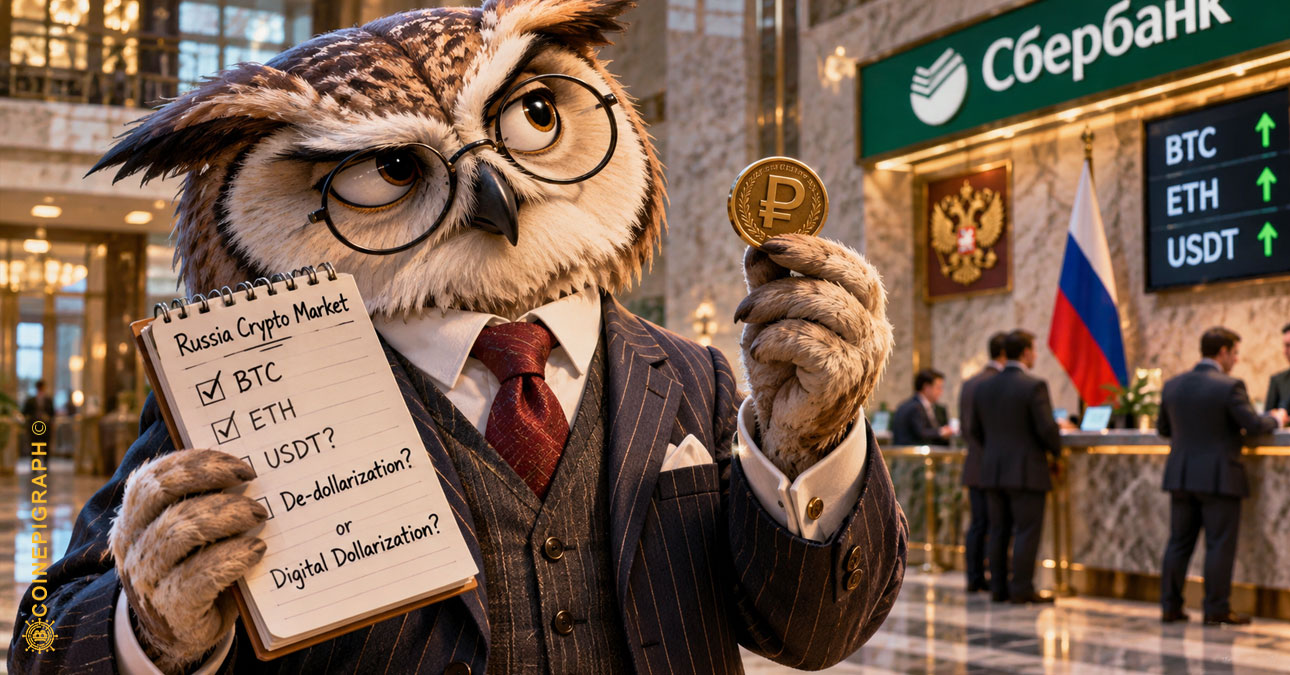
Moscow Exchange plans to bring bitcoin, ether and Tether into Russia’s regulated financial infrastructure on December 1. The inclusion of USDT exposes a more complicated form of de-dollarization: a country can reduce its dependence on American banking rails while continuing to use a digital dollar whose reserve economics remain deeply connected to U.S. government debt.
By CoinEpigraph Editorial Desk
Russia has spent years reducing its exposure to the financial infrastructure surrounding the U.S. dollar.
On December 1, it plans to begin organized trading in a digital version of one.
Moscow Exchange says its new cryptocurrency market will initially support bitcoin, ether and USDT, with transactions using technology from its existing securities market and entering the unified clearing system of the National Clearing Centre. Same-day and next-day settlement will be available, along with swaps for liquidity management. The initial rollout is expected to begin with pilot transactions before additional participants are connected.
The inclusion of bitcoin is unsurprising. Ether is hardly unexpected either.
USDT is different.
Tether’s stablecoin is denominated in dollars, issued by a private company outside Russia and supported by a reserve portfolio containing an enormous amount of U.S. government debt. As of September 30, Tether reported $191.5 billion in reserve assets supporting approximately $183.5 billion of token liabilities. Its direct and indirect holdings of U.S. Treasury bills totaled $132.4 billion. Treasury bills and reverse-repurchase agreements continued to provide most of the company’s operating income.
The result is an unusual financial arrangement.
A sanctioned Russian exchange is preparing to create an organized domestic market for a dollar instrument whose issuer remains capable of freezing tokens and whose reserve structure is deeply connected to the sovereign debt of the United States.
That does not mean Russia has abandoned de-dollarization.
It suggests that de-dollarization may be becoming more complicated than moving away from the dollar.
The Dollar and the Dollar System Are Not the Same Thing
Washington designated Moscow Exchange and the National Clearing Centre in June 2024. The sanctions were part of broader restrictions on Russia’s financial infrastructure, and the Treasury subsequently provided limited licenses allowing certain transactions involving MOEX, NCC and the National Settlement Depository to be wound down.
Traditional dollar infrastructure depends heavily on regulated financial intermediaries. Correspondent banks, payment networks, custodians and clearing institutions provide points through which access to the dollar system can be controlled.
Stablecoins change part of that architecture.
A USDT token can move across a blockchain without each transfer traveling through the conventional correspondent-banking chain. The instrument can therefore carry dollar-denominated value through infrastructure that is operationally different from the banking system historically associated with the dollar.
But the dollar has not disappeared.
Neither has centralized control.
Russia’s own regulator makes the distinction unusually clear. The Bank of Russia does not classify USDT in the same legal category as bitcoin or ether. Under its new framework, a digital asset with an identifiable issuer can be treated as a foreign digital instrument. The regulator has specifically confirmed that USDT can qualify for public circulation on organized Russian markets.
That difference matters because bitcoin has no issuer capable of freezing it.
USDT does.
Tether Remains Inside the Architecture
Tether has voluntarily applied controls associated with the U.S. Treasury’s Office of Foreign Assets Control Specially Designated Nationals list to secondary-market wallets since 2023. In April 2026, the company said it had helped U.S. authorities freeze more than $344 million in USDT across two addresses and described restrictions on assets connected to sanctions evasion and other unlawful activity as part of its continuing cooperation with authorities.
That capability does not mean every USDT token touching Russia’s new market would automatically be frozen.
It does mean USDT carries an enforcement characteristic that bitcoin does not.
The distinction becomes particularly interesting because OFAC says its Russia sanctions apply to virtual currency just as they do to conventional fiat transactions. U.S. persons generally cannot use digital assets to conduct transactions that would otherwise be prohibited merely because the transaction takes place on a blockchain.
How those restrictions will interact with USDT circulating through Moscow Exchange remains unresolved.
MOEX has disclosed that the National Clearing Centre will provide unified clearing and that a partner settlement digital depository will be involved in the market architecture. It has not publicly identified every wallet, custody or blockchain pathway through which the opening market will operate. Nor has Tether announced that it is participating directly in the Moscow Exchange launch.
Those details will matter.
The difference between USDT trading as inventory already circulating in secondary markets and USDT entering or leaving through direct issuer relationships is substantial.
Russia Is Not Decentralizing Its Financial System
There is another misconception worth avoiding.
Russia’s new crypto framework does not simply open the gates to decentralized finance.
It pulls digital assets into regulated financial institutions.
The Bank of Russia has begun registering digital depositories and cryptocurrency exchange businesses. Digital depositories can record and transfer digital assets and administer the addresses where they are held. Sberbank and VTB are among the institutions entering this regulated infrastructure. Sberbank has been admitted as both a digital depository and an organization authorized to exchange digital currencies and has said it plans to launch its first products on December 1.
The rules surrounding individual custody are even more revealing.
The Bank of Russia says an individual cannot transfer cryptocurrency from a regulated digital account to that same person’s non-custodial wallet. Direct transfers between individuals through digital-depository addresses are also prohibited under the framework. Beginning in July 2027, the permitted structure further narrows the channels through which residents can conduct crypto transactions.
This is not cryptocurrency replacing financial intermediaries.
It is cryptocurrency being absorbed by them.
Moscow Exchange intends to use its existing securities-market technology. NCC will clear the transactions. Brokers will provide access. Digital depositories will maintain records and administer addresses.
Crypto is entering the Russian financial system largely through the institutional machinery already surrounding conventional assets.
USDT Makes De-Dollarization Harder to Measure
This is where the development becomes more consequential than a new crypto listing.
De-dollarization is often measured through reserves, trade invoicing, cross-border settlements or the use of alternative currencies. Those measures remain important.
Stablecoins introduce another layer.
A country can reduce its reliance on American banks while residents and institutions continue using dollar-denominated instruments. The transaction may no longer require a conventional dollar deposit to move through the same chain of correspondent institutions, but the economic unit being transferred remains the dollar.
USDT adds another connection.
Its reserve portfolio helps transform demand for digital dollars into demand for assets that include U.S. Treasury bills. A Russian investor purchasing USDT on a secondary market is not directly buying a Treasury security, and it would be incorrect to describe USDT as a Treasury wrapper. The token is a liability of Tether backed by a broader reserve portfolio.
Yet at the system level, the connection is difficult to ignore.
Demand for USDT supports a stablecoin whose issuer has become a major holder of U.S. government debt.
The dollar can therefore travel through financial infrastructure that Washington does not control in the same way it controls correspondent banking, while the economics supporting that digital dollar remain substantially connected to U.S. sovereign debt.
That is not conventional dollarization.
It is not clean de-dollarization either.

A Different Kind of Financial Separation
Russia’s experiment may offer an early look at a distinction that will matter well beyond Russia.
The dollar’s monetary influence and America’s control over dollar payment infrastructure have historically been closely related. Stablecoins begin separating them.
That can produce uncomfortable combinations.
A country may prefer fewer transactions passing through American banks while its market participants continue preferring dollar-denominated liquidity. A domestic exchange may be sanctioned by the United States while listing a digital instrument whose issuer cooperates with U.S. sanctions authorities. A government may promote financial sovereignty while its regulated market provides access to a token supported in large part by U.S. Treasury securities.
None of those conditions necessarily cancels the others.
They show that the architecture of money is becoming more modular.
Russia’s December launch is therefore worth watching for more than trading volume. The important evidence will come from how USDT is custodied, how liquidity reaches the market, which institutions provide settlement, whether tokens move between Russian and foreign custodians, how Tether handles addresses associated with the infrastructure and whether the market develops meaningful demand for the stablecoin alongside bitcoin and ether.
Those answers will tell us whether USDT is simply another asset available to Russian investors or whether something more structural is occurring.
Russia has spent years trying to reduce the leverage that comes from dependence on the American financial system.
The arrival of USDT on Moscow Exchange suggests that escaping that system and escaping the dollar may turn out to be two very different things.
At CoinEpigraph, we are committed to delivering digital-asset journalism with clarity, accuracy, and uncompromising integrity. Our editorial team works daily to provide readers with reliable, insight-driven coverage across an ever-shifting crypto and macro-financial landscape. As we continue to broaden our reporting and introduce new sections and in-depth op-eds, our mission remains unchanged: to be your trusted, authoritative source for the world of crypto and emerging finance.
— Ian Mayzberg, Editor-in-Chief
The team at CoinEpigraph.com is committed to independent analysis and a clear view of the evolving digital asset order.
To help sustain our work and editorial independence, we would appreciate your support of any amount of the tokens listed below. Support independent journalism:
BTC: 3NM7AAdxxaJ7jUhZ2nyfgcheWkrquvCzRm
SOL: HxeMhsyDvdv9dqEoBPpFtR46iVfbjrAicBDDjtEvJp7n
ETH: 0x3ab8bdce82439a73ca808a160ef94623275b5c0a
XRP: rLHzPsX6oXkzU2qL12kHCH8G8cnZv1rBJh TAG – 1068637374
SUI – 0xb21b61330caaa90dedc68b866c48abbf5c61b84644c45beea6a424b54f162d0c
and through our Support Page.
🔍 Disclaimer: CoinEpigraph is for entertainment and information, not investment advice. Markets are volatile — always conduct your own research.
COINEPIGRAPH™ does not offer investment advice. Always conduct thorough research before making any market decisions regarding cryptocurrency or other asset classes. Past performance is not a reliable indicator of future outcomes. All rights reserved | 版权所有 ™ © 2024-2029.